

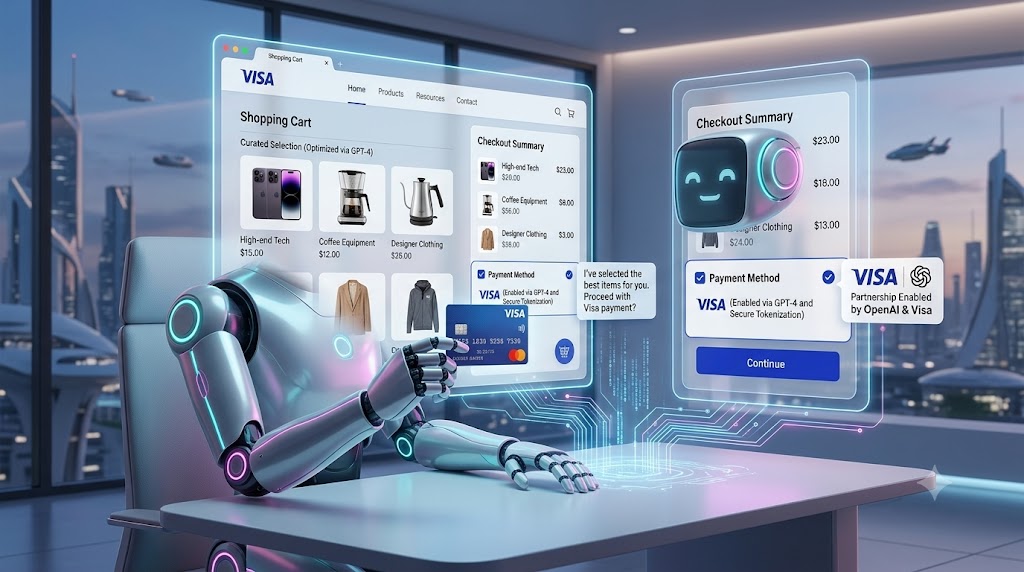
Visa just plugged its global payment network directly into ChatGPT. An AI agent can now browse, choose, and pay for things on your behalf. No checkout page. No entering your card details. No clicking confirm. The transaction just happens. Here is what this means for you if you live in the UAE, where this technology already made its first regional debut.
What Actually Happened
On June 10, 2026, Visa announced a formal partnership with OpenAI. The deal integrates Visa’s payment infrastructure directly into OpenAI’s platforms, including ChatGPT. The result is something that would have sounded like science fiction two years ago.
You tell ChatGPT what you want. The AI agent finds it, confirms the details with you, and pays for it using your Visa card. The transaction is processed, tokenized, and secured by Visa’s network. You receive confirmation. You never visited a website, filled out a form, or typed a card number.
This is not a concept or a pilot. It is a live integration being rolled out to approved partners right now, with broader availability coming later in 2026.
| Visa’s own research found that 47% of shoppers now use AI tools for at least one part of the buying process. The company predicts millions of consumers will use AI agents to complete full purchases by the 2026 holiday season. |
The UAE Was First. Here Is What Already Happened Here.
Before the OpenAI announcement, the UAE was already the testing ground for this technology. In December 2025, Visa and Aldar Properties completed the first end-to-end, voice-enabled AI payment in the Middle East.
A customer used the Live Aldar mobile app to pay a real estate service charge. They did not tap a button or enter a PIN. They spoke to an AI agent. The agent confirmed the customer’s details, asked for consent, and completed the payment in seconds. The card used was an Emirates NBD Darna Visa Credit Card linked to Aldar’s loyalty platform.
Godfrey Sullivan, Visa’s Senior Vice President for Products and Solutions in the CEMEA region, said the Aldar implementation demonstrated how Visa Intelligent Commerce can support trusted, secure agent-initiated transactions on the cardholder’s behalf, including handling sensitive payment data securely.
Aldar’s Chief Digital Officer Harry Nakichbandi described the experience as transforming a routine payment into a customer-first experience that is secure, transparent, and almost instant. More capabilities are planned across the Live Aldar platform through 2026.
| The UAE did not just adopt this technology. It hosted the world’s first live regional deployment. That is not a coincidence. It reflects the UAE’s deliberate positioning as the global testbed for AI-powered commerce. |
How the Technology Actually Works
The system runs on what Visa calls Visa Intelligent Commerce, a platform built to allow AI agents to initiate and complete payments securely. It supports four major agent communication protocols: Trusted Agent Protocol, Machine Payments Protocol, Agentic Commerce Protocol, and Universal Commerce Protocol. These are the technical standards that allow different AI systems to talk to payment networks.
When an AI agent initiates a transaction on your behalf, several things happen simultaneously. Your card credentials are tokenized. This means your actual card number is never exposed during the transaction. A digital token is used instead, which is useless to anyone who intercepts it. Visa’s real-time fraud monitoring runs on the transaction at the same moment the authorization request is processed. The system checks the transaction against the spending rules and merchant permissions you set in advance.
| Security Layer | What It Does |
| Tokenization | Your real card number is replaced with a digital token for every transaction. Even if intercepted, the token is worthless. |
| Spending limits | You set a maximum amount the AI agent can spend per transaction or per day. It cannot exceed this. |
| Merchant categories | You can restrict which types of merchants the AI agent can pay. It cannot buy from outside your approved categories. |
| Required approvals | For larger transactions, you can require the agent to seek your explicit confirmation before proceeding. |
| Real-time monitoring | Visa’s fraud detection runs on every agent-initiated transaction exactly as it does on manual card payments. |
| Consent-led flow | Every transaction requires the agent to confirm details with you before completing. You remain in control at every stage. |
The OpenAI integration specifically embeds Visa’s payment capabilities into ChatGPT’s Agentic Commerce Protocol. Developers and merchants get a streamlined way to accept Visa payments initiated by AI agents. Visa provides the underlying network infrastructure, tokenization capability, and risk management layer.
What You Can Actually Do With This Right Now
The partnership with OpenAI is the newest layer. But Visa Intelligent Commerce is already live and being tested across multiple platforms. Here is the current state for UAE residents specifically.
Aldar Properties is the first live UAE deployment. Cardholders can use AI agents through Live Aldar to pay real estate service charges using voice commands. This is available now and will expand to additional transaction types through 2026.
ChatGPT integration is rolling out to approved partners. OpenAI’s Instant Checkout feature, which allows direct purchasing through ChatGPT, is currently limited to approved merchants. The list is expanding. By the end of 2026, it is expected to be broadly available.
For developers in the UAE building on OpenAI’s platform, Visa’s payment capabilities are now directly accessible. A developer building a shopping assistant, a concierge app, or a property management tool can integrate Visa payments without building their own payment infrastructure.
Why the UAE Is Positioned to Lead This Shift
Three things make the UAE the most likely market to see rapid adoption of AI-powered commerce.
First, the adoption baseline. The UAE has 70.1% AI adoption among the working-age population, the highest rate in the world according to Microsoft’s Q1 2026 AI Economy Institute report. Consumers here are already using AI tools more than anywhere else on earth. Adding a payment capability to those tools is a natural extension of behaviour that already exists.
Second, the infrastructure investment. OpenAI is building a major computing facility in the UAE as part of its OpenAI for Countries initiative. The facility involves Oracle and NVIDIA and is set to operate from 2026. UAE organisations including G42, Mubadala, Aldar, and MBZUAI are already deploying OpenAI technologies. The partnership with Visa activates a commercial layer on top of that infrastructure.
Third, the regulatory posture. Dubai’s VARA and the CBUAE have both shown willingness to engage with new payment and digital asset technologies through sandbox frameworks and proactive licensing. When Visa and OpenAI need a market that can move fast, the UAE is structurally positioned to do that.
| In December 2025, the UAE was the first country in the Middle East to see a live AI-initiated payment. In June 2026, Visa and OpenAI made that model global. The UAE did not follow this wave. It started it. |
The Question Everyone Is Actually Asking: Is This Safe?
This is the right question. Handing a payment capability to an AI agent requires genuine trust in the system. Here is what the guardrails look like in practice.
You define the rules before anything happens. Before the AI agent can spend anything on your behalf, you set the parameters. Spending limits, approved merchant categories, transaction approval thresholds. The agent operates within those rules. It cannot override them.
Every transaction uses tokenized credentials. Your actual card number never moves. The token that is used is valid for that specific transaction only. It cannot be reused or redirected.
Visa’s fraud monitoring runs in real time on every transaction, agent-initiated or otherwise. The same systems that flag a suspicious manual card payment flag a suspicious agent-initiated one. There is no reduced protection because the buyer is an AI rather than a human.
Visa has been explicit about what this system does not allow. The agent cannot make purchases outside your approved parameters. It cannot authorize its own expanded permissions. Every transaction is traceable to your account with a full audit log. If a transaction looks wrong, you dispute it through the same Visa chargeback process you would use for any other disputed payment.
The honest answer to whether it is safe is this: it carries the same risk profile as contactless card payments and digital wallets, which hundreds of millions of people use daily. The underlying infrastructure is not new. What is new is who initiates the transaction.
What This Changes for UAE Businesses
For merchants in the UAE, the Visa and OpenAI partnership creates a new customer acquisition channel that did not exist six months ago. An AI agent shopping for a user will discover products based on the user’s stated preferences, budget, and past behaviour. If your product inventory is not accessible to AI platforms, you are invisible to that agent.
Visa’s Intelligent Commerce Connect, launched in April 2026, specifically addresses this. It helps merchants make their product inventories and details accessible so consumers can discover, select, and purchase through AI agents. It is described as an on-ramp to agentic commerce for merchants who want to participate without building custom AI infrastructure.
For UAE businesses in retail, hospitality, and real estate, the Aldar case is the reference point. Routine, repetitive transactions are the easiest first use case. Service charge payments, subscription renewals, regular orders. Anything a customer currently does on autopilot is a candidate for AI agent automation.
The bigger shift comes when AI agents are used for discovery, not just payment. A user who tells ChatGPT to find and book the best available apartment in Dubai Marina under AED 8,000 per month is not browsing a portal. They are delegating the entire search and booking process to an agent. The merchant who is discoverable and transactable through that agent wins the customer. The one who is not is simply not in the conversation.
The Competitive Picture
Visa is not moving alone. The agentic commerce space is becoming crowded fast.
Google announced in March 2026 that it had added cart, catalog, and identity-linking capabilities to its Universal Commerce Protocol and was simplifying onboarding through Google Merchant Center. This positions Google’s AI agents as a parallel channel for shopping alongside ChatGPT.
Mastercard has its own agentic commerce programme. American Express is building agent payment capabilities into its platform. Several fintech companies are building on Visa’s open protocols to create their own agent-powered shopping experiences.
The race is not just between payment networks. It is between AI platforms. Whoever’s AI agent a consumer trusts and uses most will determine which products they discover and which merchants they buy from. ChatGPT’s position as the world’s most-used AI platform gives OpenAI and Visa a meaningful distribution advantage.
What Comes Next
Visa has predicted that millions of consumers will complete purchases through AI agents by the 2026 holiday season. That is not a distant forecast. It is a six-month timeline from now.
For the UAE specifically, the expansion of the Aldar use cases through 2026 will be the most visible early signal. Real estate service charges are the start. Property viewings, service bookings, retail purchases, and travel bookings are the natural next layer.
The OpenAI data residency facility being built in the UAE means that AI transactions for UAE users will be processed locally, meeting the data sovereignty requirements that matter to government and enterprise customers. That infrastructure alignment between Visa, OpenAI, and UAE national AI strategy is not accidental.
| The bottom line: the era of you doing your own shopping is ending. The era of your AI doing it for you has started. In the UAE, it already has. |
Sources: Visa official press release (June 10, 2026), Visa Investor Relations, Visa Middle East and Aldar press release (December 18, 2025), PYMNTS.com (December 22, 2025), TechInformed (April 9, 2026), Khaleej Times UAE AI adoption report, Microsoft AI Economy Institute Q1 2026, OpenAI UAE data residency announcement (November 2025).
Robius.news — Dubai, UAE — 2026 | Built to be first. Built to be trusted.