

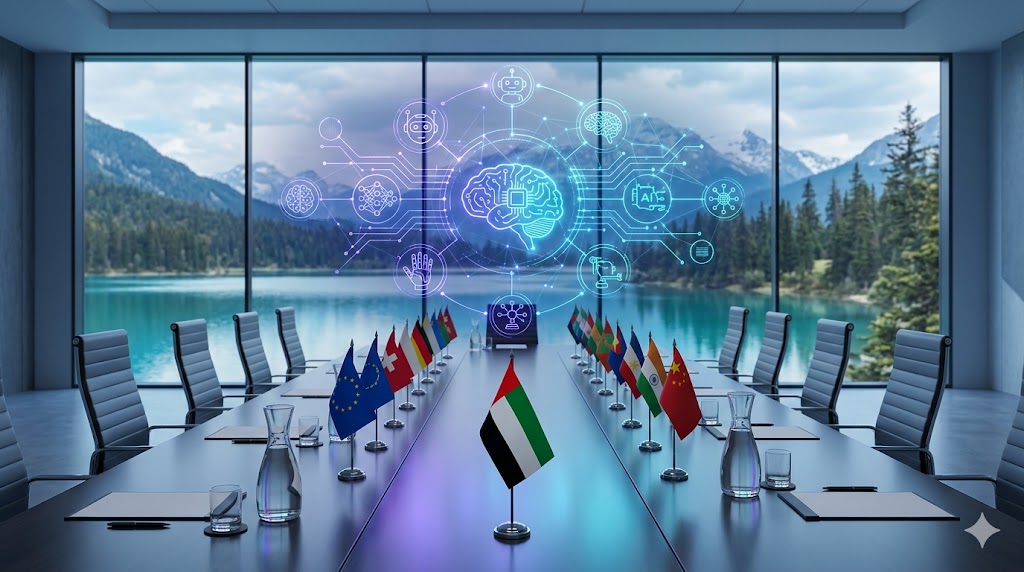
UAE G7 AI summit 2026
This week, the leaders of the world’s seven largest industrial democracies sat down in the French Alps with the chief executives of OpenAI, Google DeepMind, and Anthropic to talk about the future of artificial intelligence. The UAE was in the room.
Not as a footnote. Not as an afterthought. As an invited guest nation, with its own seat at the table, and with a one-on-one meeting between its leadership and the president of the United States. That is worth pausing on, because it is the clearest sign yet that the UAE’s years-long bet on AI has changed how the rest of the world treats it.
| VERDICT: Being invited to the room is real. It is not the same as having a vote in what happens next. The UAE’s seat at the G7 AI discussion reflects genuine recognition of its AI infrastructure and ambition. But G7 communiques and binding commitments are written by the seven member states. Guest nations participate, observe, and are heard. They do not co-author the outcome. The distinction matters for understanding what this access actually buys. |
What Actually Happened
The 52nd G7 summit ran from June 15 to 17 in Evian-les-Bains, on the French shore of Lake Geneva. France held the rotating presidency this year and made artificial intelligence a central theme from the start, alongside cybersecurity, digital infrastructure, and the protection of minors online.
Alongside the seven core members, France invited a wider circle of countries to take part in this year’s discussions. Brazil, India, Kenya, and South Korea joined earlier preparatory talks. Egypt, Qatar, Saudi Arabia, Syria, Ukraine, and the UAE were invited to the summit itself. The closing day was given over to two sessions: one on the future of artificial intelligence, one on economic growth. Executives from OpenAI, Google DeepMind, Anthropic, and Mistral AI joined the leaders for the AI discussion, including a working lunch where the conversation reportedly turned candid.
Outside the formal sessions, the US president held a small number of bilateral meetings with leaders of non-G7 nations. Most guest countries did not get one. The UAE did, alongside Qatar, Egypt, and India.
Why This Is Genuinely Significant
Diplomatic invitations are not handed out casually at a summit this size. A guest seat at the G7 table, and a bilateral meeting with the sitting US president on the same trip, signals that the UAE is now read by the world’s major powers as a serious actor in the conversation about how AI gets built, governed, and deployed globally, not simply a market that buys whatever the major labs sell it.
That reading did not happen by accident. It is the direct result of choices the UAE made years ago and has been executing on consistently since. The 2017 decision to appoint the world’s first AI minister. The national strategy that followed. G42’s emergence as a serious infrastructure builder, its $1.5 billion partnership with Microsoft, and the broader Stargate UAE compute campus now rising in Abu Dhabi. The Falcon and Jais models that gave the country a credible voice in open-source and Arabic-language AI research. And, two days before this summit even began, the creation of a single federal Artificial Intelligence and Data Authority consolidating the country’s AI and data policy under one roof.
Seen against that backdrop, an invitation to the G7 AI table is not a surprise. It is closer to the predictable outcome of a decade of deliberate positioning. The countries that get invited to shape conversations about the future of a technology tend to be the ones that have already shown up with infrastructure, capital, and a coherent national strategy. The UAE has done all three.
What Was Actually Discussed
France structured its digital agenda around four declared priorities for the year: safe artificial intelligence designed for broad public benefit, digital security, digital public infrastructure, and the protection of minors online. The leaders’ session on AI was expected to range across frontier AI risk, compute and chip infrastructure, and what officials are now calling AI sovereignty, the question of which countries can build, access, and control advanced AI capability on their own terms rather than depending entirely on others.
That last theme, sovereignty, arrived at the summit already running hot. Four days before the summit opened, the US government had issued an export control order cutting off foreign access to two of Anthropic’s most advanced models, a story we cover in detail in a companion piece, because it bears directly on what any country building its AI strategy on US infrastructure should be thinking about right now. The episode gave the AI sovereignty conversation at this G7 an unusually sharp edge, and it shadowed the working lunch where the same tech executives who build that infrastructure sat across from the leaders who increasingly depend on it.
The Honest Caveat
None of this should be read as the UAE now holding a seat with a vote inside the G7. It does not, and it is worth being precise about that, because the distinction matters for understanding what this kind of access actually delivers.
G7 communiques, the formal joint statements that come out of these summits, are negotiated and signed by the seven member states. Guest nations are present, are heard, and in many cases shape the tone of the conversation, particularly when they bring something the room needs, capital, infrastructure, or credibility on a specific issue. But they are not co-authors of the binding text. The UAE’s value at this table is its ability to influence how the conversation is framed and to build relationships and information access that pay off later, not to set G7 policy directly.
That is still a meaningful form of influence. Quiet access to the room where the most powerful governments and AI companies on earth are thinking through frontier risk, infrastructure dependency, and sovereignty is valuable precisely because so few countries get it. The UAE earning that access through a decade of consistent investment, rather than asking for it, is the real story here.
What It Means Going Forward
For UAE residents and businesses, the practical takeaway is less about this specific summit and more about the trend it confirms. The country’s AI strategy has moved from a regional ambition to something the world’s major powers now factor into their own thinking. That carries real upside: deeper partnerships, more access to frontier capability, and continued investment flowing toward Abu Dhabi and Dubai as AI infrastructure destinations.
It also raises the stakes on the questions this guide keeps returning to. A country that sits closer to the centre of global AI diplomacy is also a country whose AI strategy is more exposed to decisions made elsewhere, in Washington, in Brussels, in boardrooms in San Francisco. The Anthropic export control episode that shadowed this very summit is the clearest illustration of why that exposure deserves more attention from UAE policymakers and businesses than it currently gets. We unpack exactly that question, and what it means for any organisation building on US AI infrastructure, in the companion piece below.
Sources
• AP via The Hill: G7 summit focuses on contentious future of AI and US dominance of the industry — https://thehill.com/homenews/ap/ap-international/ap-the-latest-g7-summit-focuses-on-contentious-future-of-ai-and-us-dominance-of-the-industry/
• Fast Company: As G7 wraps, OpenAI and Anthropic meet with world leaders to discuss the future of AI — https://www.fastcompany.com/91561045/g7-wraps-openai-anthropic-meet-world-leaders-discuss-future-ai
• CNBC: AI in spotlight at G7 as Trump, world leaders joined by tech chiefs — https://www.cnbc.com/2026/06/17/g7-trump-ai-tech-leaders-openai-anthropic-google.html
• Wikipedia: 52nd G7 summit, guest nations and digital priorities — https://en.wikipedia.org/wiki/52nd_G7_summit
• AP via Union-Bulletin: Trump’s bilateral meetings with Qatar, UAE, Egypt and India — https://www.union-bulletin.com/news/national/the-latest-g7-summit-focuses-on-contentious-future-of-ai-and-us-dominance-of-the/article_d10e8ed0-f22e-56fc-a21d-328d6b0b4446.html
Robius.news — Dubai, UAE — 2026 | Built to be first. Built to be trusted