
Independently researched from public announcements and reporting. Checked on August 1, 2026.
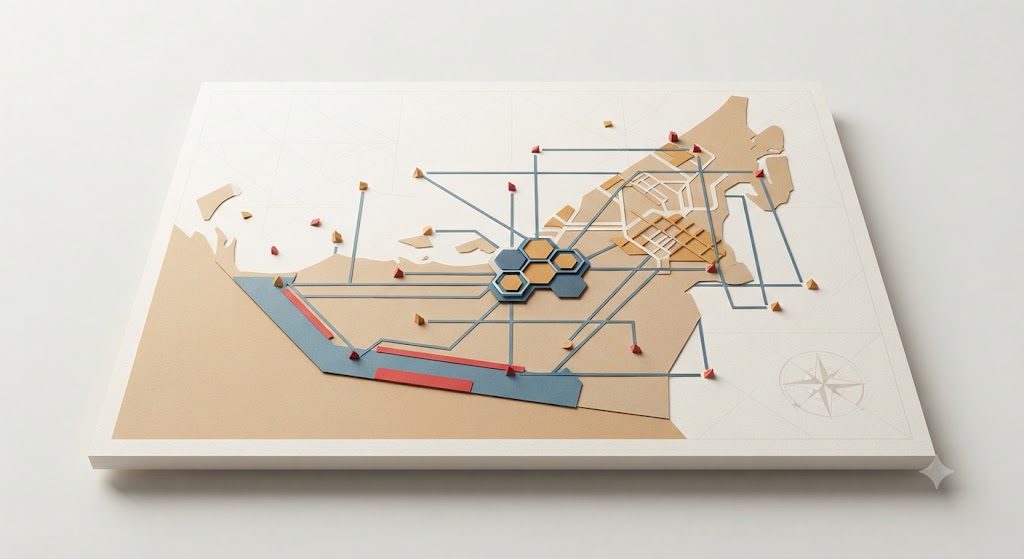
About 20 American and Emirati specialists are being assembled in Abu Dhabi to work on military artificial intelligence. The group is small enough to fit in one meeting room. Its remit is much larger: intelligence support, critical infrastructure protection, and monitoring the regional security environment.
US Central Command announced Task Force Talon Synapse on July 28 and said the bilateral team should formally launch in the coming weeks. The announcement calls it the first bilateral task force focused on accelerating military AI applications.
The easy headline is that the UAE and US are building military AI together. The more useful reading is narrower. This is a permanent working team intended to turn broad cooperation into specific systems and operating practices, but the announcement does not yet identify a single model, vendor, weapon, data set, or deployment rule.
What Was Actually Announced
Task Force Talon Synapse will be based in Abu Dhabi and staffed by approximately 20 people from the UAE and the United States. CENTCOM said the team will include expertise in AI, data, and cybersecurity. It is scheduled to start formally in the coming weeks rather than at an unspecified future date.
The official mission has three parts. The task force will work on AI applications for intelligence support, protection of critical infrastructure, and monitoring of the regional security environment. Those descriptions are broad, and CENTCOM has not published the technical architecture or operational boundaries behind them.
The National reported that Sheikh Tahnoon bin Zayed Al Nahyan, Deputy Ruler of Abu Dhabi and National Security Adviser, raised the idea with CENTCOM commander Admiral Brad Cooper last year. CENTCOM also said AI industry leaders and Emirati defense officials met during a regional visit in June to work through the concept.
Why a Small Permanent Team Matters
Twenty people will not build every model, sensor, and security system involved. A team of this size is more likely to choose problems, connect institutions, define tests, resolve data and access questions, and move promising systems from demonstration into controlled use. That is an inference from the structure, not a capability claim made in the announcement.
This is where the location matters. A team based in Abu Dhabi can work directly with UAE defense, security, technology, and infrastructure stakeholders instead of operating as an occasional visiting delegation. It also creates a shared working environment for the less glamorous issues that decide whether AI can be used safely: permissions, data quality, evaluation, cybersecurity, and responsibility when a system is wrong.
Robius has already covered how the UAE gained improved access to advanced US AI technology. Access to chips is one layer. A bilateral operating team is another. It moves the relationship from acquiring computing capacity toward deciding how that capacity is applied in real institutions.
The Three Mission Areas Need Different Guardrails
Intelligence support can mean sorting large information streams, identifying patterns, translating material, or helping analysts prioritize what deserves attention. It does not automatically mean an AI system makes the final judgment. The critical questions are which sources it can see, how uncertainty is shown, and whether a human analyst can trace the evidence behind an output.
Critical infrastructure protection is a different problem. Energy, communications, transport, water, and digital services require continuous monitoring, but defensive agents connected to operational systems can also create risk if they have authority to change configurations automatically. The recent AI agent security lesson about permissions applies even more strongly when the system being protected is physical infrastructure.
Regional security monitoring adds another layer because mistakes can carry diplomatic or operational consequences. Faster analysis is useful only when the system preserves source provenance, confidence levels, escalation rules, and human accountability. Speed without those controls can make a weak signal look more certain than it is.
What the Announcement Does Not Tell Us
CENTCOM has not named the AI models, cloud providers, defense contractors, or UAE technology companies that may participate. It has not explained what data will be shared across the bilateral team, where that data will be stored, or whether the task force will build systems itself or evaluate tools supplied by vendors.
It also does not describe rules for autonomous action, human approval, audit logs, red teaming, or the handling of model failures. That absence does not prove the controls are missing. It means readers should distinguish the public mission statement from the governance details that will determine the actual risk.
The same distinction matters in civilian government. The UAE is already moving toward agentic government services that can complete tasks, while a new federal structure has placed AI and data coordination under one authority. Military use is more sensitive, but the underlying governance questions are familiar: identity, authority, evidence, review, and a clear route to stop the system.
The Bigger Strategic Picture
Talon Synapse arrives after a wider expansion of UAE-US technology cooperation. The countries have announced major AI infrastructure plans, and the US upgraded the UAE export status in July, easing access to certain advanced computing and defense technologies. The task force gives that strategic relationship an operational AI component.
For UAE technology companies, the opportunity may extend beyond defense contracts. Security requirements developed for sensitive environments often influence identity controls, data residency, model evaluation, and infrastructure standards used elsewhere. The commercial benefit is possible, but the announcement names no procurement program and should not be read as a guaranteed pipeline for local vendors.
Language capability will also matter. Systems used in the region need to handle English and Arabic across formal, technical, and dialect-heavy material. The Robius Arabic AI comparison showed why a strong general model can still become unreliable when language, context, and local terminology change.
From Demonstration to Deployment
The difficult stage for military and infrastructure AI is not producing an impressive demonstration. It is proving that the system remains useful under incomplete data, adversarial input, communications disruption, changing conditions, and the pressure to act quickly. A bilateral team can create shared evaluation scenarios before either side relies on a tool operationally.
Deployment also requires a decision about what the AI is allowed to recommend and what it is allowed to do. A system that prioritizes information is different from one that changes a network rule or triggers a physical response. Public updates should keep those categories separate rather than treating every use of military AI as the same capability.
What to Watch Next
The first thing to watch is the formal launch. A launch statement may identify leadership, participating organizations, initial use cases, or testing standards. The second is procurement. Vendor names and contract structures will show whether the task force is mainly coordinating existing tools or building new capabilities.
The third is governance. The most meaningful disclosure would not be another promise about speed. It would be a clear description of how systems are evaluated, when humans must approve action, how access is limited, and how the two countries investigate an AI error or security incident.
The Bottom Line
Task Force Talon Synapse is a real step beyond a general cooperation agreement. It creates an Abu Dhabi team with a near-term start date, named mission areas, and personnel from both countries.
But the announcement is a structure, not a finished capability. The important story now is what the team is permitted to build, which data and systems it can reach, and whether its governance develops as quickly as the technology it is meant to deploy.
Sources
- U.S. Central Command release, republished by EIN Presswire: Announcement of Task Force Talon Synapse, its location, approximate staffing, mission areas and launch timing.
- The National: Independent UAE reporting on the July 28 announcement, bilateral background and broader technology relationship.
- EFE via SWI swissinfo.ch: Independent confirmation of the three stated mission areas and CENTCOM attribution.
- The National, UAE export status: Background on the July 2026 US export-status change affecting advanced AI and defense technology.
Robius.news — Dubai, UAE — 2026 | Built to be first. Built to be trusted.