

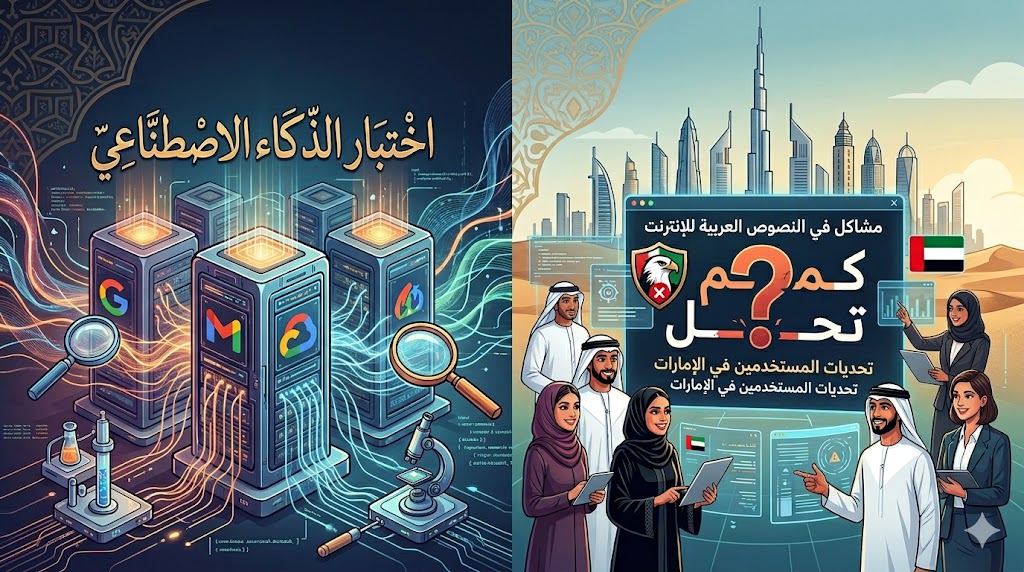
Updated September 2026: the original version of this article said Robius had personally tested major AI tools on Emirati dialect, Hijri dates, UAE addresses and local context. We could not reconstruct a prompt set, model versions, outputs, scoring method or reviewer notes that would make that a reproducible Robius test, so we have removed the first-person benchmarking claim.
The core story survives — and the published evidence is now better. Academic benchmarks in 2025 and 2026 continue to show that Arabic dialects and cultural reasoning remain harder for language models than Modern Standard Arabic, including a 2026 benchmark that explicitly evaluates Emirati Arabic.
| THE ROBIUS READ: Do not reduce Arabic AI quality to “good” or “bad.” Models can perform strongly on Modern Standard Arabic while still being less reliable on dialect, culturally specific phrasing and country-level nuance. For UAE users, Emirati Arabic is exactly the kind of case where published benchmarks say extra checking is still justified. |
Why Modern Standard Arabic Is Not the Whole Test
Most formal written Arabic — news copy, government-style prose, reports and many business documents — uses Modern Standard Arabic. That makes MSA an important benchmark, but it does not represent the language people use in every WhatsApp message, voice note or informal conversation.
Arabic is highly dialectal. Gulf Arabic differs from Egyptian Arabic, Levantine Arabic and Maghrebi varieties, and Emirati Arabic has its own vocabulary, pronunciation, expressions and cultural context.
A model that performs well on MSA therefore has not automatically proven that it can generate natural Emirati dialogue or understand every local expression.
The 2026 Emirati Benchmark Makes the Gap Measurable
DialectalArabicMMLU, published for LREC 2026, was built specifically to measure language-model performance beyond MSA. The researchers manually translated and adapted 3,000 multiple-choice questions into five dialects: Syrian, Egyptian, Emirati, Saudi and Moroccan.
Across 19 open-weight Arabic and multilingual models, the researchers found substantial variation between dialects and persistent gaps in dialectal generalization.
That does not mean every current commercial AI assistant performs poorly on Emirati Arabic. The benchmark did not test every closed model available to consumers in September 2026. It does show why it is unsafe to assume that a strong MSA score automatically translates into equally strong Emirati performance.
A Second 2026 Study Finds the Same MSA-versus-Dialect Pattern
ArabCulture-Dialogue, published at ACL 2026, evaluates culturally grounded conversations across 13 Arabic-speaking countries in both MSA and each country’s dialect. It tests cultural reasoning, translation between MSA and dialect and dialect-steered generation.
The researchers report that models performed worse on all three tasks in the dialectal setting than in MSA. That matters because real UAE communication often combines dialect, cultural references, names, English terms and local institutions in the same conversation.
AraDiCE Shows Why Cultural Context Matters Too
AraDiCE, presented at COLING 2025 in Abu Dhabi, evaluates both Arabic dialect capability and cultural knowledge across Gulf, Egyptian and Levant regions. Its authors found persistent challenges in dialect identification, generation and translation.
It also found that Arabic-focused models such as Jais and AceGPT could outperform the multilingual models evaluated on some dialectal tasks. That is evidence for a narrower point: specialization can help with regional language. It is not evidence that one Arabic model is always better than every global model on every UAE task.
What This Means for an Emirati WhatsApp Message
If you ask an AI system to produce a formal Arabic email, you are asking it to work in the part of Arabic that is most standardized and most heavily represented in benchmarks and formal text.
If you ask for a natural Emirati WhatsApp reply, you are asking for something different: dialect steering, tone, local vocabulary and cultural judgment. Published research says those dialectal tasks remain more difficult.
That does not make AI-generated dialect useless. It means a native or highly fluent reviewer should check important public-facing copy before it is sent under a company or government name.
Hijri Dates: Treat the Model as a Language Tool, Not the Calendar Authority
The old Robius article claimed our own test showed AI systems drifting by a day or more on Hijri conversions. We do not have a reproducible Robius test supporting that statement, so it has been removed.
The safer practical rule remains straightforward: if a Hijri date affects a visa, court filing, government deadline, religious observance, contract or other consequential action, verify it against the relevant official calendar or authority rather than treating a general-purpose language model as the source of record.
UAE Addresses: Give the Model the Real Location Data
The previous article also claimed major AI tools “do not understand Makani” and routinely invent postal codes. Again, that was presented as a Robius test without a documented test set.
The more defensible advice is to provide the actual address information required by the recipient or service. Do not ask an AI system to guess a missing Makani number, building name, unit, location pin or delivery instruction. If a location field matters operationally, copy it from the authoritative source rather than letting a model infer it.
Names and Transliteration Need Human Consistency
Arabic names can have several reasonable English transliterations. That is not always an AI error; there may simply be more than one accepted rendering.
For official work, the correct version is the one used by the person or the authoritative document. If a passport, Emirates ID, company licence or official profile spells a name one way, use that spelling consistently instead of asking a model to transliterate it from scratch.
The UAE’s Arabic-First Model Strategy Makes More Sense in This Context
The UAE has invested in Arabic-focused AI development, including Jais and the Falcon model family. That local investment is often framed as a race to build another large model. The dialect benchmarks show a more practical reason: Arabic is not one homogeneous language task.
Regional data, dialect coverage and cultural evaluation can materially affect model behaviour. The strongest system for English coding questions is not automatically the strongest system for an Emirati customer-service conversation.
How UAE Users Should Work With Arabic AI
- Specify the Arabic variety. Ask for MSA, Emirati Arabic or another dialect explicitly instead of simply saying “Arabic.”
- Give examples of the desired tone. A short approved sample is more useful than vague instructions such as “make it local.”
- Verify consequential dates and identifiers independently. Do not let a model invent or infer official data.
- Lock official name spellings. Reuse the transliteration from authoritative records.
- Use a fluent reviewer for high-stakes dialectal copy. Legal, government, medical, financial and reputation-sensitive communication deserves human checking.
- Do not treat one benchmark as permanent. Models change quickly; a 2026 result is evidence about tested systems and tasks, not a forever ranking.
The Bottom Line
The old article tried to make this story stronger by saying Robius had personally stress-tested the major AI tools. We do not need that claim.
The published evidence already says something useful: Arabic language models are generally evaluated more deeply on Modern Standard Arabic than on everyday dialects, and 2025–2026 research continues to find a performance gap when models move into dialectal and culturally specific Arabic.
For the UAE, the important part is that Emirati Arabic is now being benchmarked directly. That gives users a better standard than “the Arabic looked okay to me.” Use AI for Arabic, but match the level of verification to the consequence of getting the language or local context wrong.
Sources
• DialectalArabicMMLU, LREC 2026: human-curated benchmark covering Emirati, Saudi, Egyptian, Syrian and Moroccan Arabic — ACL Anthology
• IBM Research, May 2026: DialectalArabicMMLU publication summary and benchmark description — research.ibm.com
• ArabCulture-Dialogue, ACL 2026: cultural reasoning and dialect benchmark across 13 Arabic-speaking countries — ACL Anthology
• AraDiCE, COLING 2025: dialectal and cultural capabilities benchmark covering Gulf, Egyptian and Levant contexts — ACL Anthology
• Inception: Jais Arabic model — inceptionai.ai
• Technology Innovation Institute: Falcon model family — falconllm.tii.ae
Robius.news — Dubai, UAE — 2026 | Built to be first. Built to be trusted.