 UAE, UNFILTERED
Dubai’s New Street Signs Have a Makani Backbone
Dubai will replace and install signs across 186 areas by 2030. The important detail is how Makani location references and QR codes fit into the phased rollout.
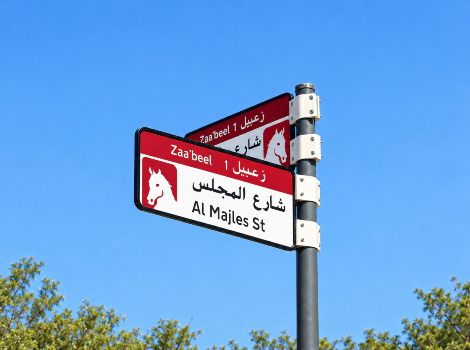
Dubai is redesigning the physical layer of its addressing system while keeping Makani as the precise digital location reference underneath it.
Dubai residents, property managers, delivery fleets, retailers, mapping providers and businesses that depend on accurate entrances and location data.
The rollout is phased through 2030. Not every district, QR function or app integration is live today, and RTA has not published district-by-district performance data.
Watch for installation progress, named app integrations, open-data updates and evidence that the new signs reduce wrong-location journeys.
Keep using the official Makani number for the entrance you actually use, verify any new QR destination independently, and do not assume personal documents or app profiles need changing unless an authority says so.
Dubai is changing the way neighbourhoods identify themselves on the street. The less visible question is whether a redesigned sign can make an address easier to find in the systems residents and businesses already use.
Dubai’s Roads and Transport Authority says a new addressing identity will eventually cover 186 areas across 19 sectors, beginning with more than 2,000 signs in five districts in the fourth quarter of 2026. The programme includes area markers, street-name signs and house number plates. Each district will have a visual colour identity, while house plates will carry a Makani number and a QR code.
The headline sounds like a redesign, but it is also an infrastructure story. Dubai already has a geographic location system. What the new programme proposes is a clearer physical interface to that system, with digital information added over time. For residents, the immediate action is modest: know the correct Makani identifier for the entrance you use, and do not assume that a new sign means your address or an app’s records have changed.
The rollout starts small, even though the map is large
The official plan runs from the fourth quarter of 2026 through 2030. Its first five areas are Za’abeel 1, Za’abeel 2, Nad Al Sheba, Al Khawaneej 1 and Nazwa. RTA says more than 2,000 signs will be installed or replaced in that first phase, not across all 186 areas at once. This distinction matters to a resident who sees the announcement but lives outside the initial districts: there is no basis for expecting a new plate at every door this month.
One timetable discrepancy deserves attention. The Dubai Executive Council announcement on 1 July 2026 described implementation across 186 areas by 2029. The more recent RTA announcement of 7 October describes a phased programme through 2030. Neither document explains the difference. It would be premature to label this a confirmed delay or assume the earlier date governs every district. Residents and businesses should use the current RTA plan while watching for district-by-district installation notices.
Five colours are intended to reflect the geography of different communities. RTA gives blue for coastal areas and gold for desert environments as examples. It has not provided a complete publicly described mapping of every colour to every area in the announcement. The colours should therefore be understood as an aid to local recognition, not a replacement for a unique address.
Priority will be based on population density and growth, centrality, tourist and residential destinations, and the share of streets that have not yet been formally addressed. That is an important design choice. It implies the project is not merely replacing old signs where they look tired; the city is also targeting gaps in how places are identified on the ground.
The Makani number is the part to keep
Dubai Municipality’s Makani system gives locations a precise numeric reference. Its official mobile app describes the identifier as a 10-digit number that can locate building entrances without relying on long directions or a conventional street-address format. Dubai Municipality already uses Makani references on its own contact pages, and its app can surface nearby Makani information.
The new RTA announcement specifically says the approved house-plate designs will carry the property’s Makani number and a corresponding QR code. It does not announce a citywide renumbering of existing Makani identifiers. Those are different things. A new colour and plate format can make a number easier to see without changing the underlying location reference.
Dubai has also worked on finer-grained addressing within buildings. A 2020 Dubai Municipality announcement described a separate geospatial unit-addressing initiative for apartments, offices and shops. That historical work is relevant because an entrance identifier and a unit identifier solve different problems. A courier reaching the correct building has not necessarily found the right lobby, lift bank or apartment. The October 2026 announcement is about the new area and house-plate identity; it should not be presented as a fresh launch of every unit-level addressing capability.
Address confusion also creates opportunities for fraudulent delivery messages. Robius’s investigation of the Dh3 parcel-text scam explains why residents should verify delivery payment requests independently. The addressing announcement itself is not evidence of a new QR-code scam wave.
A QR code is an information layer, not proof of an app update
RTA says QR codes will provide information about sectors and areas, the meanings behind street and area names, points of interest and other location-related content. Future deliverables are expected to extend the identity to bus stops, smart applications and area map boards.
The sequence matters. An approved design and a planned QR function do not prove that every plate is already installed, every QR destination is live or every map application has integrated the new information. RTA has not published a per-app delivery schedule in this announcement. Robius will treat app integration as a future milestone until the responsible authority names the service and confirms availability.
For a resident, a QR code can help interpret the area and its landmarks, but it should not replace checking the actual destination when an address matters. For building managers, the more useful question is whether the plate is visible from the approach people actually take and whether the identifier matches the intended entrance. If a code redirects to an unfamiliar page requesting payment or credentials, use the official government channel independently rather than trusting the prompt simply because it appears near a sign.
The last 20 metres are the real test
Dubai’s delivery and service economy exposes a weakness in any addressing system: finding the neighbourhood is not the same as reaching the right door. A driver may know the building name and still arrive at the wrong entrance. A technician may be directed to a loading bay instead of a customer reception. An emergency caller may be able to describe a tower but not the access point.
Makani’s value is that it provides a specific geographic reference. The new signage can improve the physical handoff from the road to that reference, especially where street naming and house plates have been inconsistent. But it would be premature to claim that this redesign alone will cut delivery times by a particular percentage. RTA has announced a rollout, not published measured before-and-after performance for the new signs.
The distinction is relevant to the wider logistics environment. Robius recently explained how Dubai’s new truck restrictions make route and timing part of delivery planning. The new addressing identity tackles a different segment of the journey: location recognition once the vehicle is close. Neither policy removes the need for dispatchers and recipients to agree on the actual entrance, access hours and loading arrangements.
What residents should check in the first five districts
Residents in Za’abeel 1, Za’abeel 2, Nad Al Sheba, Al Khawaneej 1 and Nazwa have the most immediate reason to watch the rollout. The sensible preparation is to note the current Makani number for the building or entrance, save it with the address used for deliveries, and ask building management where new plates will be positioned once installation begins.
There is no announced requirement in the RTA release for residents to replace Emirates IDs, tenancy contracts, utility accounts or delivery-app profiles because of the new signs. Anyone presenting the programme as a compulsory paid address migration should be asked to identify the exact official notice authorising that requirement. That is a claim-audit point, not evidence that a particular scam is already circulating.
Residents can also keep the digital-service layers separate. Robius’s guide to which UAE government app owns which task explains why UAE PASS, DubaiNow and specialist RTA services should not be treated as interchangeable. A physical address sign is not itself a new government app or an identity credential.
Businesses need a change-control process, not a new colour palette
For retailers, delivery fleets, property managers and mapping vendors, the interesting part of the programme is how official references are maintained through the transition. A business with several entrances should identify which Makani number belongs to customer access, which route serves deliveries and which instructions still rely on informal landmarks. These records should be checked against the official system rather than rewritten from a promotional rendering of a new sign.
Mapping providers have a related question: when will a new sign, plate or area description become an authoritative data update, and how will that update be distributed? The RTA statement names future smart-application integration but does not set an open-data release schedule, a technical interface or an obligation for private navigation providers. Those are the next disclosures to monitor.
Residents already encounter fragmentation across city services. Robius’s DubaiNow review examines how many services sit behind one city app, while the RTA Dubai app guide covers transport-specific functions. Neither should be described as already supporting the new address identity without an official product update. A coordinated data layer will matter more than whether an app adopts the same five colours.
What Dubai has not said yet
The announcement does not specify a resident fee, a mandatory replacement process for personal documents, a citywide change to Makani numbers, an exact installation date for each of the 186 areas, or a launch date for every planned QR and app feature. Those omissions should not be filled with confident guesses. The confirmed facts are the programme’s scope, first-phase districts, general timetable, visual concept and intended Makani/QR integration.
The most useful public progress reports would show the number of areas completed, signs installed, streets newly assigned an address, house plates validated against the geographic database and mapping systems updated. Over time, independent evidence could test whether the programme reduces wrong-location arrivals or improves accessibility for visitors and people who cannot easily use a smartphone. Until such results exist, those are evaluation questions, not outcomes Robius can claim.
The useful address is the one people can actually find
Dubai’s new signs are a visible piece of a less glamorous infrastructure challenge. Cities need a stable way to identify a location, a human-readable way to find it and a digital method for systems to agree on the same destination. Makani already addresses part of that challenge. The 2026–2030 programme attempts to make the physical and visual layers more consistent.
The resident takeaway is simple: keep using the official Makani reference, check the entrance, and wait for named updates before assuming any app or document needs changing. For businesses, the task is to maintain accurate location data during a phased rollout. The strongest proof of success will not be a photograph of a beautiful new sign. It will be fewer people reaching the wrong place.
Sources
- Dubai Roads and Transport Authority , New visual identity and addressing system, 8 October 2026
- Dubai Municipality , Official app and Makani location features
- Dubai Municipality , Makani unit-addressing initiative, 17 October 2020
- Khaleej Times , Dubai’s new street signs, 7 October 2026
- Dubai Municipality: Makani open data and entrance-location service
- Emirates 24|7: Executive Council approval of the address identity, 1 July 2026
Checked 11 October 2026. The first phase and proposed QR/app integrations are plans, not confirmation that every new sign or digital feature is available today.
Robius.news | Dubai, UAE | 2026 | Built to be first. Built to be trusted.