

A new Arab media report puts the UAE at about 75% AI adoption in 2026. Read that number too quickly and it sounds like three quarters of UAE media is being produced by machines.
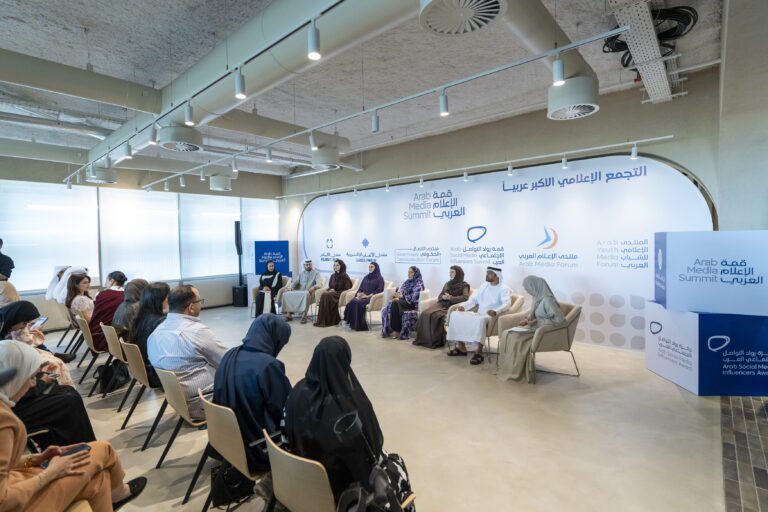
That is not what the report measures. Arab Media in the Age of AI, launched by Dubai Press Club with Deloitte during the Arab Media Summit on September 16, defines adoption as the share of media organisations using AI in at least one operational workflow across areas such as content production, editorial operations, audience engagement, translation and localisation, production automation or content analytics.
A new Dubai Press Club-Deloitte report estimates that AI has reached at least one operational workflow in about 75% of UAE media organisations.
UAE publishers, broadcasters, creators, communications teams, advertisers and readers trying to understand how quickly AI is entering regional media workflows.
Arabic data, archives, cultural context and transparent provenance can become differentiators as general AI tools become more widely available across media organisations.
The 75% is an estimated organisational-adoption figure based on use in at least one workflow; it does not measure the share of content generated by AI.
The report forecasts deeper adoption toward 2030, while the practical test will be whether AI moves from isolated tools into governed production workflows.
When reading AI adoption statistics, check the definition and methodology before treating the percentage as a measure of AI-generated content or workforce replacement.
Media organisations can gain production, localisation, analytics and distribution efficiencies, while technology and services providers gain a growing implementation market.
The report covers organisational adoption across media markets; the 75% figure is a research estimate rather than an eligibility programme or government target.
Watch disclosure of synthetic media, provenance standards, Arabic-language performance, human-review requirements and more granular evidence on depth of organisational deployment.
Under that definition, the report estimates UAE adoption at approximately 75%, ahead of Saudi Arabia at 70% and Qatar at 65%. It is a measure of organisational use, not a measure of how much published content is AI-generated.
What the 75% Actually Measures
The report’s definition sets a deliberately broad threshold. A media organisation counts as adopting AI if it uses the technology in at least one operational workflow.
That could include translation, audience analytics, newsroom support, production automation or content creation. It does not require AI to run the whole newsroom, replace editorial judgement or generate most of the organisation’s output.
This distinction matters because adoption percentages are easy to turn into stronger claims than the data supports. The useful conclusion is that AI tools appear to have reached a large share of UAE media organisations in some operational form. The report does not establish that 75% of articles, videos or broadcasts are generated by AI.
The Number Is an Estimate, Not a Census
The report says its adoption estimates are based on primary research with media companies and professionals across MENA, supported by secondary research on country-level AI adoption and market developments.
Its methodology combines a media industry survey across the Arab world, interviews with media leaders, secondary research and AI-assisted research and analysis. The report says human researchers retained responsibility for source selection, interpretation, verification and final editorial judgement.
That makes the 75% figure a research estimate rather than an official count of every UAE media company. The report itself uses language such as “estimated adoption” and “approximately 75%.” Robius is keeping those qualifiers.
MENA AI-in-Media Spending Is Estimated at $520 Million
The report separately estimates MENA media-company spending on AI software, implementation and managed services at $520 million in 2026, up from an estimated $380 million in 2025 and $260 million in 2024.
Within the 2026 estimate, Saudi Arabia accounts for about $137.4 million, the UAE $94.7 million and Qatar $36.2 million. The three markets together make up just over half of the estimated regional total.
There is another caveat. The report notes that the boundaries of AI spending are increasingly difficult to isolate as AI becomes embedded in cloud services, data platforms, enterprise software and wider technology-modernisation programmes. So the spending model should not be treated like audited company expenditure.
Most Software Spending Is Close to the Content Workflow
The report says software represents 62% of MENA AI-in-media expenditure and services 38%. Within software, content generation and content distribution together account for almost 60% of spending.
That tells us where organisations are concentrating resources: making, adapting and distributing content. It does not tell us the editorial quality of the output, whether audiences know AI was involved or how extensively a particular newsroom has automated its workflow.
Synthetic Media Is Where the Trust Question Gets Harder
The report describes the UAE as having the broadest adoption profile among the assessed markets and being especially advanced in synthetic media, including AI-powered spokespersons and AI-generated virtual characters for institutional communications and digital storytelling.
That is where adoption stops being an internal productivity question and becomes visible to the audience. Translation software used behind the scenes is different from a synthetic presenter speaking directly to viewers.
The report itself highlights verification, transparency, intellectual-property rights, provenance and responsible AI governance as areas requiring more attention. Those issues become more important as AI-generated audio, video and personas become harder to distinguish from human-created media.
That connects directly with the verification problem Robius covered in our analysis of Dubai’s SARAAB deepfake detector: better generation tools and better detection tools are developing at the same time, while provenance and source verification remain necessary.
The 2030 Numbers Are Forecasts
The report projects adoption above 95% in both the UAE and Saudi Arabia by 2030 and around 90% to 95% in Qatar. Those are forward estimates, not outcomes that have already happened.
Whether those forecasts prove accurate will depend on more than access to models. The report points to talent, Arabic-language capabilities, data, governance and leadership decisions as factors shaping the next stage of adoption.
What Robius Will Watch
- Depth, not just adoption: how many workflows inside UAE media organisations actually use AI?
- Disclosure: when synthetic presenters, voices or generated imagery are used, how clearly is that communicated to audiences?
- Arabic performance: whether local media develops stronger dialect, cultural-context and regional datasets rather than relying only on general models.
- Provenance: whether publishers adopt practical methods showing where media originated and how it was created.
- Editorial controls: where human verification remains mandatory as AI moves from support tools into more autonomous workflows.
The Bottom Line
The 75% figure is evidence of broad estimated organisational adoption, not evidence that 75% of UAE media content is machine-generated.
The report’s more useful signal is that AI is moving beyond isolated experiments into everyday media workflows. The next measurement that matters is not simply whether an organisation uses AI somewhere, but where it uses it, what decisions it influences and what the audience is told.
Sources
- Dubai Government Media Office, 16 September 2026: Dubai Press Club launch announcement and headline findings from Arab Media in the Age of AI — official announcement
- Arab Media Summit / Dubai Press Club and Deloitte: full Arab Media in the Age of AI report, including definitions, spending estimates and methodology — full report
Checked 17 September 2026. Adoption and spending figures in this article are estimates from the Dubai Press Club-Deloitte report and are described as estimates accordingly.
Robius.news — Dubai, UAE — 2026 | Built to be first. Built to be trusted.