

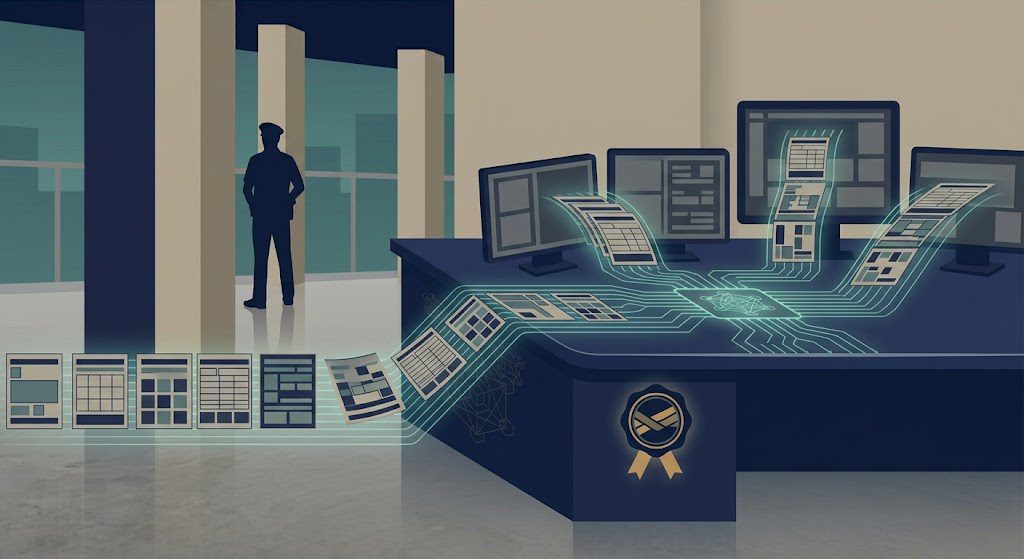
Dubai Police has 36 robots. If that sentence makes you picture metal officers patrolling Sheikh Zayed Road, the headline has already done too much work.
The force says it deployed 36 robotic process automation systems, or RPA robots, across policing and administrative operations while completing 104 strategic and operational technology projects over the past year. These robots are software systems used to automate routine digital work. They are not 36 physical police machines.
The announcement is a useful example of how public-sector automation often happens inside workflows rather than through visible humanoid robots.
UAE residents, public-sector teams and businesses following government AI should understand the difference between RPA, AI agents and physical robotics.
Routine process automation can reduce repetitive clerical work and free specialists for tasks that need judgment, investigation or direct public interaction.
Dubai Police has not publicly listed every workflow handled by the 36 RPA systems or quantified the productivity gain for each one.
Dubai Police says it plans to continue expanding AI across police, administrative and operational functions.
When a headline says 'robot' or 'AI', check whether the underlying system is physical robotics, rule-based automation or an agent that can make decisions.
Dubai Police employees can offload some routine processes while the force can standardize and scale digital operations.
This is an internal Dubai Police deployment rather than a public product; residents interact with the resulting services rather than the RPA systems themselves.
Watch for named live AI services, measurable processing improvements, human approval rules and clearer disclosure of which systems are RPA versus AI
RPA Is Software Robotics
Robotic process automation is software that carries out repetitive steps across digital systems. Think form handling, data transfer, status updates, reconciliations or other structured processes that normally require a person to click through the same sequence repeatedly.
Dubai Police has not publicly listed the exact task map for all 36 deployments, so Robius is not going to invent one. The authority and contemporary reporting describe them as RPA systems used across routine administrative and operational work to reduce workloads and increase productivity.
That is less cinematic than a patrol robot. It is also more representative of where automation creates value inside large organizations. The machine does not need a body if the work already lives on a screen.
RPA, AI Agent and Physical Robot Are Not the Same Thing
The words are easy to collapse because vendors and headlines often put them in the same paragraph. The underlying capabilities are different.
| System | What it generally does | What Dubai Police announced |
|---|---|---|
| RPA robot | Follows defined digital steps across software and records | 36 RPA systems across routine administrative and operational tasks |
| AI agent | Uses AI to interpret inputs, choose actions or work toward a goal with defined permissions | Part of the wider UAE government AI direction, but not what the 36 count means |
| Physical robot | Moves through the real world using sensors and hardware | Not the subject of the 36 RPA announcement |
This distinction is becoming important across UAE government. The UAE Cabinet’s 32 AI advisers are described as specialized AI advisers for analysis and decision support. That is a different job from a software bot repeating a structured back-office process.
The Bigger Number Is 104 Technology Projects
Dubai Police says it completed 104 strategic and operational technology projects over the past year. It also reported digital service continuity of 99.97% and technology-system continuity of 99.92% during the current year.
Those are authority-reported performance figures. They show that the General Department of Artificial Intelligence is not being presented as a single chatbot team. Its scope includes service continuity, automation, data tools, AI systems and wider technology delivery.
The inspection also covered an AI platform designed to support data analysis, procedure automation and digital tools for employees and customers. Reporting says leadership reviewed a smart assistant for Smart Police Stations as part of the same direction.
This Is the Boring Layer of the UAE AI Stack
Last week, the UAE AI conversation was dominated by systems that sound more dramatic: Cabinet advisers, agentic workflows and new foundation models. RPA sits underneath that layer.
Our UAE AI stack weekly review argued that the important change is not the number of AI announcements. It is the movement from skills and models into decision systems and real workflows. RPA is one of the least glamorous workflow tools in that picture.
A rule-based bot that moves data correctly every time can be more valuable than a sophisticated model deployed without a clear job. The opposite is also true. RPA is poor at work that depends on ambiguity, interpretation or changing context unless a human or smarter system handles those cases.
Automation Does Not Automatically Mean AI
There is another reason to keep the vocabulary straight. An organization can expand AI at the same time it expands non-AI automation. The two can even be connected. But calling every automated process ‘AI’ makes it harder to understand where judgment and risk actually sit.
Our longer guide to agentic AI in UAE government services focuses on systems that can move beyond a single scripted step and act across a workflow. RPA is usually narrower. It is strongest when the rules and interfaces are stable.
That matters for governance. If a bot only copies an approved field from one system to another, the main risks are process design, access control, data quality and exceptions. If an AI system interprets evidence or recommends a decision, the questions expand to source quality, reasoning, permissions, human review and auditability.
What We Still Do Not Know
The headline gives us a count. It does not yet give us a public inventory of the 36 workflows, how many employee hours they replace, how exception cases are handled or which controls sit around each automation.
Those are the useful next disclosures because they would let residents and other government teams judge outcomes instead of technology volume. A robot count is interesting. A processing-time reduction, error-rate change or service improvement is more informative.
The same standard applies to the smart assistant and AI platform. The practical questions are what they can access, what they can change, whether they are advisory or action-taking, and where a person must approve the result.
The Robius Layer: Count Jobs Automated, Not Robots Announced
Dubai’s new Click & Travel passport service is another example of technology becoming useful when the operating change is clear. The interesting part was not the device. It was that passport-processing capacity could move toward the passenger instead of staying tied to one fixed desk.
The same test works here. Thirty-six robots sounds futuristic. Thirty-six software automations handling repetitive workflows is more accurate. It also gives us a better question for the next update: which pieces of police work became faster, more reliable or less repetitive because of them?
Sources
- Dubai Police: Official media page for the General Department of Artificial Intelligence inspection and technology project update – https://www.dubaipolice.gov.ae/app/home/media/news/news-details?id=c7muljtht3jsjy4gfxxip38w
- Gulf News: September 6 report describing 36 RPA robots, 104 technology projects and service-continuity figures – https://gulfnews.com/uae/dubai-police-deploys-36-robots-as-ai-expands-across-operations-1.500664843
Robius.news — Dubai, UAE — 2026 | Built to be first. Built to be trusted.