
Dubai has built an AI model specifically to detect deepfake video. The useful part is not the launch superlative. It is that SARAAB is meant to become open source, giving researchers and security teams a government-built detector they can inspect, test and improve rather than another closed demo that disappears after a conference.
The Dubai Electronic Security Centre unveiled SARAAB at GISEC Global 2026 on September 16. DESC says the model was developed entirely by an Emirati team and describes it as the first deepfake-detection model of its kind developed by a government entity in the Arab region.
Dubai plans to release a government-built deepfake detector for outside technical scrutiny, but its reported 91% performance still lacks public benchmark detail.
UAE cybersecurity teams, developers, researchers, newsrooms, fraud investigators and residents following deepfake risks and verification tools.
Open release could allow independent testing, failure analysis and improvements across different deepfake generators, video conditions and real-world security workflows.
The 91% figure is authority-reported, benchmark details are not yet public, and current reporting gives conflicting release windows.
The decisive milestone is a live public repository with model documentation, evaluation details and enough access for independent researchers to reproduce or challenge the claims.
Keep verifying suspicious video through a separate trusted channel; no detector score should replace source verification for payments, credentials or sensitive requests.
Security researchers and technical teams could gain an inspectable model they can test, build on and potentially integrate into verification workflows.
DESC says the model will be made available through developer platforms; a public repository was not live in the sources Robius reviewed on September 17.
Watch for the repository URL, benchmark datasets, false-positive rates, unseen-generator performance and clarification of the September versus year-end release timing.
DESC has also reported a 91% accuracy rate. That sounds reassuring. It needs context.
What SARAAB Actually Does
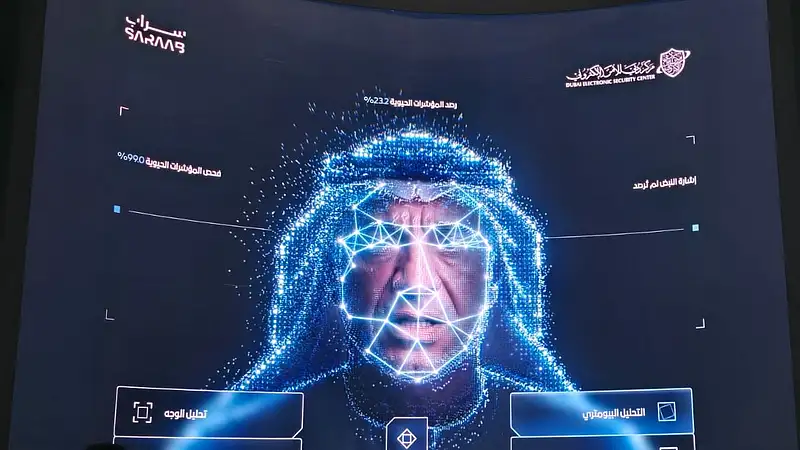
DESC says SARAAB analyses video to identify signs of synthetic manipulation. Hassan Majid Alkhazraji, Senior Artificial Intelligence Executive at DESC, told Khaleej Times that the model scans an entire video rather than sampling only one moment. If manipulation appears only in the final part of a clip, that portion is still analysed.
The system uses a heat-map approach to highlight facial areas associated with manipulation. That can make the output more useful to an analyst than a single unexplained “fake” score because it gives some indication of where the model detected a problem.
The public-release timing is less clear than some headlines suggest. DESC’s English launch announcement says SARAAB will be made available through developer platforms without naming a date. Khaleej Times quotes a DESC executive saying it is planned for Hugging Face by the end of 2026, while WAM’s Arabic GISEC coverage reports that the open-source release is expected during September. Until a live repository appears or DESC publishes a single confirmed release date, Robius is treating the timing as unsettled.
The 91% Figure Is Not a Consumer Guarantee
Accuracy figures for deepfake detection depend heavily on what the model was tested against. A detector can perform strongly on the dataset and manipulation techniques it knows, then struggle when compression, editing, new generators or deliberately adversarial inputs change the problem.
DESC’s 91% figure is therefore useful evidence about the model’s reported test performance. It should not be translated into “SARAAB catches 91% of all deepfake videos” unless the underlying benchmark supports that broader statement.
This distinction matters because our existing guide on UAE deepfake warnings reaches the same practical conclusion from the resident side: visual confidence is not identity verification. Even a strong detector should be another evidence layer, not permission to stop verifying high-stakes claims.
Open Source Is the More Interesting Choice
Deepfake detection is an arms race. Generators improve. Detectors adapt. New editing pipelines create edge cases. A model that cannot be examined by outside researchers makes it harder to understand where it works and where it fails.
Making SARAAB available through an open developer platform changes that dynamic. Security researchers can test it on different material, identify failure cases and potentially contribute improvements.
Open source does not automatically make a model accurate, safe or production-ready. It makes scrutiny possible. For a security tool, that is the more useful part of the announcement.
This Does Not Yet Give Residents a Universal Deepfake Checker
The launch announcement is aimed primarily at AI engineers, cybersecurity professionals and researchers. DESC invited GISEC visitors to experience SARAAB, but it has not announced a universal resident-facing app where anyone can upload any suspicious clip and receive an official authenticity certificate.
An open model can become the technical foundation for tools used by government teams, platforms, newsrooms or developers. It is not automatically the same thing as a finished consumer verification service.
Residents should therefore keep using the habits that already stop many impersonation attacks: verify the source through a separate trusted channel and do not let a familiar face or voice authorise money, access or sensitive information by itself. Our scam-call reconstruction shows why that second-channel check matters even when an interaction feels convincing.
SARAAB Was Only One of Three Cybersecurity Launches
DESC also launched the Dubai Cyber Skills Framework and an ISR Auditor Certification Programme at GISEC.
The skills framework creates a common reference for cybersecurity qualifications, training and career progression. The auditor programme focuses on how information-security professionals assess compliance with Dubai’s Information Security Regulation.
Together, the three launches show two sides of the same cybersecurity push: technical tools for emerging threats, and standards for the people and processes expected to use or audit security systems around them.
What to Watch Before Calling It Proven
- Public release: when does a live SARAAB repository appear, and which of the reported release windows proves accurate?
- Evaluation details: what datasets, deepfake generators and test conditions produced the reported 91%?
- False positives: how often does authentic video get flagged as manipulated?
- Generalisation: how does the model perform on deepfakes created with techniques it did not see during development?
- Real deployment: which government, media, platform or security workflows actually adopt it?
- Consumer access: does a trusted public-facing verification workflow eventually emerge?
The Bottom Line
SARAAB is more interesting than another “AI will fight AI” announcement because Dubai is promising something testable: an Emirati-built deepfake detector that outside technical users should eventually be able to inspect and work with.
The reported 91% figure is a reason to inspect the model, not a reason to stop thinking. The real evidence will come from the public release, the benchmark details and independent testing against synthetic media the model did not encounter during development.
Sources
- Emirates News Agency, 16 September 2026: DESC launch of SARAAB, Dubai Cyber Skills Framework and ISR Auditor Certification Programme — WAM English
- Khaleej Times, 16 September 2026: on-record DESC technical details including reported 91% accuracy, whole-video analysis, heat-map output and a stated Hugging Face timeline — Khaleej Times
- Emirates News Agency, 16 September 2026: Arabic GISEC coverage reporting 91% accuracy and a September open-source release window — WAM Arabic
Checked 17 September 2026. The 91% figure is reported by DESC; the underlying evaluation conditions were not published in the sources Robius reviewed.
Robius.news — Dubai, UAE — 2026 | Built to be first. Built to be trusted.