
Independently researched from official cyber guidance and current reporting. Checked on August 2, 2026.
More than 30 water systems in Minnesota were targeted, then Michigan reported activity affecting nine more. The systems in Michigan continued operating safely, and officials said there was no known public-health impact.
The incidents still matter because the attackers were not chasing customer email or an office laptop. They targeted technology used to remotely monitor and control equipment, the same category of access that makes small infrastructure teams more efficient.
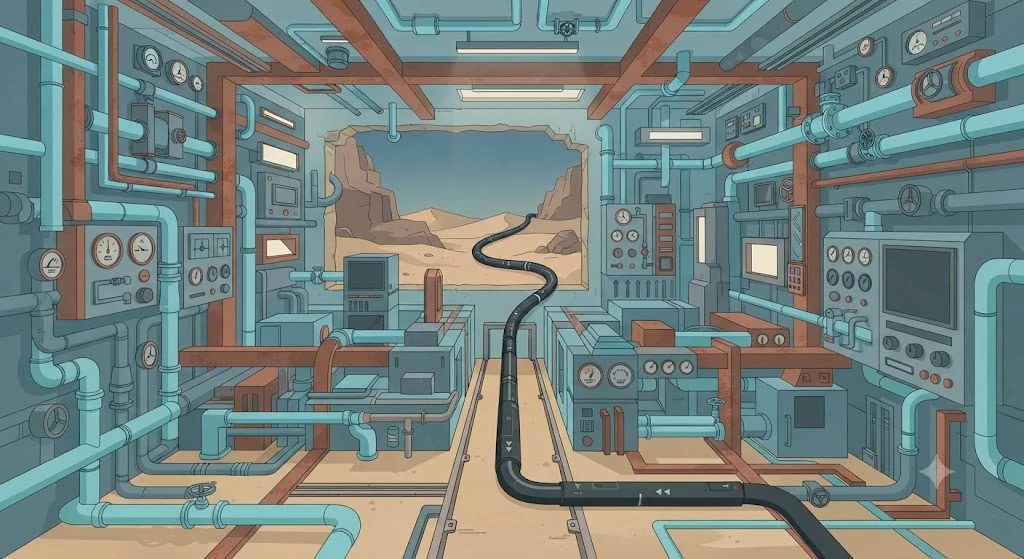
The Robius insight is simple: remote visibility is also remote reach. The device that lets an operator see and change a system from miles away can become the attacker’s control surface when exposure, credentials, segmentation, or monitoring are weak.
What Officials Confirmed
The Associated Press reported that cyberattacks targeted more than 30 Minnesota water systems and that Michigan later received reports involving nine systems. Michigan officials said all affected systems continued operating safely and that there were no known impacts posing a public-health concern.
Minnesota said most confirmed activity involved technology used to remotely monitor and control equipment. In Braham, attackers shut down operating controls, temporarily taking the well and water-treatment plant offline. The city said water quality was not affected.
The Wall Street Journal reported that hackers changed passwords and network settings on affected systems, preventing monitoring or control in some cases. One utility reported unauthorized modifications to software that automates plant operations.
The FBI has not publicly identified a culprit. Officials had separately warned about Iranian-affiliated actors targeting water, wastewater, and other operational technology, but the current incident attribution should remain qualified until investigators publish it.
The Device Was Useful Before It Was Dangerous
Water systems use remote connectivity because operators cannot stand beside every pump, tower, station, and controller around the clock. The technology can show pressure, alarms, levels, status, and equipment performance without sending a person to every site.
That operational benefit is real. NIST’s 2026 water-sector guide focuses on securely enabling remote access rather than removing it entirely. The objective is controlled access with strong identity, segmentation, logging, and recovery.
The risk appears when an internet-exposed controller or management interface becomes easier to reach than the physical site. A weak password, stale account, supplier connection, misconfiguration, or vulnerable device can turn a maintenance channel into an operational channel for an attacker.
Why This Matters in the UAE
The UAE operates dense, highly connected infrastructure across water, energy, transport, telecoms, healthcare, buildings, logistics, and digital government. This article does not claim those systems share the weaknesses reported in the United States.
It does show why cybersecurity and operational responsibility must move together. The new Abu Dhabi UAE-US military AI task force includes critical-infrastructure protection in its public mission. The practical work beneath that phrase is identity, data, permissions, network boundaries, human approval, and recovery.
Our AI agent permissions investigation made the same systems point in a different setting. A tool does not need malicious intent to cause harm. Damage becomes possible when the surrounding environment grants access without enough boundaries.
Remote Visibility Is Remote Reach
Critical-infrastructure teams often treat remote monitoring as an efficiency project and cybersecurity as a separate IT project. The attack path crosses both. The person approving the connection, the vendor maintaining it, and the operator relying on it share one risk.
The UAE’s AI infrastructure power advantage depends on physical systems that deliver power, cooling, communications, and water reliably. More compute increases the value of those systems and the consequence of an operational interruption.
The $7.6 trillion global AI infrastructure build therefore has a security side. Every new facility adds sensors, controllers, suppliers, remote maintenance routes, software dependencies, and identities that must be governed over years, not only at launch.
Five Controls to Check First
The first review should focus on the routes that can change operations, not only the systems that store business data.
| Control | Question to answer | Minimum evidence |
|---|---|---|
| Exposure | Which OT devices and management interfaces are reachable from public or corporate networks? | Current asset inventory, network map, and approved exposure list |
| Identity | Who can connect remotely, through which account, and with what authentication? | Named accounts, MFA, least privilege, and rapid revocation |
| Segmentation | Can a compromised office, vendor, or remote-access account reach control equipment directly? | Network separation, jump host, allowlists, and restricted protocols |
| Monitoring | Can the team reconstruct who connected, what changed, and which commands were issued? | Central logs, alerts for configuration changes, and retained session records |
| Recovery | Can operators run safely when remote systems, communications, or automation are unavailable? | Manual fallback, offline procedures, tested backups, and exercised incident plan |
Supplier Access Is Still Your Access
Many facilities depend on equipment vendors, integrators, maintenance contractors, and managed-service providers. A contract may assign tasks to a supplier, but it does not remove the operator’s responsibility to know which accounts, devices, and routes can reach the environment.
Require named users, time-limited access, approval before connection, recorded sessions where appropriate, and immediate revocation when work ends. Shared vendor passwords are difficult to investigate and almost impossible to attribute cleanly.
The U.S. government’s water-sector guidance repeatedly emphasizes reducing public internet exposure, strong authentication, asset inventories, and incident planning. Those controls are basic because basic failures still open consequential systems.
Do Not Overread the Incident
The reported attacks did not create a known public-health crisis in Michigan or Minnesota. Being counted as affected did not mean every community lost water service or that water quality was compromised.
The public record also does not establish one confirmed attacker for the current wave. Earlier advisories about Iranian-affiliated activity are relevant context, not permission to convert suspicion into fact.
The UAE’s improved access to advanced AI and dual-use technology increases both capability and responsibility. Strong technology partnerships should include operational-security practice, not only hardware access and deployment speed.
What Residents Should Expect From Operators
Residents do not need the network diagram of a water plant. They should expect operators to maintain tested contingency plans, communicate clearly during service changes, separate cyber activity from water-quality claims, and publish verified updates when public action is required.
A cyber incident may affect monitoring or control without contaminating water. Clear communication prevents an operational problem from becoming a misinformation problem.
For critical services, resilience means the system can continue safely or move into a controlled manual state while the cyber investigation proceeds.
The Bottom Line
The water-system attacks show that an ordinary remote-access route can become a critical-infrastructure event. The lesson is not to disconnect every smart device. It is to make every connection deliberate, limited, visible, and reversible.
For UAE infrastructure operators, the useful action is a live inventory of OT exposure, supplier access, authentication, segmentation, logging, and manual fallback. A policy document cannot replace a test of whether those controls work.
Remote access is valuable because it reaches the system. That is exactly why it must be treated as a safety-critical capability rather than a convenient support feature.
Sources
- Associated Press: August 2 reporting on more than 30 Minnesota systems, nine Michigan systems, operational effects, safety status, and the unconfirmed attribution. https://apnews.com/article/cyberattack-minnesota-water-systems-77d52a1d7356e608500a1ddb0ec373a6
- The Wall Street Journal: Reporting that attackers changed passwords and network settings and, in one case, modified plant-automation software. https://www.wsj.com/pro/cybersecurity/wave-of-hacks-hits-u-s-water-facilities-c4778225
- Michigan EGLE: Official water-sector cybersecurity page, incident contacts, alerts, assessments, and current advisory references. https://www.michigan.gov/egle/about/organization/drinking-water-and-environmental-health/drinking-water/cybersecurity
- US EPA, FBI, CISA and NSA: Official April 2026 joint advisory regarding Iranian-affiliated threats to water and other operational technology. https://www.epa.gov/newsreleases/epa-fbi-cisa-nsa-issue-joint-cybersecurity-advisory-water-system-regarding-iranian
- NIST NCCoE: Final 2026 practice guide demonstrating secure remote-access architectures for water and wastewater operational technology. https://www.nccoe.nist.gov/publications/practice-guide/cybersecurity-water-and-wastewater-sector-build-architecture-nist-sp
Robius.news — Dubai, UAE — 2026 | Built to be first. Built to be trusted.