

Why Every UAE App Is Becoming a Super-App, and Why That Is Quietly a Problem
UAE super-app trend 2026
There used to be a different app for everything. A ride app. A food app. A bank app. A bill app. A grocery app. A delivery app.
Now there is one app for everything. And the same five companies own all of them.
Careem started as rides in 2012. Today it does food, groceries, bills, money transfers, bike rentals, and bus tickets. Talabat started as restaurant orders. Today it does dark-store groceries, pharmacies, retail, and quick commerce. Noon started as e-commerce. Today it does payments, marketplace, and 15-minute delivery. e& and du started as telcos. Today they do wallets, lifestyle, music, fitness, and streaming bundles.
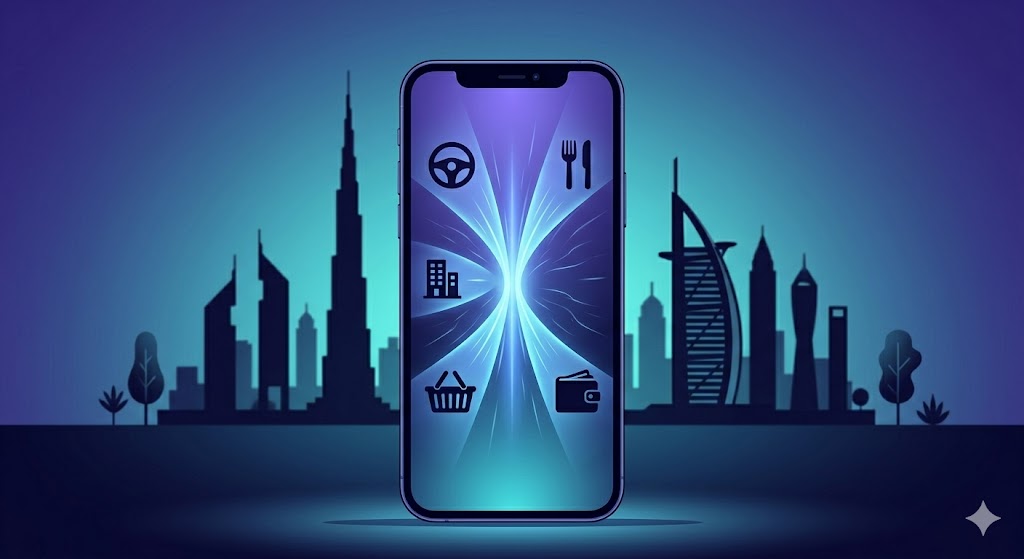
That is not five companies competing. That is five companies converging on the same product, which is the home screen of your phone. The super-app race in the UAE is in full flight. The wins for the consumer are real. So is the cost. Nobody is talking about the cost.
| THE VERDICT: Super-apps make UAE life easier. They also concentrate your data and raise your switching costs.The convenience is genuine. The trade-off is that five companies now know more about how you live than your closest friends do, and an outage at any one of them takes large parts of your day with it. Use them, but do not let your entire life run on one icon. |
Why This Happened in the UAE
Super-apps work in markets with three conditions. The UAE has all three at full strength.
A small, dense, smartphone-saturated population. The UAE has higher smartphone penetration than any G7 country. The customer is always reachable.
A regulatory environment that allows financial services to live inside non-bank apps. Careem Pay, Talabat Pay, and Noon Pay all exist because the UAE Central Bank built clear lanes for stored-value licences. Most countries do not have this.
A consumer that values convenience above almost everything else. Expat life is busy. The first app that bundles three things you used to do separately wins the screen.
Add the cashless 2026 directive, the new AI and Data Authority, and the agentic government rollout, and the super-app trend is not slowing. It is accelerating.
Who Is Winning and Who Is Bloating
Careem is the strongest pure super-app in the country. The ride engine is still healthy. The food and grocery layers are competitive. Careem Pay is genuinely useful for bill splits and remittances. As a single bundle, Careem has the closest thing to a real super-app product in the UAE.
Talabat is the dominant food and quick-commerce stack. The expansion into pharmacies and retail is sound. Its weakness is identity. People still think of it as a food app, even when it is delivering aspirin.
Noon is the e-commerce king but the super-app pivot is uneven. Noon Minutes is fast. Noon Pay is a long way behind Apple Pay and Samsung Pay in everyday usability. Marketplace remains the moat.
e& and du have the biggest distribution advantage in the country, because nobody opts out of having a telco. Their apps have quietly become the most-used bill-payment surfaces in the UAE. But their lifestyle services feel bolted on, not built in.
The next wave is the government super-app. UAE Pass, DubaiNow, and federal services will increasingly bundle into one identity layer that the private super-apps must integrate with. When that happens, the most powerful super-app in the country will not be Careem. It will be the state.
What Cross-Border Ownership Means for Your Data
Here is a structural fact worth knowing. The biggest super-apps in the UAE are not domestically owned companies in the strict sense.
Careem has been owned by Uber since 2020. Talabat is part of Delivery Hero, headquartered in Berlin. InstaShop sits inside the same Delivery Hero group. Noon is Saudi-founded with significant Emirati capital. e& and du are the genuinely sovereign players in the mix.
This was a straightforward arrangement in the era when each app was a single utility. It becomes more consequential when those same apps handle your ride home, your dinner, your medication, your salary splits, and your government bill payments at once. Cross-border ownership means cross-border data flows and cross-border control over a service layer that covers your daily life.
The UAE will answer this question through licensing, data residency rules, and procurement preferences over the next 24 months. It is worth watching which super-apps get the agentic government integrations first. That is where the real ranking will be decided, and it tells you whose hands your daily-life data ends up in.
The Four Trade-Offs Nobody Puts on the Marketing Page
Data concentration. Every additional service you use on the same app gives that company a sharper picture of your life. Your route home. Your dinner habits. Your medication. Your salary. Your bills. The friends you split with. A super-app is a profile generator running 24 hours a day.
Switching costs. Loyalty programmes are designed to make leaving expensive. The more you use, the more you lose by leaving. In the UAE this matters extra because most super-apps are tied to a stored-value wallet, which means moving away involves cashing out, not just deleting.
Outage exposure. When a super-app goes down, rides, food, and bill payments can all stop at once. People who live inside one app have a worse afternoon than people who keep three. Concentration of services creates concentration of failure.
Price drift. Without a direct competitor in the same surface, prices drift up over time. Quick-commerce markups in the UAE moved noticeably during 2024 and 2025, sitting in the 3% to 8% range against supermarket pricing. Most users never noticed because nobody was comparing line by line.
What the Agentic Future Does to This
The new federal AI authority and the agentic AI rollout in government make super-app concentration more powerful, not less.
Agentic services need a small number of trusted apps to act through. The government will not integrate with twenty grocery apps. It will integrate with three. The super-apps that survive the next two years will become the rails on which agentic life runs.
This is great if you are inside a healthy super-app. It is a structural problem if you are not, because the experience gap between residents on the dominant rails and residents off them will widen sharply.
What Residents Should Actually Do
Use super-apps. Reject super-app monogamy.
Pick one main ride and food app. Keep one alternative installed and used at least monthly. Cheap insurance against outages and price drift.
Keep wallet balances small. Stored value sitting in a super-app is value not earning interest in your bank. Move it out regularly.
Audit your data permissions every six months. Most super-apps default to maximum data sharing. The settings are buried but they exist.
Watch the government layer. UAE Pass is becoming the single most powerful identity surface in the country. Understand what it gives access to, because every super-app will plug into it.
The Bottom Line
Super-apps are not bad. They are one of the best things about living in the UAE. The combination of one-tap delivery, one-tap payment, and one-tap rides is genuinely better than almost anywhere else.
But convenience is not free. It is paid in data, in switching cost, and in the quiet concentration of five companies owning the surface of your day.
The smart move is to keep your home screen plural. One main app per category, one backup per category, and a memory that there used to be a country where these all worked separately, and we did fine.
Sources
• Robius.news: UAE grocery delivery comparison 2026 — https://www.robius.news/app-reviews/grocery-delivery-uae-2026/
• Robius.news: e& vs du comparison 2026 — https://www.robius.news/app-reviews/e-vs-du-2026-which-uae-telecom-is-actually-better-for-you/
• UAE Central Bank stored-value facilities licence framework — centralbank.ae
• GlobeNewswire: UAE Quick Commerce Databook Report 2026
• Uber 2020 acquisition of Careem: Uber Technologies public filings
• Delivery Hero group structure: Delivery Hero SE investor disclosures
Robius.news — Dubai, UAE — 2026 | Built to be first. Built to be trusted.