


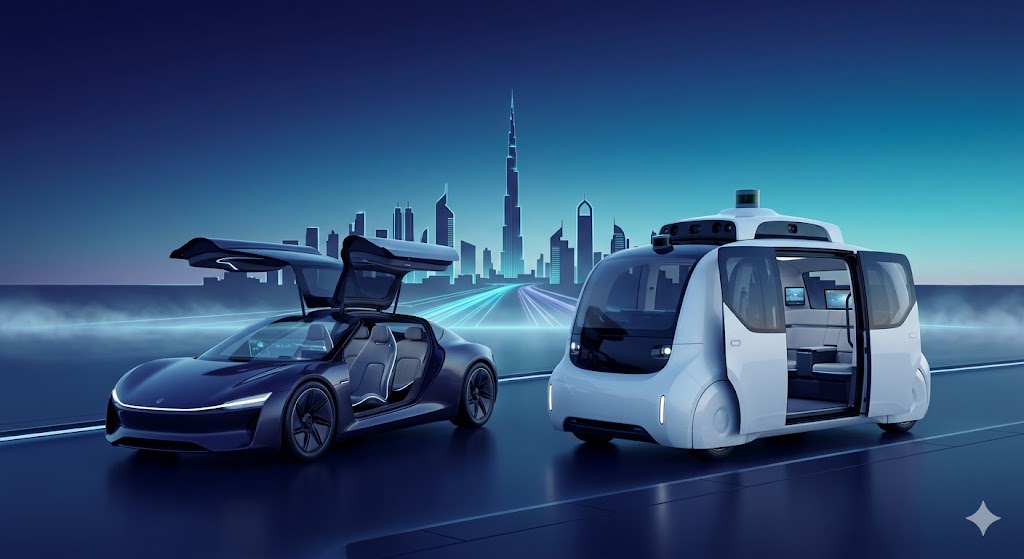
Tesla Cybercab UAE 2026.
The first full specifications of the Tesla Cybercab leaked through an EPA filing this month, and they confirm what the company has been hinting at for two years. A 48 kWh battery pack built on Tesla’s 4680 cells. Front-wheel drive. A single AC permanent magnet motor producing 163 kW, around 219 hp. Curb weight under 1,420 kg. Real-world range close to 300 miles. 165 watt-hours per mile of efficiency.
And the design details that make it different from every other car on sale. No steering wheel. No pedals. Two seats. Butterfly doors. Wireless charging as the primary interface with a backup port hidden in the rear bumper. Color-injected body panels so the factory needs no paint shop. A 21 inch main display. Automatic camera washers on every exterior camera. Braille on the door handles and emergency stop buttons for blind and visually impaired riders.
Elon Musk has confirmed across multiple appearances that the Cybercab will be available for personal purchase, not just as part of a Tesla-run fleet. That single decision is the part of the story most coverage is missing.
Because for the first time in the history of consumer cars, owning a vehicle and driving a vehicle are about to become two different decisions. And the UAE is the country building the regulatory rails for that distinction faster than anywhere else.
| VERDICT: The Cybercab is the most ambitious consumer car launch in a decade. The specifications are credible. The unboxed manufacturing process is unproven at volume. The case for personal ownership is real. The case against, in a country like the UAE that already runs three commercial robotaxi services, is also real. And the Waymo question, why the world’s most successful autonomous fleet operator is absent from Dubai, is the one the next 18 months will answer. |
What Tesla Just Confirmed
The specifications break down cleanly. The Cybercab is a small, low-mass, single-motor coupe optimised for fleet economics. A 48 kWh battery is roughly the size of a Model 3 Standard Range, which means the energy cost per kilometre is competitive with anything in the segment. 165 watt-hours per mile of efficiency is genuinely good. The vehicle is designed to drive itself for thousands of kilometres a week, so efficiency is not a vanity number. It is the unit economics of a transport business.
The unboxed manufacturing process is the more interesting confirmation. Tesla is building this car the way Apple builds iPhones. Modular sub-assemblies arrive at a central line and are combined in seconds, rather than the traditional process of stamping a body, painting it, dropping in a powertrain, and bolting on a battery. Musk says the target cycle time is under ten seconds per unit. If that holds, the production volume potential is something the auto industry has not seen before.
Holding is the operative word. Tesla has missed every major production timeline it has set in the last decade. The official Cybercab launch window is before 2027. The realistic launch window is sometime in 2027 or 2028, with the first deliveries in selected markets only.
What Personal Ownership Actually Means
For most coverage, this is where the story ends. For UAE consumers, this is where it begins.
A Cybercab cannot drive itself if regulators do not allow it to. Tesla cannot fit one with a steering wheel and tell you to drive it home, because the vehicle does not have one. The car only exists as an autonomous vehicle, in jurisdictions where autonomous vehicles are legally permitted on public roads for personal use.
Today that list is short. The UAE is on it. The RTA already approved WeRide and Uber to operate fully driverless commercial passenger service from March 31, 2026, with no vehicle operator on board. Baidu Apollo Go has approval for 65 locations across Dubai with commercial launch in Q1 2026 and a target fleet of more than 1,000 vehicles. Pony.ai is in driverless trials with a fare-charging service planned for later this year. The regulatory infrastructure to allow a privately-owned Cybercab to operate in Dubai is, in principle, being built right now.
The question is whether RTA will extend the same approvals to personal vehicles that it has extended to commercial fleets. Fleet operators provide a single point of accountability, a single insurance regime, and a single set of operational standards. A million privately-owned Cybercabs in private hands do not. This is the licensing question that every country will eventually have to answer. The UAE will answer it first.
The Waymo Question Nobody Is Asking in Dubai
Waymo is, on every operational measure that matters, the most successful autonomous vehicle company in the world. 500,000 paid rides a week. More than 3,000 vehicles deployed across 10 US cities. 10 million paid rides since 2020. Expansion plans for London and Tokyo plus 20+ more cities in 2026. A target of one million rides per week by year end.
Waymo is also conspicuously absent from Dubai.
That is the interesting part of the story for UAE consumers. The companies winning the public licences in Dubai are Chinese. WeRide. Baidu Apollo Go. Pony.ai. The American champion of autonomous mobility is busy expanding to London and Tokyo while the country with arguably the most autonomous-friendly regulatory environment in the world is choosing partners from a different ecosystem.
There are clean operational explanations. Waymo’s deployment model is heavy on local mapping, local fleet operations, and proprietary lidar hardware that ships from a single supply chain. The Chinese fleets are designed for deployment-at-distance from the start. They scale through partnerships with operators like Uber and Tawasul. For a country building autonomy at speed, the Chinese stack is the easier procurement.
There is also a less clean explanation. US-China technology competition is reshaping which AI systems and which sensor stacks end up trusted in which countries. The UAE has built relationships with both sides. The robotaxi market is the first place that bifurcation is showing up at consumer scale. If Waymo wants in, it will need to move. The longer the gap persists, the more structural it becomes.
The Vision-Only Question in Dubai’s Climate
The technology divide between Tesla and Waymo is real. Tesla’s full self-driving system uses only cameras. No lidar. No radar. Musk’s argument is that a self-driving system needs to do what a human driver does, and humans do it with two eyes. Waymo and the Chinese fleets use cameras, lidar, and radar together. Their argument is that humans crash because they only have two eyes.
Dubai’s climate is the unintentionally perfect place to test which argument is right.
Sandstorms cut visibility. Lidar struggles in dense particulate. Cameras struggle in low contrast. Both struggle when caked in dust. The 50 degree summer heat affects sensor calibration. The intense glare around midday near coastal districts pushes camera-only systems into the kind of edge cases that engineers in Mountain View have never had to design for. Tesla’s automatic camera washers on every exterior camera, confirmed in the Cybercab spec, suggest the company is already designing for exactly these conditions.
Whichever sensor stack proves resilient in the UAE in 2026 will define the consensus stack for the next decade. That is genuinely valuable testing data that the Western tech press is undercovering.
Why the Cybertruck Deliveries to the UAE Matter
Tesla disclosed in its most recent SEC filing that Cybertruck deliveries to the UAE have begun. That detail looks like a footnote. It is not.
Personal autonomous vehicle ownership is only possible in markets where the manufacturer has a credible service network, a software update infrastructure, and a charging footprint. Cybertruck deliveries are the proving ground for all three. If Tesla can run a service operation for the Cybertruck across the seven emirates, it can run one for the Cybercab. If it cannot, the Cybercab launch in the UAE is delayed by years regardless of what the RTA approves.
Watch the service centre rollout, the supercharger build-out, and the warranty experience of the first wave of UAE Cybertruck owners through 2026. That is the leading indicator for whether a privately-owned Cybercab is realistic in this market by 2028.
What This Means for UAE Drivers
Four practical things follow.
Robotaxi pricing will compress fast. WeRide is operating in tourist zones at premium prices today. Apollo Go, Pony.ai, and additional WeRide expansion will create price competition through 2026 and 2027. Expect autonomous ride prices to settle 15 % to 25 % below human-driven Uber and Careem by the end of 2027 in approved zones.
The personal car decision is about to change. If a Cybercab arrives in the UAE in 2027 or 2028 at the rumoured price of around USD 30,000, it will be the cheapest fully autonomous vehicle on sale anywhere. Whether you can actually use it autonomously will depend on how the RTA extends licensing from fleet to personal use.
Insurance will get strange before it gets simple. A car with no steering wheel cannot be at fault in the way a driver is. UAE insurers will need to write new policies that treat the manufacturer, the software provider, and the owner as a single risk pool. Some of the early Cybercab buyers in this market will pay a premium for that uncertainty until the rules settle.
The Waymo gap may close. If London and Tokyo go well in 2026, Waymo will run out of obvious next markets and Dubai becomes harder to ignore. A four-way competition between Tesla, Waymo, Apollo Go, and WeRide on UAE streets is the scenario that delivers the best consumer outcomes. Cheaper rides, faster innovation, more accountability when something goes wrong.
The Honest Read
The Cybercab is the most exciting consumer vehicle launch since the iPhone, and the most likely to slip its timeline. The specifications are real. The manufacturing process is unproven. The personal ownership case is genuinely new. The regulatory case in the UAE specifically is closer to ready than almost anywhere else.
Waymo is the company actually delivering autonomous miles at scale, and the only major autonomous operator missing from the UAE. That absence is becoming structural the longer it persists.
The UAE is the most permissive autonomous market in the world right now, and the consumer benefit will be real. Lower prices on shared rides through 2026 and 2027. A genuine ownership decision for the Cybercab class of vehicle by 2028. Sensor stacks tested in conditions no Western city offers. A licensing template the rest of the world will copy.
The Bottom Line
The interesting question is not whether autonomous cars are coming. They are already here. WeRide drove a paying customer through Jumeirah this morning. Apollo Go and Pony.ai are weeks away from their own commercial launches. Tesla just confirmed the specs of the vehicle that will let private owners join that party.
The interesting question is which country builds the rules, the licensing, and the operational culture for the world the autonomous car creates. Today, on that question, the UAE is ahead of every Western government, every Asian capital, and every consumer market that talks louder than it ships.
The future of the steering wheel ends in Dubai before it ends anywhere else.
Sources
Tesla Q1 2026 earnings call: Cybercab production confirmation
Tesla SEC 8-K filing Q1 2026: Cybertruck UAE deliveries begin, Cybercab pilot production at Giga Texas
Automotive World: EPA filing reveals Tesla Cybercab full specifications, June 2026
TechCrunch and IndexBox: Waymo 500,000 paid rides per week, 10 US cities, March 2026
CNBC: Waymo 2026 expansion plans, London and Tokyo, 20+ new cities
WeRide and Uber: Fully driverless robotaxi fare-charging operations launched in Dubai, March 31 2026
Gulf News: Dubai RTA reveals 65-location rollout for Baidu Apollo Go
Automotive World: Pony.ai eyes 2026 commercial robotaxi launch in Dubai
X / niccruzpatane thread, June 2026: leaked Cybercab spec summary
Robius.news — Dubai, UAE — 2026 | Built to be first. Built to be trusted.