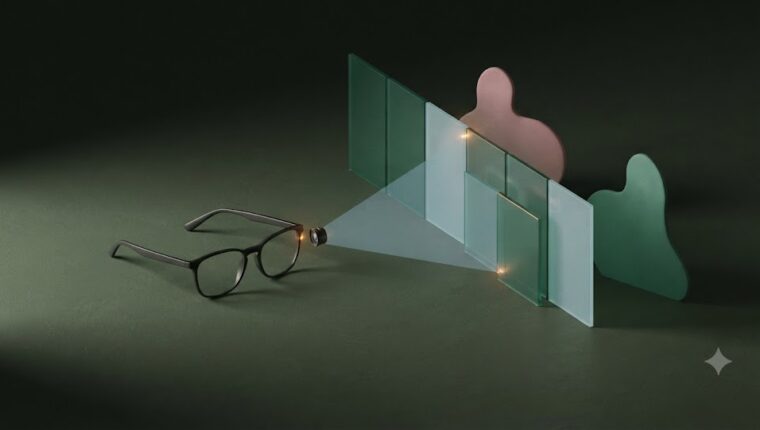


Samsung AI glasses Gemini
Samsung’s new AI glasses will not show you anything. There is no display, no projected screen, no overlay on the world. Every answer arrives as audio, spoken into your ear.
That sounds like a limitation. It is actually the most interesting design decision in the product, and it tells you what Samsung thinks these glasses are for.
They were introduced at the London Unpacked event on 22 July 2026, built with Google, and are due to launch in autumn. Here is what they actually do, and the question worth asking first.
| THE ROBIUS VERDICT: A camera on your face and an AI in your ear is genuinely useful and genuinely sensitive. Understand both halves before you buy a pair. Samsung’s intelligent eyewear runs Google’s Android XR with Gemini built in, developed with eyewear brands Gentle Monster and Warby Parker. There is no display in this first generation, so all output is audio. A built-in camera gives Gemini visual context, letting it answer questions about what you are looking at, translate, navigate, and capture notes. Samsung reports up to nine hours of battery, with the case providing several more charges. Full launch is set for autumn 2026. |
What They Actually Do
The core idea is hands-free assistance without pulling out your phone. Samsung frames these as an extension of the Galaxy ecosystem for ordinary moments, such as commuting, working, and navigating, rather than as a headset or a gaming device.
Because a camera supplies visual context, Gemini can respond to what is actually in front of you. Samsung reports the glasses can summarize long messages, read information aloud, translate conversations in real time, and provide navigation guidance without you looking at a screen at all.
There are also more specific tricks. Samsung says the glasses can capture information from a whiteboard or a meeting and organise it into Samsung Notes, and share your live point of view during a video call. Control is by voice or gesture through connected Galaxy devices.
On hardware, Samsung reports up to nine hours of use on a charge, with the charging case supplying several additional full charges. They run on Qualcomm’s Snapdragon AR1 Gen 1 platform. Google has said the glasses pair with both Android and iOS phones, which widens the audience considerably.
Why No Display Is the Real Decision
Leaving out a screen sounds like a compromise, and in some ways it is. But it changes what the product is. A display invites you to look at the glasses. Audio-only invites you to keep looking at the world while the assistant works in the background.
It also solves practical problems. Displays consume battery, add weight, and make frames look like equipment rather than eyewear. Samsung partnered with two fashion eyewear brands specifically so the glasses read as normal glasses, which only works if there is nothing glowing in the lens.
The honest trade-off is that anything visual becomes awkward. Directions you would rather see than hear, or a translation you want to read, both work less well as speech. This first generation is betting that ambient, spoken help is more useful day to day than a small screen on your face.
How This Differs From Earbuds With an Assistant
It is a fair question, since most people already have a voice assistant in their ears. The difference is the camera. An earbud assistant hears you but cannot see anything, so it can only work from what you describe to it.
| Earbuds with an assistant | AI glasses with a camera | |
|---|---|---|
| Input | Your voice only | Your voice plus what you are looking at |
| Can answer “what is this?” | Only if you describe it | Yes, from the camera view |
| Live translation of signage | No | Yes, using visual context |
| Privacy footprint | Microphone | Microphone and camera |
That last row is the trade. Visual context is exactly what makes the glasses more capable than earbuds, and it is also exactly what makes them more sensitive. You cannot have the first without accepting the second, so it deserves a clear-eyed decision rather than an impulse purchase.
The Question Worth Asking Early
Robius is not going to tell you camera glasses are sinister. They are a legitimate product category, Samsung is a serious manufacturer, and the utility is real. But a camera worn at eye level in public raises a question any advanced system anywhere would need to answer well.
That question is simple. What is captured, what leaves the device, where is it processed, and how long is it kept? Those answers matter more than any feature on the spec sheet, and they are worth reading in the product’s own privacy documentation before you buy rather than after.
There is a courtesy layer too. The people around you did not choose to be near a camera. Whatever the technology allows, the social norms in a mall, a majlis, a gym, or a workplace still apply, and the UAE takes personal privacy seriously in law and in custom.
The UAE Angle
This is a genuinely interesting product for this market. The UAE is a high-adoption country for new consumer technology, with a multilingual population that would get real daily value from live translation and hands-free navigation.
It also lands as the country invests heavily in AI infrastructure. Devices like these are the visible consumer edge of that buildout, the point where large-scale AI stops being a data centre story and starts being something sitting on your face at breakfast.
Two practical notes before you plan a purchase. Samsung has confirmed an autumn 2026 launch, but regional availability and UAE pricing were not published at the time of writing. And camera-equipped wearables sit within UAE privacy rules like any other recording device.
The Bottom Line
Samsung has built the most mainstream-looking AI glasses yet, and the no-display choice makes them feel like eyewear rather than equipment. For hands-free translation, navigation, and quick answers, the everyday case is easy to see.
So treat this as a real product with a real trade. You gain an assistant that can see what you see. You accept a camera and microphone you wear in public. Read the privacy terms, wait for UAE availability, and buy deliberately rather than on launch-day excitement.
Sources
- PhoneArena: Samsung intelligent eyewear: Android XR with Gemini, Gentle Monster and Warby Parker designs, no display and audio-only output — https://www.phonearena.com/news/everything-samsung-announced-at-galaxy-unpacked-july-2026-fold-8-flip-8-watch-9-and-more_id182052
- GadgetMatch: Battery life, Snapdragon AR1 Gen 1 platform, camera-based visual context, and note capture features — https://www.gadgetmatch.com/samsung-unveils-intelligent-eyewear-with-gentle-monster-warby-parker/
- Digital Trends: The two frame designs, and the navigation, translation and messaging use cases — https://www.digitaltrends.com/wearables/samsung-enters-the-ai-glasses-race-with-gemini-powered-intelligent-eyewear-and-android-xr-support/
- The Gadgeteer: Confirmation the glasses pair with both Android and iOS, and the wider Galaxy AI strategy — https://the-gadgeteer.com/2026/07/22/samsungs-galaxy-watch-9-and-ai-glasses-reveal-its-bigger-unpacked-plan/
Robius.news — Dubai, UAE — 2026 | Built to be first. Built to be trusted.