

Apple price increase UAE 2026 memory shortage
The AI data centers you keep reading about just reached into your pocket. Your next MacBook is the proof. On 25 June 2026, Apple raised prices across most of its Mac and iPad lineup. In the UAE, the MacBook Air with the M5 chip jumped from Dh4,599 to Dh5,499. The M5 iPad Pro climbed from Dh4,199 to Dh4,999.
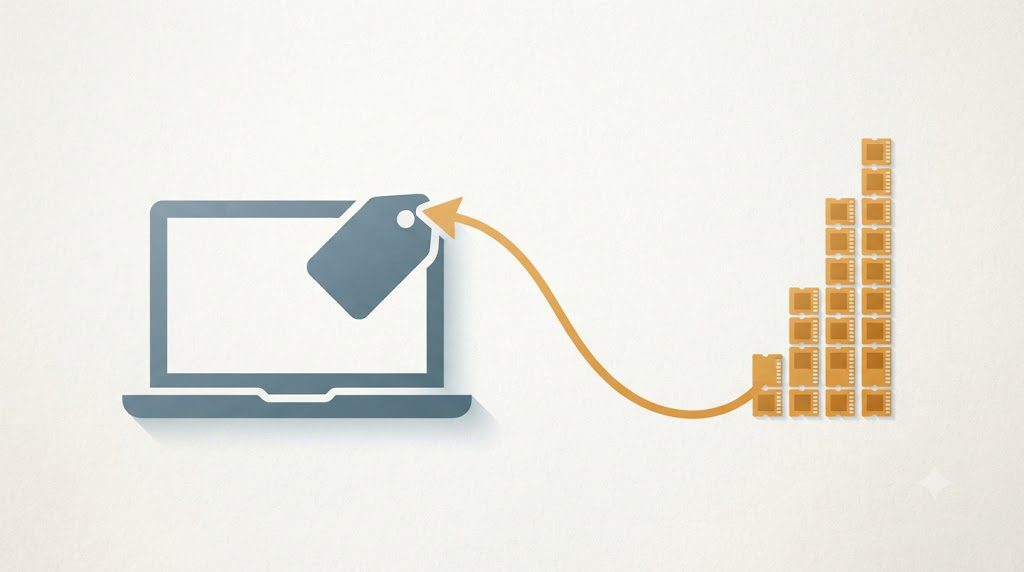
The reason is not greed, and it is not tariffs. It is a memory shortage caused by the AI boom itself. Here is what actually changed, and how to spend smartly around it.
| THE ROBIUS VERDICT: Apple raised prices because AI data centers are consuming the world’s memory chips. But part of the increase buys you more storage, so read the specs before you assume you are being overcharged. Apple raised prices on Mac, iPad, Apple TV, HomePod, and Vision Pro on 25 June 2026, citing a surge in memory and storage costs. The iPhone was spared for now, though analysts expect it to rise later this year. The cause is real: contract memory prices roughly quadrupled over three quarters as chipmakers diverted supply to AI servers. The nuance most coverage skips is that Apple also doubled the base storage on much of the lineup, so on several models you are paying more and getting more. |
What Actually Happened
Apple almost never raises prices mid-cycle. On 25 June 2026, it did, across nearly its entire hardware range at once. The increases hit the Mac, iPad, Apple TV, HomePod, HomePod mini, and Vision Pro. The iPhone was left untouched for now. Apple’s own shares fell about 6% on the news, their worst day in more than a year, which tells you the market did not read this as a routine bump.
In the UAE specifically, the MacBook Air with the M5 chip saw the steepest local rise, from Dh4,599 to Dh5,499. The M5 iPad Pro went from Dh4,199 to Dh4,999.
Why It Happened: The AI Connection
This is the part that makes it a Robius story rather than a gadget story. The cause traces straight back to artificial intelligence.
Every AI data center being built right now needs enormous quantities of memory and storage chips. That demand has drained the same supply that goes into laptops and tablets. Contract prices for DRAM memory jumped around 90% in the first quarter of 2026 and another 60% in the second, according to TrendForce. By Apple’s own framing, memory and storage now cost roughly four times what they did three quarters earlier.
Apple’s chief executive, Tim Cook, called it a hundred-year flood. In the company’s words, it had never seen a component price increase this much, this quickly. The AI infrastructure race, in other words, is now showing up on consumer price tags.
The Nuance Most Coverage Skips
Here is where a lazy headline misleads you. It is not simply the same laptop for more money, at least not everywhere in the lineup. Apple doubled the base storage on much of the range at the same time. The MacBook Air moved to 512GB as standard, up from 256GB. Most MacBook Pro configurations now start at 1TB, up from 512GB. So on those models, you are paying more and getting more, which is a genuinely different thing from a pure price hike.
The honest read sits in the middle. Some of the increase is Apple passing on a real cost shock. Some of it comes bundled with extra storage you may or may not need. Knowing which is which is what stops you overpaying.
What It Means for the iPhone
The iPhone escaped this round, but do not assume it is safe. Analysts widely expect iPhone prices to rise later in 2026. One industry analyst suggested the increase on the Pro and Pro Max models could reach as much as $200, and noted the era of small $50 rises is likely over. If you were planning an iPhone upgrade, the calculus is simple. Prices are more likely to go up than down from here.
Before vs After, and Why
| What you might assume | What is actually true |
|---|---|
| Apple is just raising margins | Memory costs roughly quadrupled in three quarters |
| Same device, higher price | Base storage doubled on much of the lineup |
| The iPhone is next, for sure | Expected to rise, but not confirmed yet |
| It will settle down soon | Driven by AI demand with no quick fix in sight |
What UAE Buyers Should Actually Do
This is a cost shock you can navigate, not just absorb. A few decisions make a real difference.
- If you need a machine now, compare the new base storage against the old. On models where storage doubled, the value gap is smaller than the price gap suggests.
- Be ruthless about configuration upgrades. Adding memory or storage at checkout is where the cost climbs fastest, and it is the least reversible choice you make.
- If you do not need to buy today, waiting is reasonable, but do not expect prices to fall soon. This is a supply problem, not a sale cycle.
- Consider the prior generation or a certified pre-owned model, where you may find the old pricing and specs that suit you.
- For a business, factor this into your device refresh budget now, because the same memory shortage is pushing up the cost of almost all computing hardware, not just Apple’s.
The Bigger Picture
Step back and this is a small, tangible preview of a large shift. The infrastructure being built to power AI is not free, and its costs do not stay inside data centres.
The UAE is investing heavily in exactly this kind of AI infrastructure, which makes the trade visible here more than most places. Cheaper, more capable AI on one side. Pricier memory in the devices you actually hold on the other. Both are the same story, seen from two ends.
The Bottom Line
Your MacBook got more expensive because the world is building AI as fast as it can, and that build is eating the memory supply. That is a real cost, honestly explained by Apple for once.
So do not panic-buy, and do not assume you are being fleeced. Check whether the storage changed, resist the checkout upgrades, and time your purchase to your need rather than to a headline. The AI boom is now a line item in your budget. Treat it like one.
Sources
- The National: UAE-specific price changes: MacBook Air M5 from Dh4,599 to Dh5,499, and M5 iPad Pro from Dh4,199 to Dh4,999 — https://www.thenationalnews.com/future/technology/2026/06/25/some-apple-products-just-got-more-expensive-in-the-uae/
- CNBC: The 25 June 2026 hikes, Apple’s worst market day in over a year, and Cook’s hundred-year-flood remark — https://www.cnbc.com/2026/06/25/apple-macbook-ipad-price-hike-memory.html
- PBS News: Specific model price changes and analyst expectations of iPhone increases later in 2026 — https://www.pbs.org/newshour/economy/apple-increases-prices-for-macs-and-ipads-blaming-memory-chip-shortage-fueled-by-ai
- New York Post: The doubled base storage across much of the lineup, and the DRAM and NAND supply diversion to AI data centres — https://nypost.com/2026/06/25/business/heres-how-much-apple-is-raising-prices-on-macbook-air-pro-models/
Robius.news — Dubai, UAE — 2026 | Built to be first. Built to be trusted.