

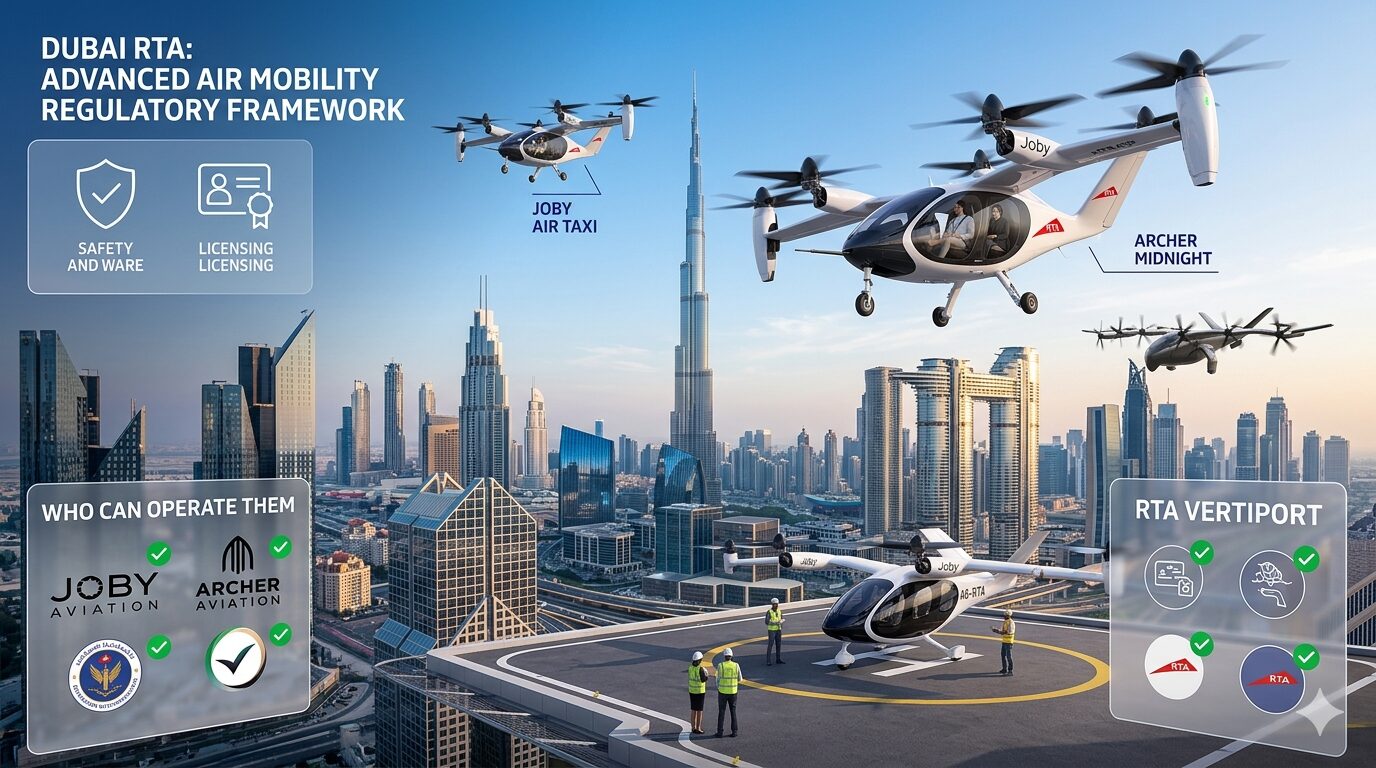
Flying taxis Dubai regulation
The UAE GCAA just approved the first flying taxi framework. We break down how they’ll work, who can get licenses, and when you might actually catch a ride.
The announcement that most people missed
In April 2026, the UAE General Civil Aviation Authority (GCAA) quietly published an Advanced Air Mobility (AAM) regulatory framework. It was not a press release. It was a 47-page technical document published on the GCAA website with minimal fanfare. But it’s the most important aviation development in the UAE since drones were regulated.
The framework essentially legalizes flying taxis. Not in theory. In practice. With timelines, licensing requirements, and operational corridors.
What exactly is a flying taxi?
A flying taxi is an autonomous or piloted electric vertical takeoff and landing (eVTOL) aircraft. Think helicopter-size, but electric, unmanned or single-pilot, optimized for urban transport. Typical specs:
- Passenger capacity: 2-5 people
- Range: 25-50 kilometers on a charge
- Speed: 100-200 km/h
- Takeoff/landing: Vertical (no runway needed)
- Autonomy: Fully autonomous or remote-piloted (no pilot in aircraft)
Companies building these: Joby, Archer, Lilium, EHang, and a dozen others globally. Several have operations in China. Some have test flights in the US and Europe. The UAE just made them legal to operate.
How they’ll actually work in Dubai
Operational corridors
Flying taxis won’t operate everywhere. The GCAA designated 6 initial ‘aerial corridors’ connecting major areas:
- Dubai International Airport ↔ Downtown Dubai (8km)
- Dubai Marina ↔ Downtown (6km)
- Downtown ↔ Business Bay (4km)
- Jumeirah ↔ Downtown (12km)
- DIFC ↔ Downtown (3km)
- Dubai Hills Estate ↔ Downtown (9km)
Flying taxis can only operate on these pre-approved routes. Think of them as ‘air highways’ with predefined paths.
Vertiports
Flying taxis need landing/takeoff sites called ‘vertiports.’ The GCAA approved 12 vertiport locations initially, mostly on existing building rooftops and designated open areas. Operators must build/maintain these facilities. Cost is estimated at AED 50-100M per vertiport.
Traffic management
All flying taxis are tracked real-time via a new ‘U-Space’ system managed by GCAA. This is essentially air traffic control for flying taxis. Every aircraft’s location, altitude, and flight path is monitored. Collision avoidance is automated. Operator input comes through a centralized platform, not individual radio comms.
Operating hours
Initial phase: 7 AM to 10 PM only. No night operations until safety data supports 24-hour use.
Who can get a license to operate
The requirements
To operate a flying taxi service in Dubai, an operator must:
- Be incorporated as a UAE registered entity (or international company with UAE subsidiary)
- Have AED 500M+ in funded capital OR insurance bonding equivalent
- Have 5+ years of aerospace/aviation operating experience (as company)
- Have ICAO-certified pilots/remote pilots on staff
- Have completed GCAA safety training and certification program
- Have aircraft that meet GCAA airworthiness standards (eVTOL-specific)
- Have liability insurance minimum AED 2B per incident
- Submit detailed safety and operational plan for GCAA approval
Who’s actually eligible
In practice, very few companies qualify:
✅ Major aviation companies: Emirates, Etihad, Air Arabia (have capital, experience, insurance capacity)
✅ Major transportation companies: Emirates Transport, Serco, Emtrack (have logistics networks, operational experience)
✅ International eVTOL manufacturers with UAE presence: Joby, Archer, EHang (if they partner with a UAE entity meeting capital requirements)
✅ UAE sovereign wealth funds and investment vehicles: Mubadala, PIF subsidiaries (have capital, can absorb losses during pilot phase)
❌ Startups: Cannot qualify due to capital and experience requirements
❌ Smaller regional airlines: Likely cannot meet AED 500M capital requirement
❌ Uber/Bolt/Careem: Could theoretically apply but would need UAE-registered subsidiary meeting all requirements
The timeline
GCAA published a phased rollout:
Phase 1 (2026-2027): Pilots and demonstration
One operator (currently in negotiations, likely a major airline or investment fund) begins limited operations on 1-2 corridors. Limited passengers (50-100 per day max). Focus on safety data collection and public perception.
Phase 2 (2028): Expansion
2-3 operators permitted if Phase 1 data is positive. Operations expand to 4-6 corridors. Passenger limits increase. Commercial pricing begins.
Phase 3 (2029+): Scale
Up to 5-6 operators. Most corridors active. Full commercial operations. Pricing normalizes.
The economics: will it be affordable?
Initial estimates for Phase 1:
- Dubai Airport ↔ Downtown: AED 500-800 per seat (roughly Uber Black pricing)
- Marina ↔ Downtown: AED 300-400 per seat
- Short trips (3-5km): AED 150-250 per seat
For context: Uber Black from airport to downtown costs AED 150-200 and takes 30-45 minutes. Flying taxi: AED 600-800, takes 8 minutes. The premium is steep but not unreasonable for premium travel.
Phase 1 will be expensive and targeting wealthy travelers and business users. Mass market adoption (where flying taxis are cheaper than cars) is 5-10 years away at best.
What happens to other transportation?
Flying taxis won’t replace taxis, Uber, or buses. They’re complementary:
- Airport to Downtown: flying taxi wins (speed) vs Uber (cost)
- Commute in traffic: flying taxi wins (no traffic) vs driving
- Local travel (1-3km): Uber/walking/metro wins (cost)
- Long distance (>50km): Car/highway wins (range/cost)
Flying taxis fill a specific niche: high-value time-sensitive trips where traffic is problematic.
The AI angle
Flying taxis are AI-heavy: autonomous flight control, collision avoidance, route optimization, traffic coordination — all AI-powered. The GCAA framework implicitly approves autonomous aircraft, which is a significant regulatory milestone. Most countries haven’t done this yet.
For the broader AI story: the UAE is one of the first jurisdictions to say ‘fully autonomous aircraft are okay.’ This positions the UAE as legitimately forward-thinking on AI regulation (as opposed to just claiming to be).
When will you actually ride one?
If you live in Dubai and are wealthy/impatient: 2027 earliest, realistically 2028-2029.
If you’re middle-class: Don’t expect affordability until 2032-2035.
If you’re counting on this replacing Uber: It won’t. Ever. The economics don’t work for mass-market ridesharing.
Robius.news — Dubai, UAE — 2026 | Built to be first. Built to be trusted