 UAE, UNFILTERED
Inside Abu Dhabi’s New Tumour Sample Pipeline
Cleveland Clinic Abu Dhabi patients can voluntarily contribute cancer samples to Abu Dhabi Biobank. Here is how sequencing, organoids, consent and research oversight fit together.
Abu Dhabi is building a hospital-to-biobank pathway that can turn routine cancer samples into a long-term research resource under a formal consent and governance framework.
Cancer patients, clinicians, researchers, biotechnology companies and anyone following Abu Dhabi’s precision-health infrastructure.
This is research infrastructure, not a new treatment. Enrollment totals, individual consent terms, return-of-results policies and future clinical benefits have not been established publicly.
Watch for recruitment numbers, cancer types represented, approved studies, peer-reviewed findings and evidence that laboratory results progress into validated clinical use.
Patients invited to participate should ask what is collected, how samples may be used, whether findings are returned, how withdrawal works and who to contact with questions.
A cancer sample taken during a hospital visit can tell researchers much more than whether a tumour is present. Abu Dhabi is now building a more deliberate route for that material to become a long-term research resource, with patient consent at the entrance.
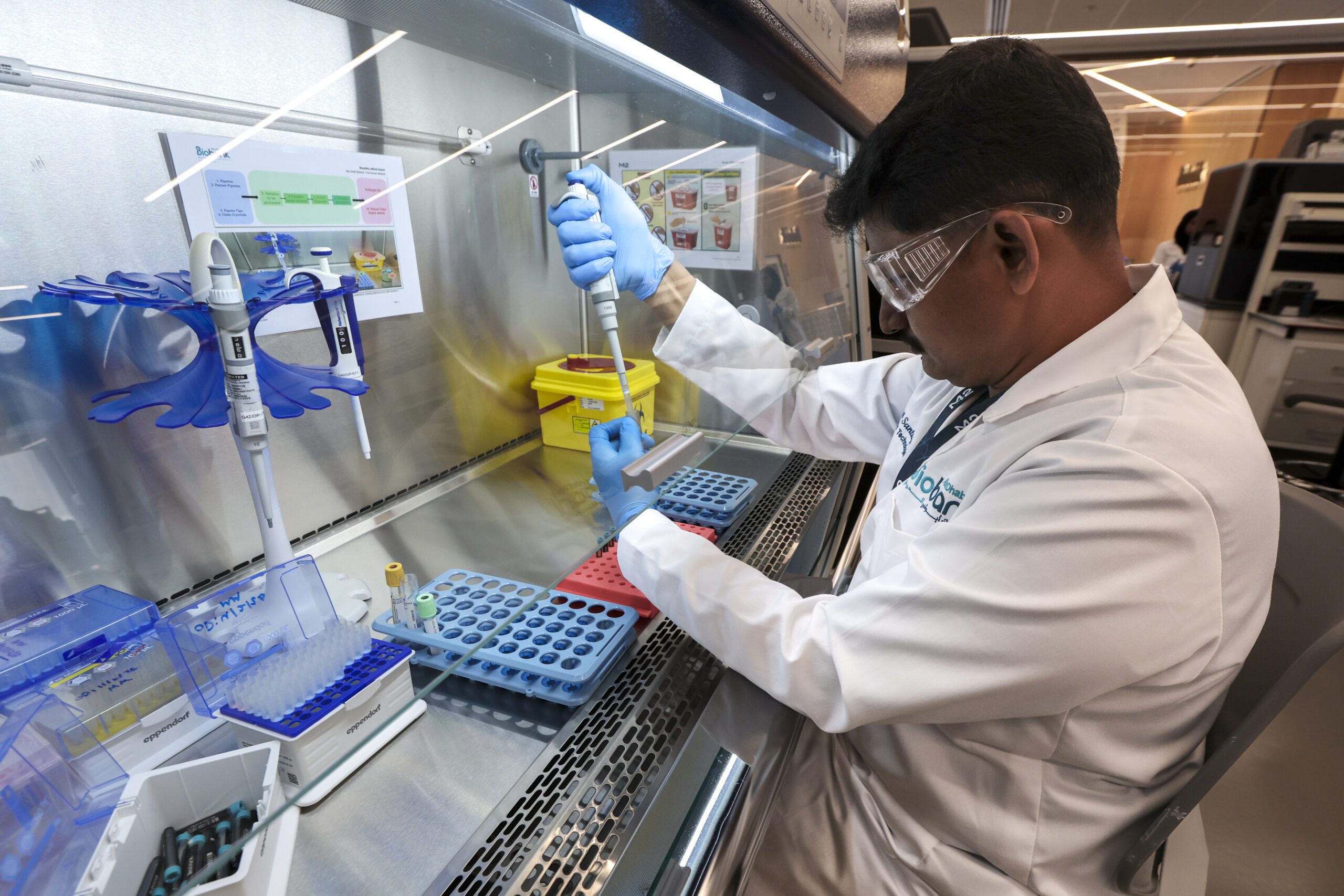
On 13 October 2026, Abu Dhabi Biobank and Cleveland Clinic Abu Dhabi announced an oncology collaboration involving patients at the hospital’s Fatima bint Mubarak Center. Patients will be invited to voluntarily contribute blood and tumour tissue collected during routine medical visits. With informed consent, samples will be transferred to the Biobank for processing, preservation and research. The pilot includes sequencing of tumour tissue from consenting participants and aims to support laboratory models derived from patients’ tumours.
That is a meaningful infrastructure change, but it is not a new cancer cure or a promise of a personalised treatment for every donor. For UAE patients, the immediate question is what a sample can be used for, who can access it, whether research findings come back to the donor and how consent can be withdrawn. For hospitals and researchers, the test is whether carefully governed samples can generate evidence strong enough to improve clinical decisions later.
A hospital visit becomes a research pathway
The announcement connects two different parts of the healthcare system. Cleveland Clinic Abu Dhabi supplies the clinical relationship, including patients, treatment histories and tumour material. Abu Dhabi Biobank, a Department of Health – Abu Dhabi and M42 initiative, supplies the specialised infrastructure for handling biological specimens and linked health information over time.
Patients at the Fatima bint Mubarak Center are invited to take part voluntarily. The official statement describes blood and tumour tissue collected during routine care, then transferred securely after consent. It does not specify the pilot’s planned number of participants, the exact recruitment timetable or a new procedure required of every patient. Nor does it say that participation is a condition of treatment. Those gaps matter because a research invitation must not be mistaken for a mandatory part of cancer care.
The study is intended to include multiple cancer types, including breast and pancreatic cancers. Its announced scope is broad, but the evidence base will depend on which patients actually participate, the quality of their samples and the clinical information researchers can legitimately connect to those samples. A freezer full of tissue is not automatically a representative research cohort.
Why sequencing and organoids belong in the same story
Two scientific capabilities make this more than a storage arrangement. The first is somatic sequencing of tumour tissue, which the announcement says is included for all consenting pilot participants. Somatic changes are alterations found in tumour cells; they are not the same thing as inherited variants carried throughout a person’s body. That distinction matters when someone hears the word ‘genetics’ and assumes a research result automatically describes their family’s inherited cancer risk.
The second capability is the possible development of patient-derived organoids, laboratory-grown models made from tumour material. Researchers can use such models to investigate how cancer behaves and explore responses to treatments in controlled conditions. They are research tools, not a guarantee that a particular drug will work for the patient whose tissue supplied the model.
Robius previously examined Abu Dhabi’s collaboration with MIT on cancer research. The new Biobank pathway addresses a different practical constraint: supplying well-characterised local material and clinical context to support research. Computing and sophisticated models are useful only when the biological evidence beneath them is sound.
For patients, the key boundary is between a research finding and a validated clinical test. The official announcement does not say that every donor will receive an organoid, a new genomic report or a treatment recommendation. Any such clinical application would require its own evidence, professional interpretation and relevant approvals.
The five-million figure is capacity, not enrollment
Abu Dhabi Biobank was inaugurated in Masdar City in April 2026. The Department of Health said the facility can store up to five million biological samples and more than 100,000 cord blood samples. Those are infrastructure capacities, not counts of cancer samples collected through today’s partnership. The October statement does not provide a starting inventory for the oncology pilot.
The potential value is in pairing samples with reliable longitudinal information: diagnosis, treatment, outcomes and changes over time. A tumour taken before therapy may answer a different question from one taken after resistance develops. Without consistent documentation and appropriate permissions, comparing the two can produce misleading conclusions.
That is why this project sits alongside, rather than replaces, Abu Dhabi’s digital disease registries. Registries organise clinical information across conditions. A biobank preserves biological material that can be studied alongside approved clinical data. Neither one by itself proves that an AI system, biomarker or treatment is clinically effective.
Officials have also highlighted Abu Dhabi’s population diversity as a reason local research matters. That is a credible research objective, but the mix of nationalities living in the emirate is not proof that the eventual donor cohort will reflect all those communities. Recruitment figures and published study characteristics will be needed before claiming improved representation.
Consent is a process, not a single checkbox
Cleveland Clinic Abu Dhabi’s own August explainer says cancer-biobank donation is voluntary and generally uses material collected during normal medical care. It also distinguishes research donation from a change to the patient’s immediate treatment. The October collaboration explicitly requires informed consent for the new sample pathway.
Abu Dhabi’s Department of Health biobanking standard provides the more useful operational detail. It requires donors to be told the purpose, risks and possible benefits of collection, and it addresses future research use, access to genetic information, withdrawal and the handling of findings that may matter clinically. Research participation should therefore be discussed in terms a patient can understand, not sold as a vague contribution to innovation.
One important nuance is withdrawal. The standard recognises the right to withdraw, but it also describes different withdrawal options and potential limitations once material or data have already been distributed or included in research. A patient should ask which option applies to the consent form in front of them and what happens to previously generated data. The announcement does not publish the pilot’s actual consent form, so Robius cannot claim which options it presents or how individual requests will be processed.
The same caution applies to results. A donor can reasonably ask whether unexpected genetic findings might be communicated, who would interpret them and whether they are intended for clinical care. The standard calls for policies on returning results, but it does not mean every research result will be returned to every participant.
Privacy and research access need separate answers
Biological samples can become unusually sensitive when combined with genomic and clinical data. The Department of Health standard requires privacy safeguards, including de-identification or pseudonymisation, and sets requirements for research approvals and permitted uses. The fact that samples are stored in Abu Dhabi does not by itself answer who may analyse them, under what conditions or whether an international collaboration is proposed.
For research distribution, the DoH framework calls for ethics and regulatory approvals and for uses to remain consistent with informed consent. It also addresses cross-border collaboration and additional permissions. The public partnership announcement says samples will be protected by governance controls, but does not list the research projects, approved recipients, data-access terms or retention schedule for this particular pilot. Those details should not be invented.
The issue resembles the distinction Robius drew in its analysis of Abu Dhabi’s connected patient-safety system: an impressive technical network is only one layer. Trust also depends on definitions, oversight, correction mechanisms and what happens when the system encounters an exception.
Hospitals, researchers and prospective industry collaborators should be able to explain their roles in sample custody, data access and publication. Patients should have a clear contact point for questions or withdrawal requests. This is a practical governance test, not an allegation that the programme has failed it.
What would count as a real result?
Today’s statement announces a pathway and research ambitions. It does not report an oncology trial outcome produced by this collaboration, a clinically validated organoid test or a new approved therapy. The difference is central to evaluating health-technology announcements: infrastructure can be operational long before its benefits become measurable in patients.
Near-term progress would be visible through transparent recruitment numbers, cancer types represented, sample-quality metrics, approved research protocols and a clear description of how tumour sequencing and derived models are being used. Later, the meaningful evidence would be peer-reviewed findings, independently reproducible biomarkers, validated decision tools or clinical trials that connect the laboratory work to patient outcomes.
For biotechnology companies and researchers, the opportunity is access to well-governed, locally relevant research material rather than a blank cheque to use patient data. The official statement does not disclose commercial access fees, intellectual-property arrangements or open applications for external researchers. Those are important business questions for the partners to clarify as the programme develops.
What a patient can ask before donating
A patient approached during a clinical visit does not need to understand every sequencing method to make an informed decision. They should be able to ask what will be collected, whether any extra procedure is involved, how long samples and associated information may be retained, who can use them for future studies and whether consent can be limited or withdrawn. They can also ask how to obtain the participant information sheet, whether findings may be returned and whom to contact with concerns.
Those questions are especially important when the invitation arrives in the middle of cancer treatment, when a person may feel pressure to agree with clinical staff. The official policy requires voluntary participation; declining research is not the same as declining medical care. Patients should confirm the practical details with their treating team rather than relying on a news article as a substitute for the study’s consent documents.
For UAE readers who are not patients, the story is still consequential. Research built from local clinical samples may help address gaps in how cancers affecting the region are understood. But the benefits will depend on consent, representativeness, scientific quality and the ability to turn discoveries into evidence-based care.
Robius’s measure of progress
Abu Dhabi now has a named hospital-to-biobank pathway, a defined research purpose and an existing regulatory framework against which its operation can be assessed. That is more useful than another generic promise that AI will transform medicine. The announcement’s most concrete commitments are voluntary sample contribution, somatic tumour sequencing during the pilot and the intention to support patient-derived laboratory models.
The next story should not be another photograph of a freezer or a larger capacity figure. It should show whether the consent process works in practice, whether the resulting research cohort is scientifically useful and whether findings survive the difficult journey from laboratory observation to validated patient benefit. Until then, this is promising research infrastructure, not a treatment breakthrough.
Sources
- Abu Dhabi Media Office: Abu Dhabi Biobank and Cleveland Clinic Abu Dhabi oncology collaboration, 13 October 2026
- Cleveland Clinic Abu Dhabi: What is a cancer biobank?, 5 August 2026
- Department of Health – Abu Dhabi: Standard for Pan-Human Biobanks, informed consent, privacy and withdrawal requirements
- Department of Health – Abu Dhabi: Inauguration and capacity of Abu Dhabi Biobank, 3 April 2026
- Abu Dhabi Biobank: Pan-human biobank participation and research safeguards
Checked 13 October 2026. The collaboration and pilot activities are confirmed; clinical benefits, enrollment totals and individual consent terms must not be inferred from the announcement.
Robius.news | Dubai, UAE | 2026 | Built to be first. Built to be trusted.