 UAE, UNFILTERED
Abu Dhabi Is Training 20,000 Government Employees in AI. The Real Test Starts After the Course
AiNative will train 20,000 Abu Dhabi government employees with OpenAI, Microsoft and MBZUAI. The harder question is how those skills change real workflows and accountability.
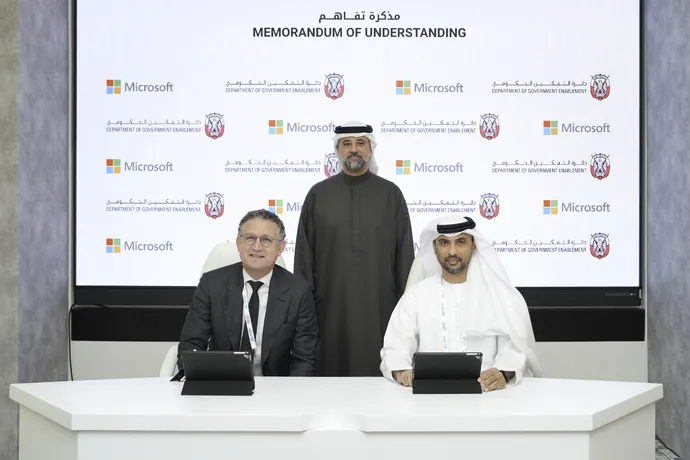
Abu Dhabi is treating practical AI capability as a workforce requirement across government, not a specialist skill limited to technology teams.
Government employees, public-sector leaders, HR and learning teams, AI vendors and residents following Abu Dhabi’s AI-native government strategy.
Course completion does not prove better services. AI outputs can still be wrong, sensitive data can be mishandled and old processes can remain inefficient.
Watch for function-specific certifications, public access through Tomouh and operational metrics showing time saved, errors reduced and workflows redesigned.
Judge the programme by what changes after training: which tasks disappear, which decisions stay human and how employees verify AI-generated work.
Abu Dhabi is preparing to train 20,000 government employees in practical AI use before the end of 2026.
The programme is called AiNative.
It was built with OpenAI, Microsoft and Mohamed bin Zayed University of Artificial Intelligence, and covers tools including ChatGPT, Codex and Microsoft 365 Copilot.
The headline is the scale.
The more important question is what happens when thousands of public-sector employees start using the tools in real work.
This is not just another digital-literacy course
AiNative includes a government learning journey, an executive programme for department leaders and later function-specific certifications in areas such as coding and data.
DGE says the goal is practical use, not theoretical awareness.
That matters because Abu Dhabi has already deployed Microsoft 365 Copilot to 35,000 government employees through the Frontier Employee Programme.
Access to tools came first.
AiNative is intended to build the operating capability around them.
The harder problem is moving from personal productivity to institutional work
An employee using AI to rewrite an email is easy to understand.
An employee using AI to analyse a policy file, summarise a case, draft a recommendation or write code for an internal system raises more difficult questions.
The value can be much higher.
So can the consequences of an error.
Training needs to include judgement, not just prompting
A useful public-sector AI programme should teach more than how to ask a model for a better answer.
Employees need to understand:
- which information may be entered into an approved tool;
- when a model output must be verified independently;
- how to identify hallucinations or unsupported claims;
- which tasks require human approval;
- how generated code or analysis should be reviewed;
- what records need to be preserved for audit or accountability.
Abu Dhabi’s AI-native target makes this operational
Robius has been tracking Abu Dhabi’s target to become an AI-native government by 2027.
That ambition only works if AI capability spreads beyond specialist teams.
A government cannot become AI-native if the tools are available but most employees do not know when to use them, how to verify them or when not to trust them.
Access and training are two different infrastructure layers
The 35,000-employee Copilot rollout provides access.
AiNative provides skills.
The third layer is workflow redesign.
If employees are trained but still have to complete exactly the same forms, approvals and duplicated tasks, the productivity effect will be limited.
The strongest evidence will therefore come from redesigned processes where AI removes work rather than simply helping staff complete old work faster. Robius saw the same distinction in the UAE’s 89% digital-government satisfaction score: the next benchmark is not more technology, but less effort for the user.
Government AI also needs role boundaries
Not every employee should use AI in the same way.
A communications officer, software developer, procurement specialist and regulatory investigator face different risks.
That is why the later function-specific certifications may matter more than the general foundation course.
A mature programme should eventually define AI use by role, data sensitivity and decision impact.
The public version makes the programme unusual
AiNative is not limited to government employees.
Citizens and residents will later be able to access a public learning journey through the Tomouh app using UAE Pass.
The public version will cover everyday uses such as personal finance, running a small business, finding work, studying and creating content responsibly.
DGE says it will use the free version of ChatGPT.
That turns AiNative into both a workforce programme and a broader digital-literacy initiative. It also connects with the direction Robius examined in TAMM 5.0, where government services are moving toward more proactive and context-aware interactions.
What should be measured after 20,000 people finish
Completion numbers are the easiest metric.
They are not the most useful.
Robius would rather see:
- time saved in specific government workflows;
- reduction in repetitive manual tasks;
- error rates before and after AI adoption;
- how often outputs require correction;
- how many processes are redesigned rather than merely accelerated;
- employee confidence in knowing when not to use AI.
The Robius Read
Training 20,000 government employees is significant because Abu Dhabi is treating AI capability as a workforce requirement rather than a specialist skill.
But the course itself is not the transformation.
The transformation begins when employees use those skills inside real workflows with clear data rules, verification steps and accountability.
The best outcome would not be 20,000 people who know how to prompt ChatGPT.
It would be 20,000 people who know when AI can remove work, when it needs checking and when a human decision must remain human.
Sources
Checked 14 October 2026. AiNative is being rolled out in phases, with an initial government pilot already under way before public access begins.
Robius.news | Dubai, UAE | 2026 | Built to be first. Built to be trusted.