
AI CEOs G7 message world leaders
Do not cede your responsibilities to AI labs like mine. That is what Sam Altman told the assembled leaders of the G7 this week, in the same Alpine room where the UAE sat as an invited guest and where, five days earlier, Washington had switched off access to one of the world’s most advanced AI models without warning anyone in the room first.
It was an extraordinary thing for the head of the world’s most prominent AI company to say out loud. And it was not the only uncomfortable line delivered at that lunch.
| VERDICT: The people building frontier AI just told world leaders their own industry cannot be trusted to govern itself, then proposed a system in which their own companies and home government would do exactly that. At a closed-door working lunch on the final day of the G7 summit, the CEOs of OpenAI, Anthropic, and Google DeepMind warned that AI could soon become the dominant source of economic and military power on Earth, and called for urgent international governance. In the same breath, two of them proposed a US-led coalition to control global access to the technology. No binding outcome emerged. The tension between the warning and the proposed solution is the real story, and the UAE, present at the same summit, has more at stake in how it resolves than most coverage has acknowledged. |
What Was Actually Said
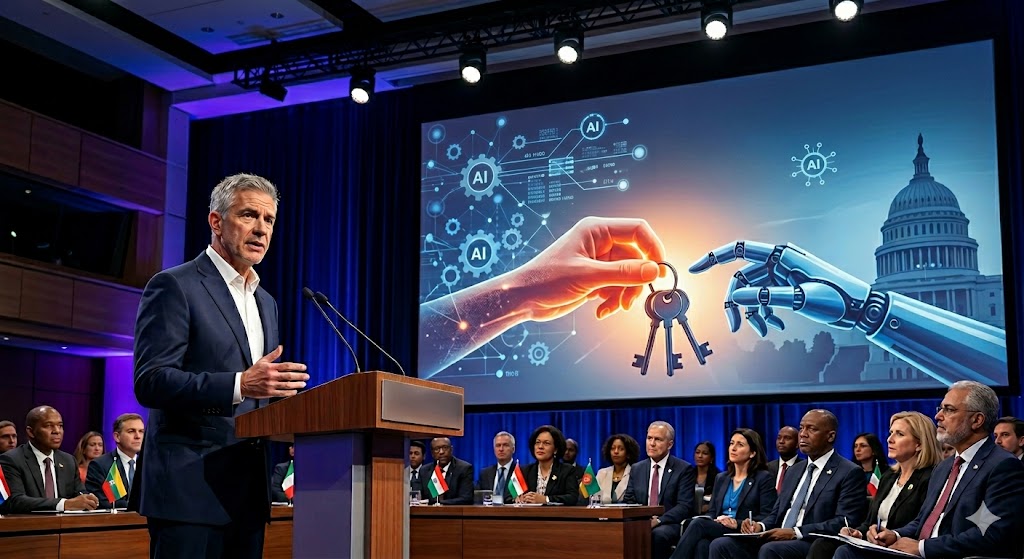
The setting was a working lunch on June 17, the final day of the three-day G7 summit in Évian-les-Bains, France. Around a dozen technology executives joined G7 heads of state, including President Trump, Treasury Secretary Scott Bessent, Commerce Secretary Howard Lutnick, and Secretary of State Marco Rubio. The tech side included OpenAI’s Sam Altman, Google DeepMind’s Demis Hassabis, and Anthropic’s Dario Amodei, alongside executives from Mistral, Cohere, Black Forest Labs, Synthesia, Salesforce, Meta, and AI labs from Italy, India, and Japan, a guest list France deliberately widened to make the conversation feel global rather than purely American.
In public remarks, Altman said the technology’s future must be shaped by people, democratic institutions, and society as a whole, not just by the companies building the most capable systems. He called for an international forum that would establish globally accepted standards for testing and provide impartial analysis of AI capabilities and risks. Hassabis struck a similar note, saying the issue was too important to be left to technologists alone, and that the world needs to define AI’s future together.
Amodei’s warning was the starkest of the three. If the current trajectory continues, he told the room, AI could become the dominant source of economic and military power for nations. For the leaders in that room outside the United States, where every one of the major frontier AI labs is ultimately headquartered, that is not a reassuring sentence to hear from the person building the technology in question.
Then the Closed-Door Session Happened
The public remarks were only part of the story. In the same closed-door lunch, Amodei and Hassabis went further, proposing a US-led coalition of democratic countries to shape global rules and standards for AI, control structured access to frontier models, and coordinate trade in chips and critical components in a way that excludes China. Amodei reportedly told leaders to resist the temptation to splinter into competing national AI standards, framing unity behind US leadership as the alternative to fragmentation. Canada’s prime minister, Mark Carney, reportedly agreed the US could lead such a coalition.
Altman’s own framing was narrower and more procedural, an international testing and standards forum rather than an explicit US-led bloc, and OpenAI’s global affairs chief said non-US leaders in the room acknowledged the US could plausibly lead in establishing AI standards. No binding commitment came out of the lunch in either direction.
Notice what did not get said. According to people familiar with the discussion, nobody in the room raised the export control order that had suspended global access to Anthropic’s own most advanced models five days earlier, the episode we covered in detail in our companion piece on the AI kill switch. Amodei was, in effect, asking the room to trust a US-led structure for global AI governance, in the same week his own company had been shown, by its own government, that the access it grants can be revoked overnight without consultation. Nobody mentioned it directly. Everybody in the room had read about it.
The Part That Should Concern the UAE Specifically
This is where the story stops being an interesting study in Silicon Valley diplomacy and becomes directly relevant to readers here. The UAE was an invited guest nation at this exact summit, a story we covered separately this week. The proposal on the table at that lunch, structured access to frontier models controlled by a coalition that explicitly excludes one major power, is not an abstract policy idea. It is the precise architecture the UAE has already been navigating in practice for two years.
G42’s $1.5 billion partnership with Microsoft in 2024 came with a condition to unwind its Chinese technology relationships specifically to remain inside the US-aligned AI ecosystem. Stargate UAE runs entirely on Nvidia chips and US partners. The UAE made its choice before anyone called it a coalition. What changed this week is that the people who build the technology are now proposing to formalise that exact arrangement into explicit international policy, with the US and its closest partners on one side of a structured-access line and everyone else, by implication, on the other.
Separately, the Financial Times reported that US and European officials have been discussing a trusted partner programme that would let approved allied countries retain continued access to advanced AI technology even as export controls tighten elsewhere. If that kind of tiered access system becomes real policy rather than lunch conversation, the question that matters for the UAE is not abstract. It is which tier the country sits in, and what qualifies a country for trusted partner status versus the kind of unilateral suspension Anthropic’s own models just experienced.
None of this means the UAE’s strategic alignment with the US AI ecosystem was the wrong call. The G7 seat earned this week is partly the reward for that alignment. It means the stakes of exactly how that alignment gets formalised, and what obligations or vulnerabilities come attached to it, just became considerably more concrete than they were two weeks ago.
The Honest Read
Strip away the diplomatic language and the message from the room was unusually blunt for an industry that spends most of its public communication trying to sound reassuring. The people building the most powerful technology in a generation stood in front of the leaders of the world’s most powerful democracies and said, in effect, we cannot be trusted to govern this alone, and you should not let us. That is a genuinely significant thing to hear stated plainly.
What followed it was less reassuring than the warning itself. Two of the same executives immediately proposed a structure in which their own companies, operating inside their own home country’s regulatory and export-control regime, would sit at the centre of whatever global governance system emerges. The warning and the proposed remedy came from the same people, in the same room, within the same conversation, and the tension between the two was not lost on the leaders who had just watched that same government suspend access to one of those companies’ own products five days earlier.
For the UAE and every country navigating this moment from outside the small circle of frontier AI labs, the lesson is not that international AI governance is a bad idea. It clearly is needed, and even the AI companies now say so publicly. The lesson is that whoever writes the rules tends to write them with their own position in mind, and the countries with the most at stake in how those rules land are rarely the ones holding the pen.
Sources
• CNBC: CEOs of Anthropic and Google DeepMind call for US-led AI coalition in meeting at G7 — https://www.cnbc.com/2026/06/17/anthropic-amodei-google-hassabis-us-ai-coalition-g7.html
• The Next Web: Anthropic and Google DeepMind called for a US-led AI coalition at the G7, and Canada said yes — https://thenextweb.com/news/anthropic-google-us-led-ai-coalition-g7-amodei-hassabis
• Capacity Media: Tech titans caution G7, frontier models are too dangerous to ignore — https://capacityglobal.com/news/ai-bosses-caution-g7-frontier-models-are-too-dangerous-to-ignore/
• citybiz: Anthropic CEO Dario Amodei urges G7 leaders to avoid AI fragmentation — https://www.citybiz.co/article/862113/anthropic-ceo-dario-amodei-urges-g7-leaders-to-avoid-ai-fragmentation/
• Financial Times: reported discussions on a US-EU AI trusted partner access programme (June 2026)
Robius.news — Dubai, UAE — 2026 | Built to be first. Built to be trusted.