

You hear the same pitch about Dubai every year. High salaries. No income tax. Great lifestyle. Worth every dirham.
We decided to check if that is still true in 2026.
We surveyed 312 tech workers in Dubai. Developers, engineers, product managers, designers. We asked them about their salary, their rent, their monthly costs, and their savings. Then we compared those numbers to what they reported in 2023. Three years of data.
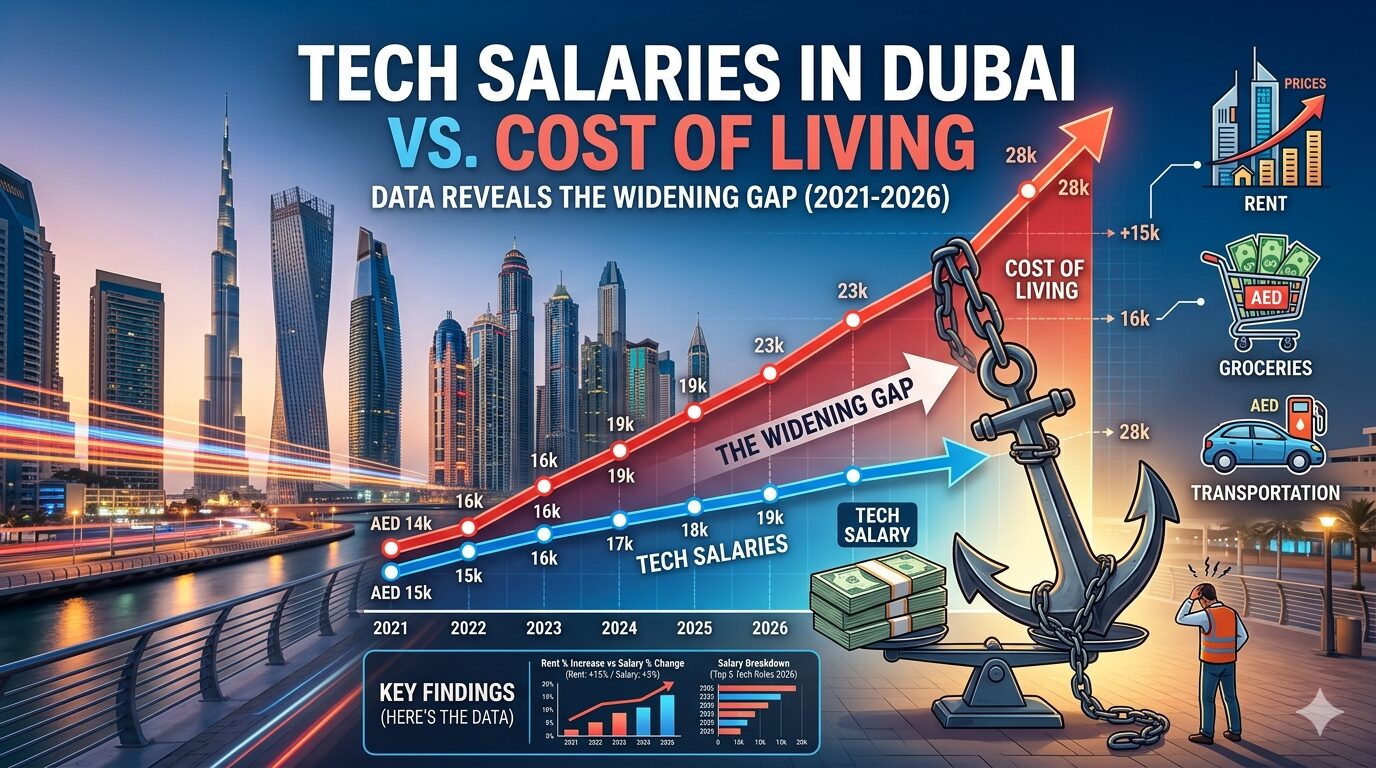
The gap between what people earn and what things cost has gotten noticeably worse. Here is what we found.
The Numbers First
| Category | 2023 | 2026 | Change |
|---|---|---|---|
| Average tech salary (annual) | AED 240,000 | AED 262,000 | +9% over 3 years |
| Rent — 1BR Marina/JBR (annual) | AED 90,000 | AED 120,000 | +33% over 3 years |
| Rent — 1BR JVC/Al Barsha (annual) | AED 55,000 | AED 72,000 | +31% over 3 years |
| Food and groceries (annual) | AED 30,000 | AED 41,000 | +18% over 3 years |
| Transport — car (annual) | AED 20,000 | AED 23,600 | +12% over 3 years |
| Utilities (annual) | AED 12,000 | AED 13,200 | +10% over 3 years |
| Workers saving AED 2K+ monthly | 68% | 41% | 27% points worse |
Salaries went up 5%. Cost of living went up 12 to 18%. In real terms, tech workers are getting poorer even though they are earning more.
What This Looks Like in Practice
Take a mid-level software engineer earning AED 262,000 a year. That is roughly AED 21,800 per month, tax-free.
They pay AED 14,400 per month for a one-bedroom in Marina. That is 66% of their monthly salary going to rent alone.
Add groceries, transport, utilities, phone, and basic dining out. You are left with very little. The savings that were supposed to be the point of coming to Dubai are shrinking fast.
“I moved to Dubai for the high salary three years ago. Now I am paying more, working the same, and have less money at the end of the month than I did in London.”
Software engineer, British national, Dubai Marina
That is not an isolated complaint. We heard versions of it from dozens of respondents. The calculation that made Dubai attractive in 2021 and 2022 is not the same calculation in 2026.
Why Is This Happening?
1. Real estate went up faster than anyone expected
Dubai became one of the most sought-after places to park money globally after 2020. Investors from Russia, Europe, and Asia poured into the property market. Prices went up fast. Rents followed. Supply of new housing has not kept pace with that level of demand.
2. Salary reviews happen once a year. Rent does not wait.
Most tech companies do annual reviews. They give raises based on performance and budget cycles. But your landlord can increase rent every year at renewal. The mismatch between when salaries adjust and when costs rise means workers are always catching up.
3. Remote work changed who companies compete with
Dubai companies used to compete against each other for local talent. Now they compete against remote-first companies offering London or New York salaries. Some local employers have responded by raising pay. Many have not. The ones who have not are losing their best people quietly.
Who Is Getting Hit the Hardest?
Not everyone equally. The data shows clear differences based on seniority.
Senior engineers and tech leads earning above AED 350,000 are largely fine. Their salaries have kept pace better and they have more leverage to negotiate. The squeeze is worst for mid-level workers in the AED 180,000 to 280,000 range. These are people who are too senior for entry-level roles but not senior enough to command the salaries that genuinely buffer against cost increases.
Workers in their first two years in Dubai are also struggling. They came based on numbers that were accurate when they read them. By the time they arrived and paid a deposit, a year’s rent upfront, and agency fees, the financial cushion they planned for was already gone.
The Tax Advantage Is Still Real. Just Less Powerful Than Before.
Dubai’s zero income tax is not nothing. A AED 262,000 salary in Dubai is take-home. The same salary in London, Paris, or Sydney would lose 30 to 45% to tax. That is a real advantage.
But the advantage is shrinking. Not because tax policy changed. Because costs have risen to the point where the tax saving is being absorbed by higher rent and higher prices rather than going into savings.
“The no-tax pitch was compelling when rent was AED 80K a year. Now rent is AED 150K and rising. The math is different.”
Product manager, Indian national, Business Bay
What Tech Workers Are Actually Doing About It
The practical responses we heard from respondents fall into a few categories.
- Moving to cheaper areas. Al Quoz, Jumeirah Village Circle, and International City are seeing increased demand from mid-level tech workers priced out of their preferred neighbourhoods.
- Sharing apartments. Flatsharing among professionals in their thirties is more common now than it was three years ago. Nobody loves it but the numbers make sense.
- Negotiating harder at renewal. Workers are more informed about the market and less likely to accept a rent increase without pushback.
- Looking for remote-first roles. A significant number of respondents said they were actively looking for fully remote positions that would let them keep the Dubai lifestyle while earning in a stronger currency.
- Leaving. Some have already left. A few told us they were planning to.
Is Dubai Still Worth It?
For senior tech workers with strong leverage, yes. The combination of high salaries, no tax, and genuine quality of life is still hard to beat at that level.
For mid-level workers, it is more complicated. The answer depends heavily on where you live, whether your company adjusts salaries to market conditions, and how much of the Dubai lifestyle you actually need versus how much you could live without.
For people thinking about moving to Dubai for a tech job in 2026, the honest advice is this: run the real numbers before you go. Not the numbers from a 2022 blog post. Current rent prices, current grocery costs, current transport costs. Add 15 to 20% buffer for things you did not think of. Then decide.
The dream is still real. It just costs more than it used to.
Robius.news — Dubai, UAE — June 2026 | Built to be first. Built to be trusted.