

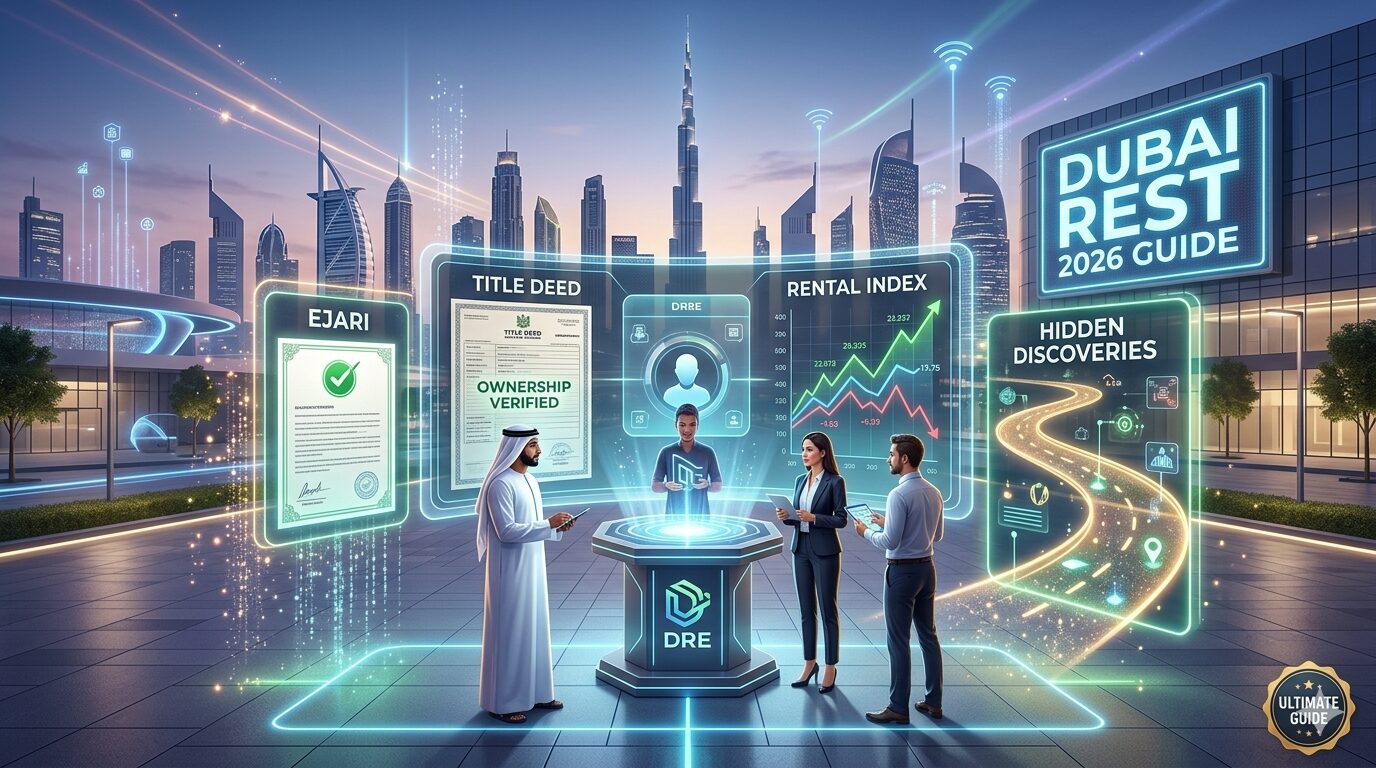
Dubai REST App Guide
Dubai REST is the Dubai Land Department‘s official platform for every property transaction in the Emirate. It is where you register Ejari, verify title deeds, check your legal rent increase limit, track off-plan construction, and manage your property portfolio. In a market that hit AED 917 billion in transactions in 2025, understanding this app is not optional. This is the guide most residents should have read the day they signed their lease.
What Dubai REST Is and Who Uses It
REST stands for Real Estate Self Transaction. It is the Dubai Land Department’s official digital platform, not a third-party service, not a property portal, but the government system through which all DLD-regulated real estate activity in Dubai is processed. The app processed over 320,000 transactions in 2025, covering approximately 78% of all non-developer property transactions in the emirate.
The platform serves five distinct user groups with different needs and different dashboard views. Understanding which role applies to you determines which features are relevant and how the app organises itself for your specific situation.
| User Type | Primary Use Cases | Key Features Unlocked |
| Tenant | Register and renew Ejari, verify landlord ownership, check legal rent increase limits, file Rental Disputes Centre (RDC) cases | Ejari registration, Smart Rental Index, RDC dispute filing, tenancy contract download |
| Property Owner (Landlord) | Manage portfolio, issue Ejari approvals, verify title deeds, pay service charges, apply for NOCs, request property maps and valuations | Real Estate Wallet, title deed vault, Mollak service charge payments, mortgage tracking, Green List |
| Investor (Non-Resident) | Track owned properties remotely, view transaction history, access market analytics, manage off-plan investments | Portfolio dashboard, REST Insights AI analytics, Mashrooi off-plan tracker, transaction log |
| Real Estate Broker | Verify licences, access broker directory, manage client transactions, check DLD rankings | Broker directory, licence verification, training and certification via DREI |
| Developer | Track project registrations, Oqood off-plan data, escrow account status, project completion milestones | Oqood project view, escrow tracking, Mashrooi construction updates |
Ejari: Why It Is the Starting Point for Almost Everything
Ejari, from the Arabic ‘my rent’, is Dubai’s mandatory tenancy contract registration system, operated by RERA under the DLD. Every residential and commercial tenancy in Dubai must be registered through Ejari to be legally valid. Without it, you cannot activate DEWA electricity and water, you cannot process a residency visa application, you cannot open a UAE bank account using your address, you cannot connect internet or telecoms, and you cannot file a case at the Rental Disputes Centre.
Ejari is not optional paperwork. It is the legal foundation of your tenancy. And yet a significant number of Dubai tenants, particularly those new to the emirate sign their lease, move in, and assume someone else has handled it. Often the agent did. Sometimes they did not. The consequences of an unregistered Ejari emerge at the worst possible moments: when you need DEWA, when your visa renewal requires proof of residence, or when a landlord dispute requires RDC intervention.
| Never pay your DEWA deposit or attempt utility activation until you have received your Ejari certificate with its unique Ejari number. Do not assume your agent or landlord completed it. Verify it yourself through the Dubai REST app. |
How to Register Ejari Through Dubai REST — Step by Step
Both tenants and landlords can initiate Ejari registration through the Dubai REST app. For residential properties, tenants typically initiate the process. For commercial units, landlords or property managers often lead. Either way, the landlord must digitally approve the application within the app before the certificate is issued — an unresponsive landlord is one of the most common causes of Ejari delay.
| Step | What Happens |
| 1. Log in to Dubai REST | Use UAE Pass (recommended) or Emirates ID. UAE Pass is faster and links your registered properties automatically. |
| 2. Select ‘Register Ejari’ | Found under the RERA Services section. Choose ‘New Registration’ for a new lease or ‘Renewal’ for an existing contract. |
| 3. Upload required documents | Unified tenancy contract (signed by both parties), tenant’s Emirates ID, landlord’s title deed copy, and Power of Attorney if applicable. |
| 4. Pay the fee | AED 155 to AED 220 depending on registration type and channel. Payable via card, Apple Pay, or Noqodi within the app. |
| 5. Landlord approval | The landlord receives a notification and must digitally approve within the app. This step can take hours or days depending on landlord responsiveness. |
| 6. Receive Ejari certificate | Sent by email and available for download in the app under ‘My Contracts’. The certificate includes the unique Ejari number and QR code. |
Processing time: same day to a few days, depending on document completeness and landlord approval speed. If your landlord is unreachable or refuses to approve, contact the DLD directly on 800 4488. If a previous Ejari on the same property has not been cancelled by the prior tenant, the new registration may be blocked. This is a common friction point for residents moving into properties with administrative loose ends.
Important for renewals: if you are renewing a lease at a different rent, both parties must give 90 days’ written notice before the lease expiry date if any terms are changing. Failure to provide this notice defaults the renewal to the same terms for one year under Dubai Law No. 26 of 2007 (amended by Law No. 33 of 2008). The Smart Rental Index in the app tells you whether any proposed rent increase is legally permissible before you negotiate.
The Smart Rental Index: Your Legal Protection Against Arbitrary Rent Increases
One of the most practically valuable tools in the Dubai REST app is also one of the least known among tenants: the Smart Rental Index. This is the DLD’s official rent calculator, embedded directly in the app, that tells you the maximum permitted rent increase for your specific property based on your current rent and the market benchmark for your building and area.
How it works: enter your contract end date, the area, property type, and current annual rent. The calculator returns the legally permissible rent range for your renewal based on RERA’s rental index the same data used by the Rental Disputes Centre when adjudicating rent disputes. The index is updated annually and reflects actual DLD transaction data.
The permitted increase framework in Dubai is tiered. If your current rent is within 10% of the market average for your building, no increase is permitted. Between 11-20% below market, the maximum increase is 5%. Between 21-30% below market, 10% maximum. Between 31-40% below, 15% maximum. More than 40% below market rate, the maximum permitted increase is 20%. Landlords cannot legally exceed these thresholds, and the RDC will not recognise increases that do.
| The Smart Rental Index is one of the best-kept secrets in the Dubai REST app. Before your landlord’s renewal notice arrives, run your property through it. You will know exactly what increase is legal — and what is not — before negotiations begin. |
The service charge index is a companion tool for property owners. Entering a community name, project, and year returns the verified service fee charged by that development’s owners’ association, benchmarked against comparable buildings. For buyers evaluating a purchase or owners disputing excessive service charge increases, this is official DLD data, not a third-party estimate.
Digital Title Deeds: What Changed in 2024 and What It Means
Since 2024, the DLD has ceased issuing physical title deeds for Dubai properties. The digital title deed on the Dubai REST platform is now the legally binding ownership document. There is no paper equivalent. If you purchased a property before 2024 and have a physical title deed, it remains valid, but all new transactions, transfers, and registrations produce digital-only documentation.
The practical implications are significant. Title deed verification, which used to require visiting a DLD office or a licensed typing center is now instant through the REST app. Enter the certificate number, year, property type, and owner’s full name. The system returns the verified ownership record directly from DLD’s database. For buyers conducting due diligence before purchase, tenants wanting to confirm their landlord actually owns the property they are renting, or banks running mortgage assessments, this verification takes under two minutes.
The DLD Document Vault within the app stores all official documents title deeds, Ejari certificates, property maps, valuation certificates in a secure digital repository. Documents can be shared with service providers, banks, or legal representatives directly from the vault without printing or physical delivery. For overseas investors managing Dubai properties remotely, this eliminates one of the most persistent friction points in the old paper-based process.
Mashrooi: Tracking Your Off-Plan Property in Real Time
Dubai’s off-plan property market attracted significant investment through 2025 and into 2026, driven by strong yield expectations and the continued expansion of major development projects across Palm Jebel Ali, Dubai South, and Creek Harbour. For buyers who have committed capital to an off-plan property, the Mashrooi feature within Dubai REST is the official window into what is actually happening on site.
Mashrooi shows real-time construction completion percentage for each registered off-plan project, updated by developers and audited by the DLD. Alongside the completion figure, the feature displays current project photographs, escrow account status and balance (confirming buyer funds are protected and held correctly), upcoming payment milestones linked to construction stages, and the developer’s DLD registration and compliance record.
The escrow visibility is particularly important. Under Dubai Law No. 8 of 2007, developers are required to hold off-plan buyer payments in DLD-regulated escrow accounts that can only be released as construction milestones are verified. Mashrooi shows buyers whether their payments are sitting correctly in escrow, a protection that many buyers do not realise they can check themselves without contacting the developer.
For projects on the DLD’s Incomplete and Cancelled Projects list properties where development has stalled or been halted. The REST app provides access to the relevant committee’s services, where affected buyers can register claims and track resolution status.
REST Insights: The AI Layer Added in January 2026
The most significant update to the Dubai REST platform in recent history arrived in January 2026: REST Insights, an AI-powered analytics layer built directly into the app. For property owners and investors, this transforms the app from a transactions platform into an active portfolio management tool.
| REST Insights Feature | What It Provides |
| Automated Rental Yield Calculator | Based on your property’s current Ejari-registered rent and the latest comparable DLD transaction values in your community, REST calculates estimated gross and net rental yield, updated monthly. |
| AI Price Trend Analysis | 12-month and 3-year price trend charts for your specific building, community, and sub-area, drawn from DLD’s complete transaction database. Compares your property’s value trajectory against the community average. |
| Predictive Maintenance Alerts | For communities with connected building management systems, flags potential maintenance issues — HVAC aging, warranty expirations, upcoming major maintenance cycles before they become expensive problems. |
| Smart Investment Map | Overlay of transaction density, yield rates, and price appreciation by area across Dubai, allowing owners and investors to benchmark their holdings against the broader market. |
| Property Tokenisation Tracker | Early-stage feature tracking DLD’s blockchain property tokenisation programme, the pilot allowing fractional property ownership to be registered and traded digitally. |
The property tokenisation feature is worth watching. DLD’s pilot programme allows properties to be registered on a blockchain and divided into digital tokens that can be traded, enabling fractional ownership of Dubai real estate. This is early-stage and not yet widely available, but its presence in the app signals the direction the DLD is moving the entire transaction infrastructure.
What Overseas Owners and Investors Need to Know
Dubai REST was designed with the reality of overseas ownership in mind. A significant proportion of Dubai’s property investors are based outside the UAE, in the UK, India, Russia, China, and across the GCC. The app allows overseas owners to manage their Dubai property portfolio entirely remotely, provided their contact details and Emirates ID (or passport details for non-resident owners) are correctly registered with DLD.
Overseas owners without UAE residency can access most services using title deed details rather than UAE Pass. However, UAE Pass significantly improves access and unlocks the full feature set. For non-residents who hold UAE Pass possible for holders of certain UAE visa types, the full platform is available without limitations.
The critical point for overseas landlords: if your contact details in DLD’s records are outdated, an old mobile number, a closed email address you will not receive Ejari approval notifications, service charge alerts, or transaction OTPs. Updating your profile details requires a visit to a Property Trustee office or the DLD directly. This cannot be done through the app, which is one of the most significant operational gaps in the platform for owners who are not physically in Dubai.
What Dubai REST Needs to Improve
- Self-service profile updates. The inability to update owner and tenant profile details through the app requiring an in-person visit to a Property Trustee office is a meaningful design failure for a platform built around digital self-service. This is particularly acute for overseas owners who cannot easily visit Dubai for administrative corrections.
- Corporate landlord UAE Pass compatibility. Corporate landlords, companies that own multiple investment properties frequently cannot complete Ejari approvals through the app because UAE Pass authentication is not supported for corporate entities. They must complete approvals in person. In a market with significant institutional landlord presence, this is not a niche edge case.
- Landlord approval timeout and escalation. When a landlord is unresponsive to an Ejari approval request, there is no automated escalation within the app. Tenants must contact DLD directly. A 72-hour timeout with automatic DLD notification and a clear in-app escalation path would eliminate significant waiting and uncertainty for tenants in the process.
- Smart Rental Index prominence. The Rental Index is buried within RERA Services and is largely unknown among tenants who would benefit from it most. Placing it prominently on the tenant dashboard particularly during Ejari renewal periods would reduce Rental Disputes Centre caseload and empower tenants in negotiations.
- Ejari certificate shareable links. Currently, sharing an Ejari certificate requires downloading the PDF and sending it separately. A secure, time-limited shareable link like those used by other government document platforms would simplify the process of sharing Ejari with DEWA, banks, schools, and employers who routinely request it.
| Dubai REST verdict: The most complete and consequential government app in Dubai’s resident ecosystem. If you rent, own, or invest in Dubai property, this platform touches your life whether you use it actively or not. The Ejari registration, Smart Rental Index, title deed verification, and Mashrooi off-plan tracker are all genuinely useful. The profile update restriction, corporate landlord limitations, and landlord approval timeout gaps are real friction points that DLD needs to close. |
Download: App Store and Google Play (search ‘Dubai REST’). Web: dubairest.gov.ae. DLD Customer Care: 800 4488. Real Estate Trustee Centres (EGSH and others): for in-person services requiring physical presence.
Robius.news —Dubai, UAE — June 2026 | Built to be first. Built to be trusted