

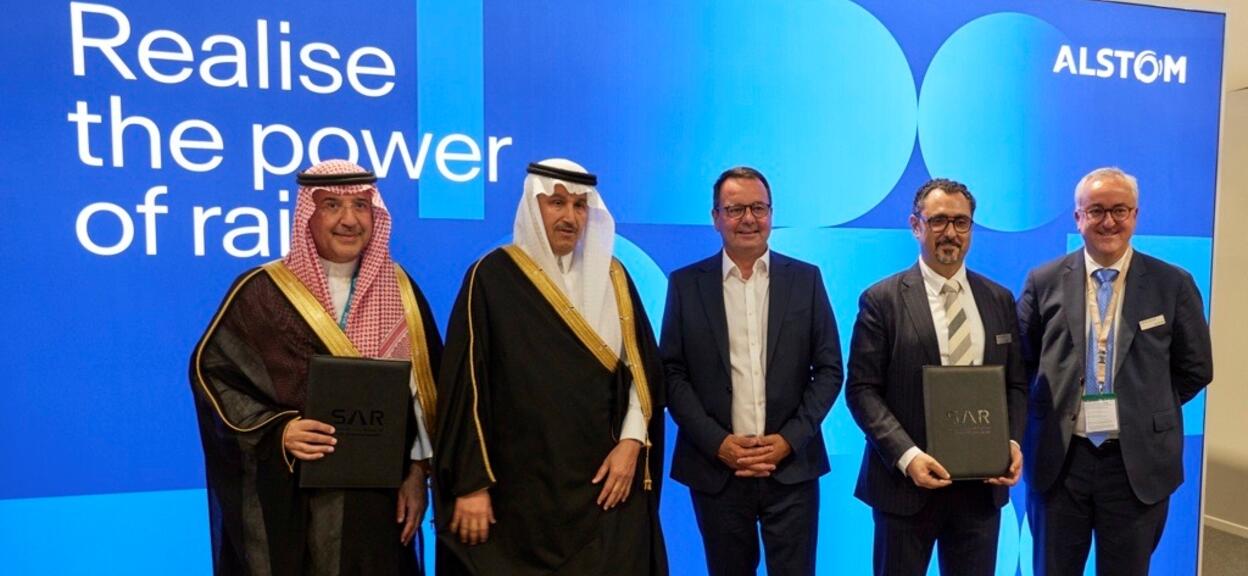
Saudi Arabia’s freight railway is getting a more proactive maintenance layer — and the significance is easier to see in the cargo already moving underneath it.
Alstom said on September 22 that it has signed a €22 million, five-year contract with Saudi Arabia Railways (SAR) covering critical onboard systems on the North Freight locomotive fleet. The scope includes real-time monitoring, system upgrades, improved spare-parts availability, digital maintenance tools and workforce training.
A corridor already carrying about 13.5 million tonnes annually is adding a real-time maintenance layer while SAR expands freight rolling stock, linking digital operations directly to industrial logistics reliability.
Saudi logistics operators, mining companies, industrial shippers, rail suppliers and infrastructure investors.
More proactive freight-fleet maintenance, improved spare-parts readiness, digital maintenance tooling and technical training for Saudi rail staff.
The agreement supports existing onboard systems rather than adding rail capacity by itself. Reliability gains and localisation outcomes have not yet been quantified.
Watch implementation of real-time monitoring and upgrades across the North Freight fleet during the five-year contract.
For logistics and mining operators, track whether improved fleet readiness translates into more predictable industrial freight capacity on the northern corridor.
SAR freight operations, mining and industrial shippers, maintenance teams and suppliers dependent on reliable North–South rail movements.
No public participation mechanism was announced; supplier and workforce opportunities would sit within SAR and Alstom procurement and training programmes.
Fleet availability, downtime, freight throughput, maintenance response times and evidence of technical capability transfer to Saudi teams.
What is actually changing
This is not a contract for a new railway line or a new fleet. It is an operations and maintenance agreement intended to make existing freight locomotives more reliable on the Kingdom’s North–South corridor.
Alstom says the systems covered by the agreement help monitor train performance, manage speed and communicate with signalling infrastructure. The company plans to combine real-time monitoring with system upgrades and better access to spare parts, shifting more of the maintenance model toward identifying problems before they disrupt operations.
Why 13.5 million tonnes matters
The northern line already carries approximately 13.5 million tonnes of freight annually, according to Alstom. It links mining areas with processing facilities and export points, making reliability an industrial issue rather than simply a railway-performance metric.
That distinction matters as Saudi Arabia expands mining and logistics capacity. A freight corridor can add locomotives and wagons, but higher capacity has limited value if the systems controlling existing trains become a bottleneck. Predictive or real-time maintenance does not create new capacity by itself; it is intended to protect availability and reduce operational disruption across the capacity already in service. The same operational distinction appeared in Robius’s recent look at Etihad Rail’s Fujairah-to-ICAD cargo service, where the infrastructure mattered most because of what changed around the movement of freight.
The contract sits inside a wider rail expansion
The Alstom agreement is only one part of a broader SAR procurement push. Arab News reported on September 23 that SAR has also signed agreements involving new heavy-haul locomotives and freight cars for phosphate transport, alongside rail-system upgrades elsewhere in the network.
That makes the maintenance contract more interesting than its €22 million headline value. Saudi freight rail is being expanded at both ends: additional physical capacity is being procured while the technology and maintenance layer supporting existing operations is being strengthened. It also fits a wider Saudi push to localise transport and industrial capability, visible in projects such as CEER’s newly revealed EXOBOT electric vehicles, where execution after the announcement remains the key test.
The localisation piece
Alstom says the programme will also include training and knowledge transfer for Saudi engineers, technicians and operators. That is a company commitment rather than evidence that localisation outcomes have already been achieved, so the meaningful measure will be how much technical capability is ultimately transferred during the five-year contract.
What to watch
The interesting signal is not that Saudi Arabia signed another rail contract. It is that a corridor already moving industrial-scale freight is being fitted with a more continuous operational-maintenance layer at the same time SAR is expanding rolling stock. The next useful numbers will be operational ones: fleet availability, downtime, freight throughput and whether the promised localisation translates into measurable Saudi technical capability.
Sources
- Alstom — “Alstom and Saudi Arabia Railways deepen long-term partnership to enhance freight rail performance across the Kingdom,” 22 September 2026.
- Arab News — “Saudi Arabia Railways signs deals to expand freight capacity, upgrade rail systems,” 23 September 2026.
Checked 24 September 2026. Contract value, duration, freight volume and technical scope were cross-checked against Alstom’s primary announcement and contemporary regional reporting. Forward-looking localisation and performance benefits are identified as commitments rather than realised outcomes.
Robius.news — Dubai, UAE — 2026 | Built to be first. Built to be trusted.