

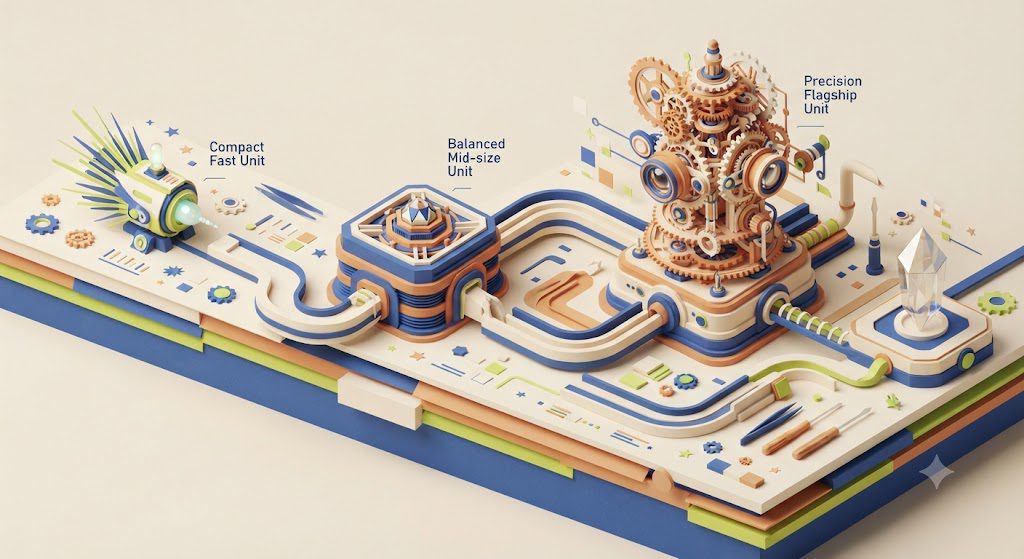
OpenAI cut the API price of GPT-5.6 Luna by 80% on July 30. Terra became 20% cheaper. Sol kept its standard price, while a new Fast mode offers up to 2.5 times the speed at twice the price.
The tempting SME response is to switch everything to the cheapest model. The other common mistake is to keep sending every task to the strongest model because it feels safer. Both approaches waste money in different ways.
The better rule is to route work by consequence. Use the cheapest model that consistently meets the quality standard, then spend more only where ambiguity, customer impact, or the cost of an error justifies it.
The New API Prices
Starting July 30, OpenAI lists GPT-5.6 Luna at $0.20 per million input tokens and $1.20 per million output tokens. Terra is $2 per million input tokens and $12 per million output tokens. Sol remains $5 per million input tokens and $30 per million output tokens.
These are API token prices, not the monthly price of a ChatGPT subscription. OpenAI says Terra and Luna also consume fewer credits in ChatGPT Work and Codex, but subscription prices and quota budgets did not change.
The cuts are large enough to change which automations are economically sensible. Classification, extraction, routine drafting, document triage, and background agents can now run at greater volume before token cost becomes the main constraint.
| Model | New API input / output price | Best starting use |
|---|---|---|
| GPT-5.6 Luna | $0.20 / $1.20 per 1M tokens | High-volume, well-specified, low-risk tasks. |
| GPT-5.6 Terra | $2 / $12 per 1M tokens | Most everyday business work and client-facing drafts. |
| GPT-5.6 Sol | $5 / $30 per 1M tokens | Complex, ambiguous, high-stakes analysis and review. |
Luna: Make It the Volume Worker
Luna is OpenAI’s cost-sensitive model. After the price cut, it is the natural first test for repetitive workflows with clear inputs and outputs: classifying support messages, extracting fields from standard documents, tagging leads, summarizing known formats, checking whether required information is present, or drafting a first-pass response from approved facts.
The important phrase is “clear inputs and outputs.” A cheap model becomes expensive when the workflow produces inconsistent work, forces employees to correct everything, or creates a customer error. Price per token is not the same as cost per successful task.
Use Luna when you can define acceptance rules. A support classifier can be tested against a labelled set. An invoice extractor can be checked field by field. A background agent can be restricted to read-only access and a narrow list of actions.
Terra: Make It the Everyday Default
Terra is the balanced tier. It should be the first candidate for work where language quality, instruction following, and handling some ambiguity matter, but the task does not require the maximum model for every call.
Examples include drafting customer emails from case notes, preparing internal summaries, turning meeting notes into action lists, producing first versions of proposals, comparing supplier responses, or assisting employees across a controlled knowledge base.
For many UAE SMEs, Terra is likely to be the safest default model while Luna is introduced into well-measured high-volume steps. The Robius UAE SME software guide emphasizes tools that remove repetitive work without creating a second job in supervision. Terra fits that middle ground.
Sol: Buy Judgment, Not Routine Output
Sol is the flagship tier. Use it where the work is genuinely difficult or where the cost of a weak answer is much higher than the extra token charge. Complex contract comparison, strategic planning, difficult debugging, multi-source research, risk review, and final quality control are stronger candidates than basic rewriting.
Sol can also be used as the planner in a routed workflow. It can resolve ambiguity, create a detailed plan, or review edge cases, while Luna executes the repetitive steps. OpenAI itself gives a similar example: a stronger model defines the approach, then Luna implements well-specified changes and runs tests.
The Robius report on government restrictions affecting OpenAI and Anthropic is a reminder that model access and policy can change. Do not design a critical business process that cannot fall back to another model or manual path.
What the Price Difference Looks Like
Consider a monthly workflow using 10 million input tokens and 2 million output tokens. At current standard API prices, Luna would cost about $4.40, Terra about $44, and Sol about $110. The exact bill can also include tools, caching behavior, long-context multipliers, or other platform charges.
At 50 million input tokens and 10 million output tokens, the same basic calculation becomes about $22 for Luna, $220 for Terra, and $550 for Sol. The gap is material at scale, but still small compared with the cost of an employee repairing thousands of low-quality results.
| Monthly token volume | Luna | Terra | Sol |
|---|---|---|---|
| 10M input + 2M output | $4.40 | $44 | $110 |
| 50M input + 10M output | $22 | $220 | $550 |
The Uber AI budget lesson was not that businesses should avoid AI. It was that usage can scale faster than controls. Put a cost ceiling, token limit, retry limit, and escalation path around every production workflow.
Build a Three-Level Routing Policy
Level one is routine. Use Luna for structured tasks with objective checks and low downside. Keep permissions narrow and send uncertain cases upward rather than asking the model to guess.
Level two is judgment. Use Terra for customer-facing drafts, mixed documents, multilingual support, and tasks where context changes the answer. The Robius Arabic AI test shows why the business must evaluate its own language and dialect needs rather than rely on a general benchmark.
Level three is consequence. Use Sol for high-value decisions, complex research, edge cases, and final review. Human approval should remain mandatory where the output changes money, employment, legal rights, access, or a public statement.
Do Not Route by Brand Claims Alone
OpenAI provides performance claims and customer examples, but every SME has a different error profile. A model that performs well on coding benchmarks may still misunderstand the company’s Arabic product names, internal abbreviations, or customer-policy exceptions.
Create a small evaluation set from real work. Include normal cases, difficult cases, incomplete inputs, Arabic and English examples, and cases where the correct answer is to escalate. Compare quality, latency, total tokens, correction time, and failure severity.
The Google response to the latest ChatGPT generation shows how quickly model competition moves. Routing makes the business less dependent on whichever provider currently has the strongest headline. The workflow standard remains stable while models can be replaced.
The Bottom Line
The GPT-5.6 price cuts make high-volume AI much easier to justify. They do not remove the need for evaluation, access controls, budget limits, and human review.
Start Luna on narrow routine work, use Terra for most everyday business assistance, and reserve Sol for problems where better reasoning changes the outcome. The cheapest model is not the one with the lowest token price. It is the one that completes the task correctly at the lowest total cost.
Sources
- OpenAI price update: Official July 30 announcement of the Luna and Terra reductions, Sol Fast mode, model-selection guidance, and current API prices.
- OpenAI GPT-5.6 launch: Official description of the Sol, Terra, and Luna capability tiers and original pricing structure.
- OpenAI API model documentation: Official Luna model description, context limits, and API pricing notes.
- OpenAI API pricing: Current complete API pricing and additional tool or processing charges.
Robius.news — Dubai, UAE — 2026 | Built to be first. Built to be trusted.