

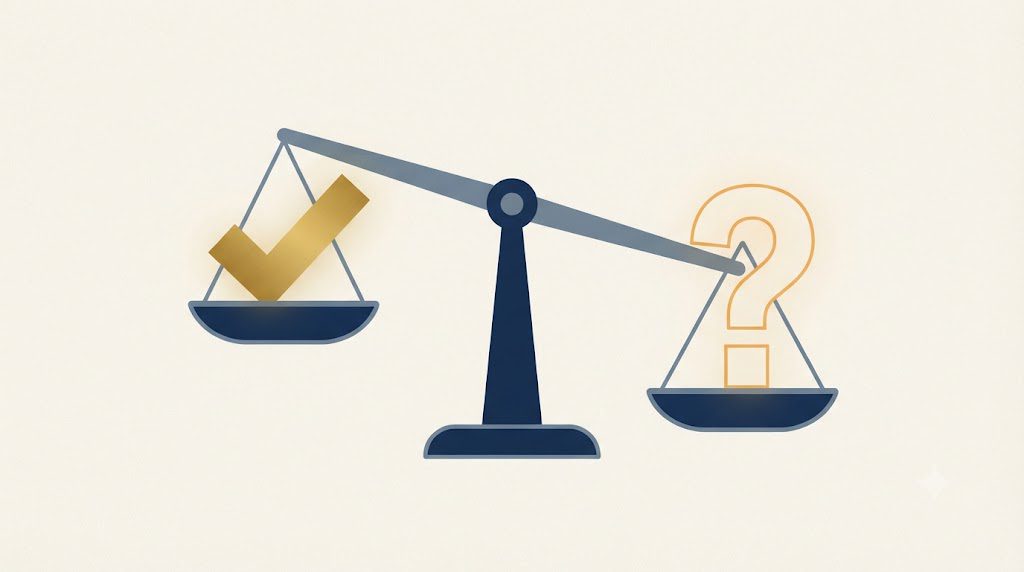
Most review sites give you two boxes. Scam, or safe. Real life has a third box, and it is where people actually get hurt.
Legal to use. Not locally protected. A platform can operate perfectly legally in the UAE, take your money, pay most withdrawals, and still leave you with no UAE regulator to turn to if it all goes wrong.
So we built a verdict for exactly that gap. We call it “Legit, But.” Here is how it works, using two early examples — including one that was later reclassified when new regulator evidence changed the facts.
| THE ROBIUS VERDICT: “Legit, But” means a platform is legal to use and genuinely risky to rely on. Both halves are true at once, and the second half is the one nobody tells you. |
Why This Verdict Needs to Exist
The honest answer to “is this platform a scam” is often no. It has operated for years. It pays most people most of the time. Calling it a scam would be wrong.
But stopping at “not a scam” is also wrong, because it hides the real risk. The danger is not that the platform steals your deposit tomorrow. It is that one day it changes a withdrawal policy, or hits trouble, and your recourse turns out to be far thinner than you assumed.
“Legit, But” exists to name that gap out loud. It is for platforms that pass the legality test and fail the protection test.
The Scorecard
Every “Legit, But” verdict answers the same five questions. They are the questions that actually decide what happens to your money.
- Legal to use in the UAE? Whether residents can use it without breaking any law.
- Holds a UAE license? Whether a UAE regulator (CMA, DFSA, or FSRA) actually supervises it.
- Your recourse if it fails? Which body, if any, you can turn to in a dispute.
- Track record? How long it has operated, and whether it pays withdrawals.
- Who holds your money? Whether funds sit with a supervised entity or offshore.
A platform can score well on legality and track record while scoring badly on license and recourse. That combination is the whole point. It is what “Legit, But” captures that a simple scam-or-safe label cannot.
Case One: Exness
UPDATE — 9 SEPTEMBER 2026: Exness no longer fits the “no UAE license” example originally used in this article. A later Robius register check confirmed that Exness MENA Financial Brokers L.L.C. holds an active UAE Capital Market Authority brokerage license for OTC derivatives and spot currencies. The remaining question is which Exness legal entity governs your specific account.
| Question | Exness |
|---|---|
| Legal to use in the UAE | Yes |
| Holds a UAE licence | Yes. Exness MENA Financial Brokers L.L.C., UAE CMA, CP-0001100 |
| Recourse if it fails | Entity-specific. Check which company your client agreement names. |
| Track record | Long-running |
| Verdict | LEGIT — but confirm the contracting entity before funding. |
Exness is now a useful example of why Robius checks live regulator records instead of freezing a verdict in time. When this article was first prepared, Exness was widely described as offshore-only. A subsequent regulator check confirmed a genuine UAE brokerage entity, Exness MENA Financial Brokers L.L.C. The correct question is therefore no longer whether Exness has a UAE license. It does. The question is whether your specific account is actually governed by that UAE entity or another Exness group company. Regulatory protection follows the legal entity on your agreement, not the brand name alone.
Case Two: Olymp Trade
| Question | Olymp Trade |
|---|---|
| Legal to use in the UAE | Yes, no law prevents it |
| Holds a UAE license | No. Entity is Aollikus Limited, Vanuatu |
| Recourse if it fails | FinaCom membership, not a UAE regulator |
| Track record | Operating since 2014, 129M+ users |
| Verdict | Legit, But: not Tier-1 protected |
Olymp Trade is not a confirmed fraud. It has run for over a decade and pays most withdrawals. But its legal entity is Aollikus Limited, licensed in Vanuatu, and its dispute cover comes from FinaCom rather than a UAE regulator. One industry safety score put it below the halfway mark. Operating, not collapsed, not Tier-1 regulated. The full picture is in our Olymp Trade review.
Why One Example Changed and the Other Still Fits
Exness and Olymp Trade originally appeared to share the same shape: real operating history, no verified UAE-regulated entity, and recourse outside the UAE. The later CMA check changed one half of that comparison. Exness now has a verified UAE brokerage entity, while Olymp Trade remains an offshore-regulated platform with no UAE brokerage licence identified in the registers checked for our review.
That change is not a problem with the verdict system. It is the reason the system has to stay evidence-driven. A platform can move into or out of a category when licensing, contracting entities, or regulator records change. Robius should change the verdict when the evidence changes too.
How to Use a “Legit, But” Platform
This verdict is not a ban. Plenty of people use these platforms without incident. It is a set of eyes-open conditions.
- Assume your recourse is foreign. Know which regulator actually covers your account before you deposit.
- Never deposit more than you can afford to have tied up if withdrawals slow down.
- Withdraw regularly rather than letting a large balance build up on the platform.
- Keep records of every deposit, trade, and withdrawal request, with dates.
- Treat “guaranteed returns” or pressure to deposit more as a separate, brighter red flag.
And know the limit of your local safety net. Sanadak, the UAE’s financial ombudsman, resolves disputes for free, but only for firms actually regulated here. For an offshore broker, that door is closed, which is precisely why the license question matters before you fund anything.
The Bottom Line
The world is not divided cleanly into scams and safe bets. The largest, quietest risks live in between, in platforms that are perfectly legal and quietly unprotected.
That is the space “Legit, But” exists to map. When you see this verdict on Robius, read it as exactly what it says. You may use this. Just know what is, and is not, standing behind you.
Sources
- Capital Market Authority (official): UAE federal securities regulator, formerly the SCA, and its licensed-firms register — https://www.uaecma.gov.ae/en/home.aspx
- DFSA (official): Public register of firms authorized in the DIFC — https://www.dfsa.ae/public-register
- FSRA / ADGM (official): Regulator for firms inside the ADGM in Abu Dhabi — https://www.adgm.com/
- Traders Union: Independent broker safety scoring referenced for track-record context — https://tradersunion.com/brokers/forex/view/olymptrade/
This is not financial advice.
Robius.news — Dubai, UAE — 2026 | Built to be first. Built to be trusted.