
The Gulf already has plenty of announcements about bigger models, more GPUs and larger data centres. HUMAIN’s latest deal is interesting because it moves lower in the stack, into the unglamorous work companies actually pay people to do every day.
On September 1, HUMAIN announced a strategic investment in and partnership with Arabic.AI and Tarjama. The investment amount was not disclosed. The companies say the collaboration will target AI-powered translation, document intelligence and enterprise language workflows across Saudi Arabia and international markets.
The deal pushes Arabic AI toward enterprise workflows such as translation, document intelligence and archive digitisation instead of another benchmark-only model launch.
GCC enterprises, government teams, regulated businesses and UAE organisations handling large volumes of Arabic and multilingual documents.
Arabic-first document agents could reduce manual work in translation, contracts, archives and multilingual enterprise processes where generic models still need heavy review.
The investment amount is undisclosed, early customer results are not public and product quality across dialects, legal language and high-stakes documents still needs real-world evidence.
The companies say first solutions will move into market with early enterprise customers, with initial solutions unveiled at LEAP 2026.
If evaluating Arabic enterprise AI, test it on your own contracts, forms and mixed-language documents rather than relying on general Arabic benchmarks.
Arabic.AI and Tarjama gain a strategic investor and full-stack infrastructure partner, while HUMAIN adds specialised enterprise language tooling to its broader AI stack.
The companies say initial solutions will target Saudi enterprises and international markets; public customer eligibility and commercial terms have not yet been published.
Watch named customers, deployment architecture, model and data-location choices, error rates, human-review requirements and measurable workflow outcomes.
This Is Not an Acquisition
The first correction matters. HUMAIN did not announce that it bought Arabic.AI or Tarjama. The public statement describes a strategic investment and partnership, with no disclosed deal size or ownership percentage. Robius therefore treats this as a capability and distribution deal, not a takeover.
Arabic.AI says the partnership combines HUMAIN’s infrastructure, advanced models and full-stack AI capabilities with Tarjama’s language expertise and Arabic.AI’s translation and document-intelligence products. The companies say they bring more than 18 years of enterprise language experience into the collaboration.
That focus lands directly on a gap we found when testing major AI tools on real Arabic used in the UAE: formal Arabic can look impressive while dialect, local context, dates and operational details still create failure points.
The Workflow Layer Is Where the Value Gets Measured
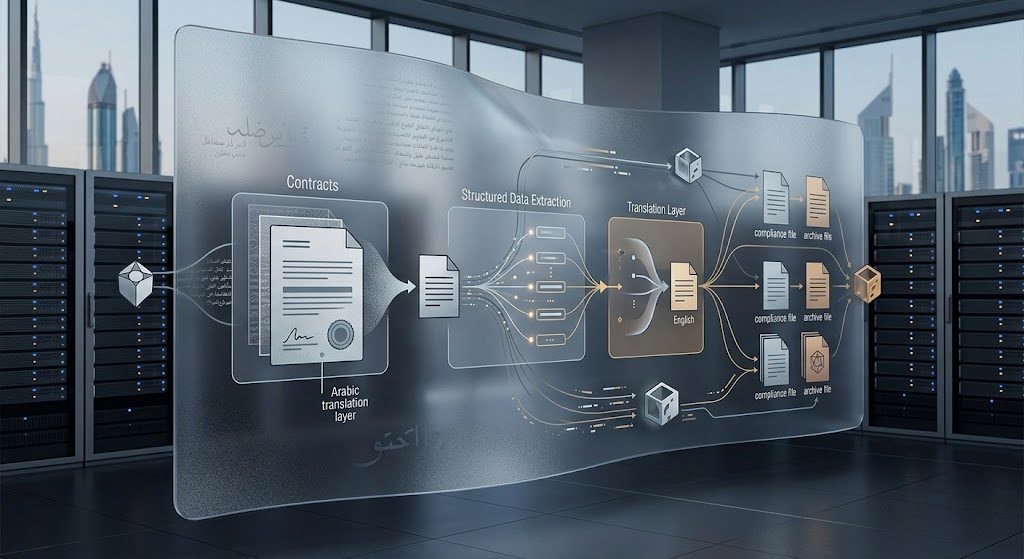
A language model can generate an Arabic paragraph. An enterprise workflow has to do much more: open the right document, preserve formatting, identify the document type, extract named fields, compare clauses, translate consistently, respect access controls, route the result to the right employee and leave evidence of what changed.
That difference is why document intelligence is a more useful signal than another model leaderboard. A company does not buy “Arabic capability” in the abstract. It buys a process that has to work on invoices, tenders, legal files, HR documents, customer communications or archives with measurable accuracy and review costs.
HUMAIN Already Owns the Infrastructure Story
PIF describes HUMAIN as a full-stack AI company spanning data centres, cloud infrastructure, models and applications. Its portfolio includes the ALLAM Arabic multimodal model and partnerships across the global AI hardware and cloud ecosystem.
The Arabic.AI/Tarjama deal therefore fills a different part of the picture. Infrastructure and models become more valuable when they are attached to repeatable enterprise work. The announcement specifically points to translation, archive digitisation, document intelligence and agents that read, check and draft enterprise documents.
This is also a useful counterweight to the region’s infrastructure race we covered when the US changed advanced AI-chip access for the UAE and HUMAIN. Compute matters, but a rack of accelerators is not a finished business workflow.
The Hard Test Is Not “Does It Speak Arabic?”
For a GCC enterprise, the better test is whether the system can operate inside the document environment the company actually has. That can mean Modern Standard Arabic mixed with English terms, scans, stamps, tables, legacy PDFs, inconsistent templates, local legal language and documents that cannot leave a controlled environment.
The public announcement does not yet give us production accuracy, named customers, data-location architecture, human-review rates or pricing. It also does not establish how the systems perform on Emirati dialect or UAE-specific legal and administrative documents. Those are future evidence questions, not details we should assume from the partnership.
The same governance problem appears when agents move outside IT into legal and operational teams: the closer AI gets to real documents and decisions, the more important permissions, review and audit trails become.
What UAE Buyers Should Ask
- Which model handles the task, and can the customer choose where inference runs?
- Where are source documents stored, processed and retained?
- How does the system handle mixed Arabic-English documents, tables, scans and poor OCR?
- Which actions are generated automatically and which require human approval?
- What measured accuracy exists on the customer’s own document types, not a generic benchmark?
- Can every extraction, translation or rewrite be traced back to the source document and reviewer?
The Robius Layer
The Arabic AI race is maturing when the interesting question stops being “whose model speaks Arabic best?” and becomes “whose system can reliably process the documents a bank, ministry, hospital or company actually uses?”
HUMAIN’s investment is a signal in that direction. The announcement is promising, but the proof will come from named deployments, measurable workflow performance and evidence that Arabic-first systems can survive the messy documents and approval chains of real enterprises.
Sources
- Arabic.AI / Tarjama: September 1 strategic investment and partnership announcement — https://arabic.ai/humain-invests-in-and-partners-with-arabic-ai-tarjama-to-advance-arabic-language-translation-and-document-intelligence/
- Public Investment Fund: HUMAIN portfolio description covering its full-stack AI infrastructure, models and applications — https://www.pif.gov.sa/en/our-investments/our-portfolio/humain/
- Robius background: Existing Robius testing of Arabic performance and local-context failure points — https://www.robius.news/ai-news/we-put-the-big-ai-tools-to-the-arabic-test-here-is-where-they-break/
Robius.news — Dubai, UAE — 2026 | Built to be first. Built to be trusted.