 UAE, UNFILTERED
Mahboub’s Next Test Is the Last Click
Dubai RTA's upgraded Mahboub aims to finish vehicle-service journeys in one conversation. The public rollout is still pending. Here is what drivers should verify.
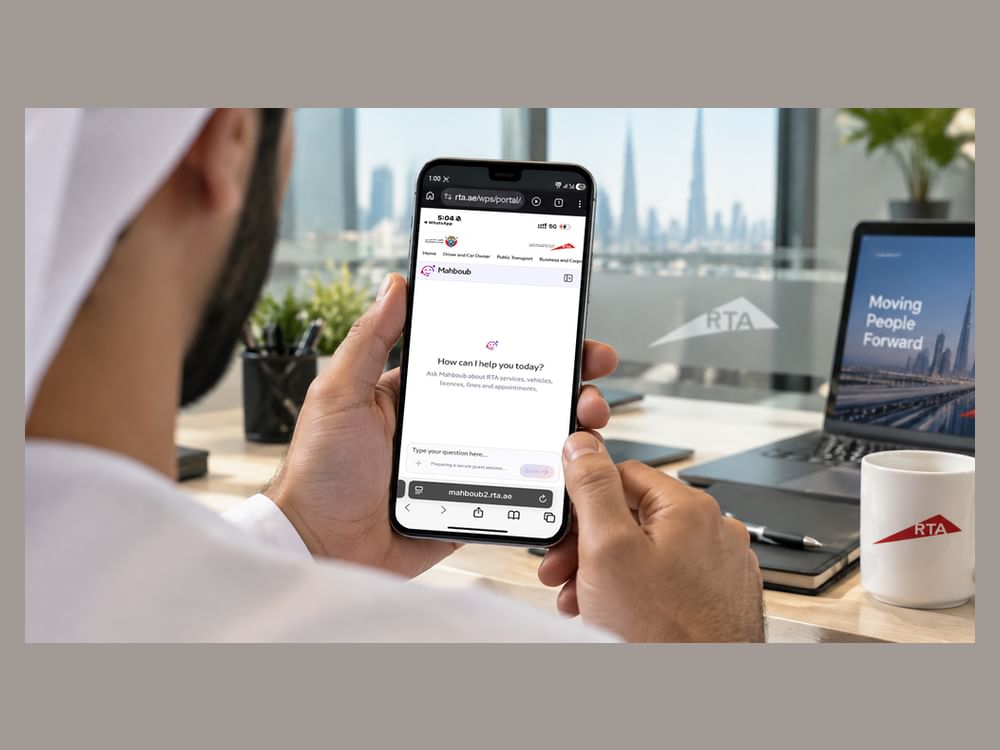
RTA is preparing Mahboub to coordinate fine payment and vehicle renewal in one conversation, but has not announced public availability.
Dubai vehicle owners, drivers, RTA service teams and government technology suppliers.
Public rollout date, supported channels, failure recovery and independent completion rates remain undisclosed.
RTA prepares the enhanced assistant for public rollout, initially focused on vehicle-licensing services.
Continue using official RTA channels; verify fines, UAE PASS prompts, payment receipts and the final registration status.
Dubai’s upgraded Mahboub assistant is being prepared to handle a chain of vehicle services in one conversation, including paying a fine before renewing registration. It is not yet a confirmed public rollout. That distinction matters to anyone expecting a chatbot to complete a time-sensitive government transaction today.
The Roads and Transport Authority (RTA) announced the new agentic-AI capability on 22 October 2026. The change is not that Mahboub suddenly answers questions about driving: it has done that for years. The proposed step forward is coordinating several authorised actions in sequence, with UAE PASS for identity verification and Dubai Sadad for payment. Drivers should continue using currently available official RTA channels until the new journey is explicitly released, and should check the final payment and renewal records rather than relying on a chatbot’s reassuring reply.
The upgrade is about completing a sequence
Consider a driver whose vehicle renewal is interrupted by an outstanding fine. A conventional chatbot may explain where to pay the fine and where to renew the registration. A connected assistant could, in principle, guide the user through both actions without making them restart a separate process after the payment. RTA’s October announcement uses that precise fine-payment-to-renewal sequence as its example.
The initial scope is narrower than a promise to operate every transport service. RTA names four vehicle-licensing activities: vehicle registration renewal, payment of vehicle fines, issuance of a clearance certificate and renewal of number plate reservations. It says specialised agentic components will coordinate the required steps according to the request. Arabic and English are supported, with language models adapted to local context.
There is an important status qualifier. RTA describes the enhanced version as being prepared for public rollout. It has not published a general availability date, a public list of supported accounts, a completed independent evaluation or a service-level guarantee for the new workflow. A resident should not assume the example is already available on every RTA channel. The agency’s announcement establishes a development milestone and intended scope, not evidence that a particular customer can complete the new flow this afternoon.
Mahboub was already more than a FAQ bot
RTA’s own history prevents the October announcement from being mistaken for the first time the assistant has handled transactions. In January 2024, RTA introduced driving-test appointment booking and rescheduling through Mahboub on WhatsApp, including related payments. Its announcement then described more than 250 informational and procedural services on that channel.
In August 2025, RTA reported that Mahboub provided 330 services across its website, apps and WhatsApp, including fines, vehicle renewals, nol top-ups and appointments. It also said the assistant had handled more than 27 million conversations and completed 800,000 transactions since launch. Those were cumulative figures published in 2025, not a fresh October 2026 performance measurement.
The same 2025 statement reported a 1.5% transfer rate to live chat and a reduction in call-centre demand of up to 70%. Those are RTA’s own operational claims, without the underlying cohort definitions or independent audit presented in the announcement. They should not be converted into a claim that 98.5% of conversations ended in a successful completed government transaction. An answered question, a chat that does not reach an agent and a paid renewal are different outcomes.
Robius’s updated guide to UAE driver apps explains which current official channels already handle driving and parking tasks. The agentic upgrade would change the interaction between steps, not abolish those existing service obligations or payment requirements.
Identity and payment remain separate controls
The new journey names two existing pieces of public infrastructure. UAE PASS authenticates the person requesting the service; Dubai Sadad handles the payment leg. Neither is simply an AI feature. Their roles matter because a conversational assistant must not be allowed to confuse an instruction to explain a payment with permission to execute one.
The federal digital-government service page describes UAE PASS as an identity and authentication mechanism used to access participating providers’ services. It is not itself the place where every government service is performed. The distinction is also central to Robius’s comparison of UAE PASS, DubaiNow, TAMM and RTA Dubai: identity, service ownership and the user-facing interface are related but different layers.
For a multi-step vehicle journey, a responsible design should make the transition between these layers visible. The customer needs to know which record is being retrieved, which fine or fee is being paid, which authority receives the payment and whether the renewal is actually completed. RTA says the upgrade follows its governance and cybersecurity procedures. It has not publicly detailed the exact approval screens, authorisation limits, error handling or transaction logs of the forthcoming version.
These are questions to ask at launch, not claims that a flaw exists. An AI model may be able to plan a sequence, but the authoritative records must still determine eligibility, the amount owed and the legal result. The safest design principle is to treat the model as a coordinator, not as the source of truth for the transaction.
One conversation can still contain several failures
Combining steps creates a simpler-looking experience, but it does not remove the separate dependencies. A fine payment can succeed while the renewal is delayed. An identity check can pass while the vehicle is not eligible for renewal. A payment authorisation can be abandoned before the final confirmation. Those are illustrative failure modes of a multi-system workflow, not incidents Robius has observed in Mahboub.
The difference matters most when money moves. A conversational message saying that a process is under way should not be treated as proof of a settled fine or renewed registration. Residents need a durable reference, a clear final status and a route to resolve an incomplete sequence without paying twice. The October announcement does not explain whether the new assistant will automatically resume failed journeys or how it will distinguish a pending payment from a confirmed one.
There is also a design question about reversibility. The assistant might correctly identify a fine and guide the customer toward payment, but an irreversible or difficult-to-reverse action should require a clear customer confirmation. Any later cancellation, correction or dispute still belongs to the relevant government service and payment rules. The words ‘agentic AI’ do not replace those rules.
This is why a government-service platform should be assessed through completed tasks rather than feature counts. Robius’s analysis of Abu Dhabi’s TAMM Global architecture examines a related problem: reusable digital workflows are valuable only when they remain accountable to the underlying institution and its legal process.
The rollout needs a different scorecard
RTA has not disclosed new public benchmarks for the upgraded Mahboub. That leaves room for a useful evaluation framework. First, measure end-to-end completion: of people who start an eligible vehicle journey, how many finish with a valid final record without switching channels? Second, measure correctness: how often does the system select the right account, vehicle, fee and service?
Third, measure recovery: when a step fails, can the customer see which actions completed and continue without duplicating a payment? Fourth, measure human escalation: are complex cases transferred with context, and can customers reach help when the assistant cannot resolve a problem? Finally, measure accessibility: do Arabic and English users, people with disabilities and residents less comfortable with conversational interfaces get equally usable routes?
These measures should be reported separately. A low transfer-to-agent rate can indicate an effective automated service, but it can also hide customers who abandon a conversation. A high number of interactions can indicate demand without proving completion. A five-minute average saving is meaningful only if the comparison includes the same type of transaction, the same eligibility conditions and a clear start and finish.
Robius recently covered Abu Dhabi Police’s sign-language service, where the essential test is whether a person can access a public service independently. The same standard should apply to a voice or text assistant: convenience for the typical user is not sufficient if difficult cases become invisible.
What Dubai drivers should do now
There is no need to install an unofficial ‘agentic Mahboub’ app or change how you pay a fine because of the announcement. RTA already provides official channels for checking vehicle expiry, fines and licensing services through its website and current apps. Use those existing routes for deadlines and payments while waiting for an explicit rollout notice.
When the new experience appears, start with the correct vehicle and traffic file. Read the displayed fine and renewal amounts, confirm that any UAE PASS approval corresponds to the service you initiated, and use the payment screen presented through the official channel. Save the final payment receipt and check that the renewal record itself has changed. A payment confirmation and a renewed registration are not necessarily the same record.
For unusual cases, such as disputed fines, account mismatches, plate-reservation problems or transactions that show as pending, use RTA’s official support route instead of repeatedly issuing the same instruction. Robius has not performed a hands-on test of the new agentic journey, and no current success rate for those edge cases has been established.
The next evidence is a live, accountable transaction
The October development is worth following because it moves the ambition from conversational information toward coordinated public-service execution. That is a meaningful technical and operational direction for Dubai, but the current evidence stops short of a public performance result.
The Robius conclusion: Mahboub’s next milestone is not how naturally it talks. It is whether an eligible resident can finish a multi-step vehicle transaction, see exactly what was authorised and paid, and recover safely when one part fails. Watch for a dated public release, supported channels and customer groups, independently understandable completion metrics, documented escalation and an explicit distinction between payment success and service completion. Until then, the existing RTA channels remain the practical choice.
Sources
- Dubai RTA, 22 October 2026: Mahboub agentic-AI upgrade, initial vehicle-licensing scope and public-rollout status
- Emirates News Agency, 23 October 2026: RTA upgrade and stated transaction sequence
- Dubai RTA, 19 August 2025: earlier Mahboub services and operator-reported usage figures
- Dubai RTA, 5 January 2024: WhatsApp appointment booking and payment history
- UAE Digital Government: UAE PASS identity, authentication and service-provider roles
- Dubai RTA official service portal: current vehicle, fine and licensing entry points
Checked 26 October 2026 against official RTA statements, the UAE Digital Government and Emirates News Agency. This is a source-based analysis, not a hands-on test of the unreleased upgrade. Service availability may change after publication.
Robius.news | Dubai, UAE | 2026 | Built to be first. Built to be trusted.