 UAE, UNFILTERED
A QR Code Can Now Verify Your Professional Skills
A QR code on a credential is only useful if scanning it answers a harder question: what exactly has been verified? Abu Dhabi Quality…
The card gives employers and regulators a direct way to verify an accredited certification instead of relying only on a PDF, screenshot or printed certificate.
Professionals, recruiters, HR teams, regulators and employers handling roles where verified technical or occupational competence matters.
A valid QR check proves the linked certification record; it does not automatically validate every CV claim, work history, trade license or job-specific legal requirement.
UAC says the scope is intended to expand to a broader range of certifications, qualifications and professional achievements.
If a candidate presents the card, scan it to verify the linked certification, then separately check any license, employment or role-specific requirement.
A QR code on a credential is only useful if scanning it answers a harder question: what exactly has been verified?
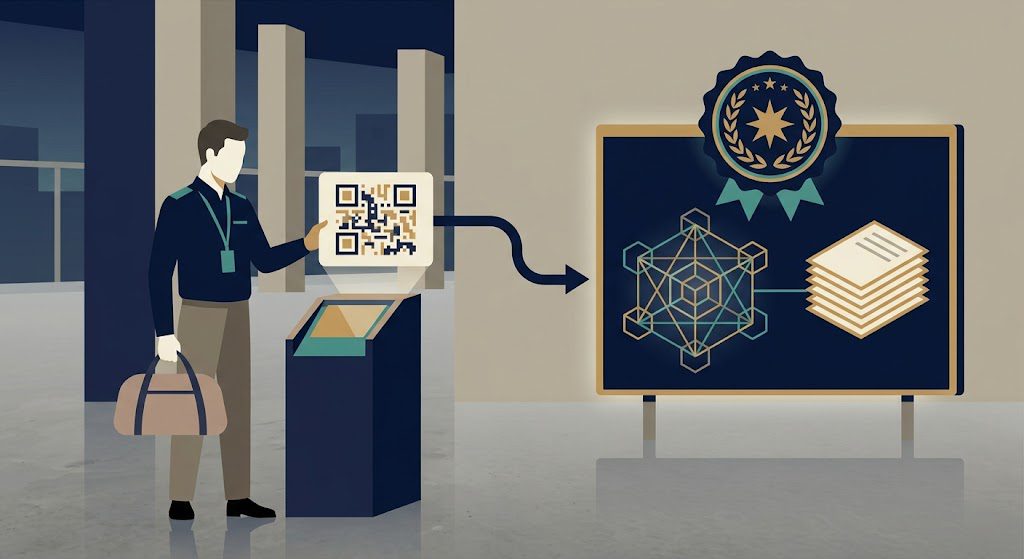
Abu Dhabi Quality and Conformity Council and Union Assessment and Quality Accreditation launched a Digital Skills Card on September 7. Each card is linked to a certification awarded through personnel conformity programs accredited by QCC and delivered by UAC. Employers, regulators and other stakeholders can scan the card to verify that certification’s validity and authenticity through ADI Chain.
That last sentence is the Robius part. The card can be genuine and useful without becoming a universal proof-of-person system.
What the QR Code Actually Proves
The launch material is specific. The card is linked to a certification. The QR code lets the checker confirm that certification’s validity and authenticity through the underlying digital infrastructure.
| Question | What the card supports | What still needs a separate check |
|---|---|---|
| Is the linked participating certification authentic? | Yes, the QR verification is designed for this. | Nothing beyond confirming the verification result and current validity. |
| Does the person have every skill listed on the CV? | No. | Check each material claim or credential separately. |
| Does the person hold a required UAE work permit or occupational license? | Not established by the card itself. | Check the relevant employer, regulator or licensing authority. |
| Does the credential prove work experience or performance? | No. | Check references, employment records, assessments or other evidence. |
That distinction protects both sides. A professional should get credit for a credential that can be verified cleanly. An employer should not turn one verified credential into a blanket assumption about everything else on the application.
This Is More Useful Than a Screenshot of a Certificate
Traditional credential checks are surprisingly weak in practice. A PDF can be edited. A screenshot can be copied. A paper certificate can be difficult to verify outside the issuing organization.
A direct verification path improves that. The receiving party can check the status against the system rather than judge the document by how official it looks. That is the same basic reason public registers are more useful than logos when Robius checks brokers, apps or regulated companies.
We made a similar distinction in our analysis of BOTIM One Credential: the product label matters less than the specific capability underneath it. Here the useful capability is not ‘blockchain.’ It is that the employer can verify a named credential without trusting the candidate’s copy alone.
The Blockchain Is Infrastructure, Not the Proof by Itself
The launch uses ADI Chain as the verification infrastructure. That may help create a tamper-resistant record and a portable verification path. But the word blockchain should not do more work than the evidence.
The real trust chain starts earlier. QCC accredits the personnel conformity programs. UAC delivers them and awards the certification. The digital card then gives another party a way to verify the resulting credential.
If the underlying assessment is weak, putting the result on a blockchain does not make the skill stronger. If the underlying certification is meaningful, the digital record can make it easier to prove.
A Credential and a Legal Permission Are Still Different Things
This matters in a job market where people increasingly advertise certificates, short courses and specialist badges. Our UAE AI skills analysis argued that demonstrated capability is becoming more important than simply saying you know a tool. The Digital Skills Card can strengthen the evidence around a recognized credential, but it still does not show how somebody performs in the job.
The same separation already appears in our online coaching guide. A professional credential can answer one question, while a UAE business license answers another. A Digital Skills Card should not collapse those questions into one badge.
There is also a broader UAE pattern here. UAE PASS is becoming a document, identity and consent layer across government and private services. The Skills Card applies a similar idea to professional evidence: make the verified record portable enough that another party can check it directly.
What Is Still Unclear at Launch
The public launch materials reviewed by Robius do not provide a complete catalogue of every certification currently eligible, nor do they set out one universal fee or validity period for all future credentials. Those details can vary with the underlying certification program and should be checked at the program level.
That is not a flaw in the concept. It is a reason not to treat the existence of the card as the whole answer. Recruiters should ask what certification sits behind it, who issued it, whether it is current and whether that certification is relevant to the role being filled.
The Robius Layer: Verify the Claim the Card Was Built to Verify
The best use of the Digital Skills Card is narrow and strong. A person says they hold a participating credential. You scan the card. The system confirms whether that credential is authentic and valid.
Do not ask the card to prove more than that. It is not a universal employment background check, not a work permit and not evidence that every line on a CV is true.
That restraint is what makes the product useful. Good verification systems are strongest when everybody knows exactly what the green check means.
Sources
- Emirates News Agency (WAM): Official launch details from QCC and UAC, including the accreditation chain, QR verification and ADI Chain. https://www.wam.ae/en/article/c24l25t-abu-dhabi-launches-region%E2%80%99s-first
- The National: Independent UAE reporting on how employers and officials can verify certification authenticity and the planned expansion of the card. https://www.thenationalnews.com/news/uae/2026/09/07/abu-dhabi-blockchain-verified-digital-skills-card/
Robius.news — Dubai, UAE — 2026 | Built to be first. Built to be trusted.