
Independently researched from Meta, ARPA-H, the University of Pittsburgh, HERL, and UAE government policy. Checked on August 5, 2026.
A mobility device approaches a curb. Its cameras identify the edge, the AI interprets the scene, and the control system must react before a small perception error becomes a physical one. In assistive robotics, a useful answer is not enough. The machine has to behave safely in the same unpredictable world as its user.
On-device vision could increase independence and offline responsiveness, but a research prototype has not yet established product-level safety or availability.
UAE rehabilitation centers, hospitals, mobility programs, assistive-technology buyers, clinicians, engineers, and People of Determination should watch the project.
UAE organizations could evaluate assistive robotics against local heat, glare, surfaces, door systems, languages, and accessibility needs.
Battery, heat, prediction errors, maintenance, connectivity, and failure behavior remain material, while the current system is still a prototype.
The team plans real-world testing, voice and touch controls, stronger temporal consistency, and deeper integration between perception and control.
Require local user testing, documented fail-safe behavior, manual control, environmental validation, maintenance support, and clear responsibility before procurement.
People with limited mobility benefit if the platform reliably reduces physical effort while preserving user control and safe manual operation.
RAMMP remains a US research consortium project; the sources checked announce no public UAE trial, purchase route, or commercial availability.
Watch for user-trial evidence, safety metrics, manual override, incident reporting, product certification, price, maintenance, and UAE deployment.
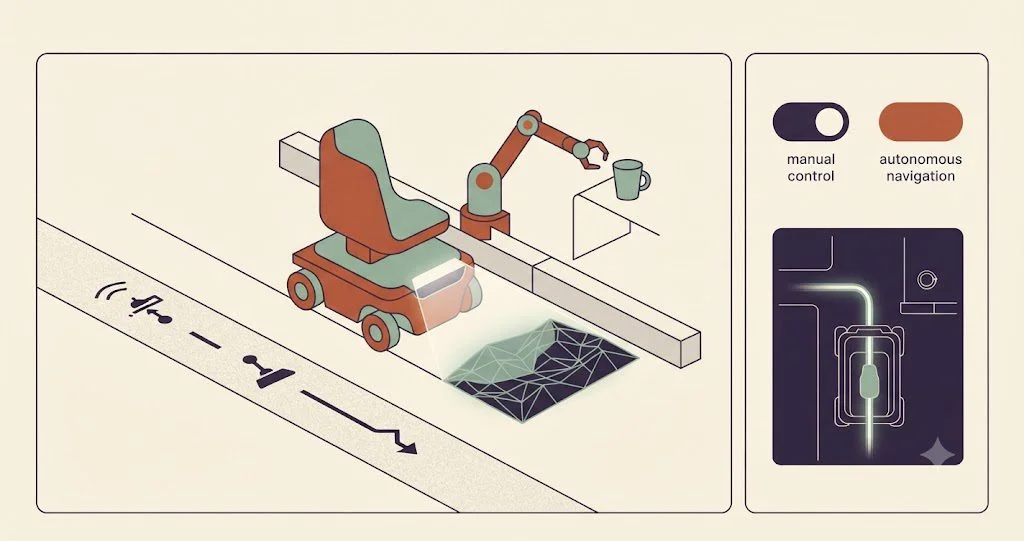
Meta’s July 27 update describes RAMMP, a University of Pittsburgh-led robotic mobility and manipulation project using DINO and Segment Anything vision models. The first prototype can identify automatic door buttons, cups, and curbs or ground for navigation assistance. It is ready for real-world testing, not ready for ordinary purchase.
The Robius question is not whether the AI recognizes a curb once. It is whether the full device remains predictable after hours of use, poor connectivity, glare, heat, dust, crowded spaces, battery decline, and an unexpected object entering the path.
What RAMMP Actually Is
RAMMP stands for Robotic Assistive Mobility and Manipulation Platform Providing Independence for People with Disabilities. The University of Pittsburgh’s Human Engineering Research Laboratories leads the project with a wider consortium that includes clinicians, engineers, wheelchair users, advocacy groups, and technology partners.
The system combines powered mobility, a robotic arm, environmental sensing, artificial intelligence, a new open-source assistive-technology operating system, and a digital twin used to test behavior in simulated environments. The official ARPA-H award page lists funding of up to $41 million. Meta and Pitt materials describe up to $41.5 million, so Robius uses the funder’s live figure.
This is not simply a wheelchair with a camera. The ambition is a platform that can perceive an environment, help negotiate obstacles, interact with objects, and reduce the number of separate controls a user must manage for an everyday task.
Why the AI Runs on the Device
Meta says the project processes camera and sensor information on the device. That matters because a curb, moving person, dropped object, or doorway requires an immediate response. A cloud round trip introduces delay and creates dependence on network coverage at the moment the system needs to act.
Local processing can therefore be a safety and continuity feature. It can also reduce how much raw visual data needs to leave the device. But edge computing forces trade-offs. The hardware is battery-powered and constrained by heat, memory, size, weight, and power consumption.
The team is optimizing DINO and SAM-derived systems for practical resolutions and efficient processing. Meta says the design may trade some boundary precision or feature detail for speed and stability. That is a reasonable engineering choice, but it turns the test from benchmark accuracy into failure behavior.
A Prototype Is Not a Product
The first prototype is meaningful because the vision system is already being integrated into a physical device. The team reports that it can identify door buttons, cups, and curbs or ground, and that this functionality is ready for real-world testing. Engineers are also developing voice and touch interaction.
Those are development milestones. They do not establish a commercial release date, a purchase price, medical or product certification, maintenance coverage, battery performance, service life, insurance treatment, or availability outside the United States. The sources checked announce no UAE trial or sales route.
That distinction is similar to the availability boundary in our ChatGPT Health review. A real product or research system can be important without being locally available, locally integrated, or ready for the decision a UAE reader wants to make today.
Accuracy Is Not the Safety Test
A vision model can perform well on a dataset and still fail in the conditions that matter to one user. Curbs vary in color, height, damage, shadow, and surface. Door buttons appear at different angles. Transparent objects, reflective floors, crowded entrances, and abrupt motion can change the scene faster than a static benchmark captures.
For an assistive device, the important questions are temporal and operational. Does the object remain identified as the platform moves? What happens when confidence falls? Does the device slow, stop, ask the user, or continue? Can the user override it immediately? Does one sensor failure degrade safely or create a new hazard?
The project’s participatory design is a strong foundation because wheelchair users, clinicians, and advocacy groups are involved. It does not remove the need for published trial evidence across different disabilities, environments, body positions, control preferences, and levels of fatigue.
The UAE Fit Is Real, but Local Evidence Is Missing
The UAE’s National Policy for Empowering People of Determination includes health and rehabilitation, supportive technologies, accessible environments, employment, and participation in public life. Assistive robotics fits that policy direction because the value is not novelty. It is independent access to ordinary places and tasks.
The country is also building deeper healthcare AI capability, including the Abu Dhabi and MIT cancer research hub. But research capacity does not automatically produce a locally validated mobility product. Rehabilitation centers and procurement teams would still need evidence from the environments where the device will operate.
Heat, direct sunlight, reflective surfaces, dust, steep transitions, building thresholds, automatic-door systems, lift layouts, Arabic and English voice input, and long distances inside malls, hospitals, airports, and public facilities are not cosmetic localization issues. They can change perception, battery use, user effort, and safe fallback behavior.
What a UAE Buyer Should Demand
| Requirement | Why It Matters | Evidence to Request |
|---|---|---|
| Local environment | Vision and control may behave differently in heat, glare, dust, reflective floors, ramps, curbs, and crowded entrances. | Trials across representative UAE indoor and outdoor routes, with failure cases and weather conditions recorded |
| User control | Semi-autonomous assistance should reduce effort without taking away immediate control from the user. | Manual override, stop behavior, confidence prompts, configurable assistance, and user-led acceptance testing |
| Battery and heat | On-device AI, motors, sensors, and a robotic arm compete for power and create heat. | Operating time by workload, thermal limits, recharge cycle, degradation plan, and safe low-power behavior |
| Failure behavior | A wrong detection can become movement, contact, a fall risk, or a dropped object. | Hazard analysis, sensor-failure tests, safe-stop logic, incident logs, and recovery procedure |
| Maintenance | A device that depends on cameras, software, motors, and models needs long-term local support. | Parts availability, technician training, update policy, service times, warranty, and manual-use route during repair |
| Data and updates | Cameras and logs may capture people and places, while model updates can change behavior. | Data map, local storage rules, access controls, update approval, version history, and rollback |
| Accessibility | Voice and touch controls must work for different speech, dexterity, vision, fatigue, and cognitive needs. | Co-design records, Arabic and English testing, alternative inputs, and results across diverse users |
Connected Intelligence Creates a Second Risk
A device can process locally and still connect for updates, diagnostics, tele-support, fleet management, or data review. Every remote route that helps a technician can also become a security and continuity dependency if identity, permissions, logging, and revocation are weak.
Our analysis of remote access inside critical infrastructure focused on larger physical systems, but the principle carries over. Remote visibility is also remote reach. Assistive devices need signed updates, named support access, time-limited permissions, session records, and a safe mode when connectivity is unavailable.
Cybersecurity should not make the device harder for the user to operate. The goal is invisible control around the support route, not extra prompts placed on a person who already depends on the equipment.
Open Source Does Not Mean Ready to Deploy
ARPA-H describes an open-source assistive-technology operating system as a foundation for future development and commercial applications. That can improve interoperability, research access, and the ability of other teams to build compatible functions.
Open source does not answer product questions by itself. A buyer still needs to know who integrates the components, validates the full device, signs off on safety, supplies parts, supports updates, handles incidents, and remains responsible when the system changes.
The UAE’s Artificial Intelligence and Data Authority creates a stronger national center for AI and data governance. A future local deployment would still need healthcare, product, accessibility, privacy, and service responsibilities to meet at the device, not remain divided across institutions and suppliers.
The Bottom Line
RAMMP is a serious assistive-robotics project with real public funding, a physical prototype, user-centered design, on-device vision, and a clear next testing phase. The ability to detect curbs, door controls, and objects points toward more independent mobility and manipulation.
The honest status is still promising but unproven. The project has not published the product evidence a UAE hospital, rehabilitation center, insurer, family, or user would need for procurement. Local conditions, safety behavior, manual control, battery life, maintenance, certification, data handling, and price remain open.
The best future version will not be the one that appears most autonomous in a demonstration. It will be the one that gives the user more control, fails predictably, works without perfect connectivity, and remains supportable long after the first camera recognizes the curb.
Sources
• Meta AI: Official July 27 technical update covering DINO and SAM use, on-device processing, prototype capabilities, engineering trade-offs, real-world testing, and participatory design. https://ai.meta.com/blog/assistive-robotics-university-of-pittsburgh-sam-dino/
• ARPA-H: Official award record describing the open-source assistive-technology operating system, digital twin, semi-autonomous goal, University of Pittsburgh leadership, and funding of up to $41 million. https://arpa-h.gov/explore-funding/awards/2771
• Human Engineering Research Laboratories: Official RAMMP project page describing 360-degree awareness, adaptive control, robotic-arm integration, AI, and simulated testing. https://www.herl.pitt.edu/rammp
• University of Pittsburgh: Official prototype reporting covering curb navigation, door opening, object handling, physical controls, and the research-stage demonstration. https://www.pittwire.pitt.edu/features-articles/2026/04/23/herl-rammp-wheelchair-arpa-h
• UAE Government: Official National Policy for Empowering People of Determination covering health, rehabilitation, supportive technology, accessibility, employment, and participation. https://u.ae/en/about-the-uae/strategies-initiatives-and-awards/policies/social-affairs/the-national-policy-for-empowering-people-with-special-needs
Robius.news — Dubai, UAE — 2026 | Built to be first. Built to be trusted.