

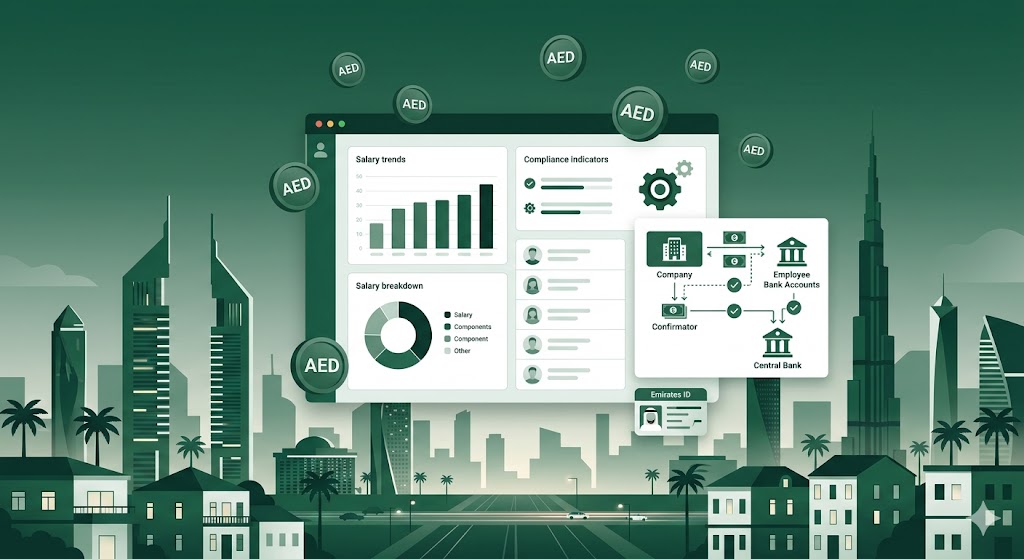
UAE payroll software 2026
UAE Payroll Software 2026: Which One Actually Handles WPS and Gratuity Without You Doing It Manually
Payroll in the UAE is not like payroll anywhere else. Every employer with at least one worker on a UAE bank account must comply with the Wage Protection System. Every employee is entitled to end-of-service gratuity calculated to a specific formula under UAE Labour Law. Get either wrong and MOHRE can fine you, block your trade licence renewal, or suspend your business licence for repeat violations.
The problem is that most payroll software on the market is global first and UAE second. A tool built for the UK or the US and tweaked for the Gulf is not the same as one built for the UAE from the ground up. Here is how to tell the difference, and which tools are actually worth your time.
| THE VERDICT: Bayzat for UAE-native compliance. Zoho Payroll for value under 50 staff. For an SME that wants WPS and gratuity handled correctly out of the box, without an implementation project or a consultant, Bayzat is the most straightforward path. It was built in the UAE for UAE businesses and WPS compliance is default, not a setting. Zoho Payroll at AED 7 to 11 per employee per month is the best-value option for smaller teams. Global tools like Gusto, Rippling, and Sage do not operate in the UAE context and should not be on your shortlist. |
The Two Things UAE Payroll Cannot Get Wrong
Before comparing tools, understand what the compliance requirements actually are, because this is where most guides skip the detail you need.
First, WPS. The Wage Protection System is run by MOHRE and requires that every UAE-registered employer pay employees through MOHRE-approved financial channels using a Salary Information File, or SIF. The SIF is a standardized file format that banks use to process WPS-compliant salary payments. Your payroll software must generate a correct SIF file every pay cycle. If it generates an incorrect file, your bank rejects the payment and you miss the WPS deadline. Miss it and MOHRE flags your account. Repeat violations can result in a ban on new work permit approvals and eventually business license suspension.
Second, end-of-service gratuity. UAE Labour Law requires that employees who complete at least one year of service receive a gratuity payment calculated as a specific multiple of their last basic salary. The formula differs depending on whether the contract is fixed-term or indefinite, and the gratuity accrues progressively over the employment period. The calculation is not complicated, but it is specific, and it must be tracked from day one. Your payroll software should accrue gratuity automatically and calculate the correct payout on termination. Doing this on a spreadsheet is where mistakes happen.
Some employers in the DIFC also need to handle DEWS, the DIFC Employee Workplace Savings scheme, which replaces the standard gratuity structure. Not all payroll software supports DEWS.
What to Look For Before Paying
Three questions for any payroll vendor before signing.
Does it generate WPS-compliant SIF files automatically and submit directly to your bank, or does it just export a file you then manually upload? The second is fine, but it is an extra step and an extra chance for error. The first is better.
Does it calculate gratuity automatically for both fixed-term and indefinite contracts, accrue it monthly, and produce a settlement calculation on exit? This should be a default feature, not a paid add-on.
Is it regularly updated when UAE Labour Law changes? The new UAE Labour Law that came into force in February 2022 changed several key provisions around probation, notice periods, and contract types. Tools that were not updated for this are giving you wrong calculations.
The Tools Worth Considering
Bayzat is the strongest UAE-native option for SMEs. It was founded in the UAE, built specifically for the local market, and its WPS compliance is not a regional setting on a global engine. It is the actual engine. SIF file generation, gratuity calculation for both contract types, bilingual payslips in English and Arabic, MOHRE compliance updates built in, and a mobile app for employees. It integrates with its own HRMS module and with leading accounting tools. Pricing is on request and scales by headcount, which means it is not always the cheapest entry point, but for a business that wants to get UAE payroll right without building expertise in-house, it is the most reliable starting point.
Zoho Payroll at AED 7 per employee per month on the standard plan, or AED 11 on professional, is the best-value option in the market for teams under around 50 people. It generates WPS-compliant SIF files automatically, calculates gratuity for both contract types, integrates cleanly with Zoho Books for accounting journal entries, and supports Emiratisation compliance tracking. If you are already in the Zoho ecosystem for accounting, the integration is seamless. The catch is that Zoho’s support quality at lower price tiers is inconsistent, and complex setup scenarios often need a local Zoho partner rather than the global support line.
Yomly, founded in Dubai, is positioned at the upper end of the SME market and into mid-enterprise. It is GCC-native, handles GPSSA contributions for Gulf nationals, multi-currency payroll, and cost-centre breakdowns. It is more capable than Bayzat for more complex organisations but comes with a correspondingly more involved implementation.
Odoo payroll, as part of the broader Odoo ERP, handles WPS and gratuity and has the advantage of integrating directly with Odoo Accounting and Odoo HR. For SMEs already on Odoo for other functions, adding payroll makes sense. For businesses not already on Odoo, it is heavy for standalone payroll.
The Tools to Avoid for UAE Payroll
Gusto, Rippling, and Deel in their standard forms are not UAE payroll tools. They operate in US and European markets primarily, and their UAE handling is either not available, incomplete, or dependent on a local EOR arrangement that changes the cost and the employment structure significantly.
Generic accounting tools like QuickBooks Desktop or older versions of Sage that let you run payroll through a journal entry are not WPS-compliant. They can track salaries as an accounting entry but cannot generate a SIF file or manage gratuity accrual correctly. Using them for payroll in the UAE means you are doing the compliance work yourself on the side, which is where errors and fines originate.
And spreadsheets. A well-built Excel spreadsheet can produce a roughly correct salary calculation, but it cannot generate a SIF file, it does not update when labour law changes, and it scales to about ten employees before it becomes the main source of your payroll errors. If you are on a spreadsheet today, that is fine as a starting point. It is not fine at fifteen people.
The Side by Side
| Tool | Best for | WPS SIF | Gratuity | Price / employee / month |
|---|---|---|---|---|
| Bayzat | UAE-native compliance, all sizes | Yes, automatic | Yes, both contract types | On request |
| Zoho Payroll | SMEs under ~50, Zoho ecosystem | Yes, automatic | Yes, both types | AED 7-11 |
| Yomly | Mid-market, GCC nationals, GPSSA | Yes | Yes, multi-entity | On request |
| Odoo Payroll | Existing Odoo users | Yes | Yes | Part of Odoo stack |
| QuickBooks / Sage | Accounting only | No | Manual only | Not applicable |
The Honest Things to Know Before You Sign
Implementation matters more than the software. The best UAE payroll tool in the world configured incorrectly still produces wrong SIF files. Before you go live, run a parallel payroll for one month, your existing manual process and the new tool side by side, and reconcile every line. Any difference is a configuration error you want to find before it is a compliance issue.
Pricing always grows with headcount. AED 11 per employee per month sounds negligible at ten people. At fifty people it is AED 6,600 a year. At 200 people it is AED 26,400. Get a quote at your expected headcount in twelve months, not today.
Ask specifically about DEWS if you operate in the DIFC or plan to. Not all tools support it and finding out after onboarding your team is the worst timing.
And check the last time the vendor updated their UAE Labour Law calculations. Ask them directly. February 2022 is the most important update. If they cannot confirm their software reflects the current law, move on.
The Bottom Line
WPS compliance is not optional, gratuity is not optional, and the software that handles both correctly is not the same as the software that says it handles both correctly. For most UAE SMEs with under fifty staff, Bayzat or Zoho Payroll are the two most honest starting points. Bayzat if you want UAE-native compliance and do not mind on-request pricing. Zoho if you want transparent per-employee pricing and are already using Zoho for accounting.
The spreadsheet era ends the day you hire your tenth employee. At fifteen it becomes a liability. Pick the tool before MOHRE picks your non-compliance for you.
Sources
• Bolto: UAE payroll software 2026, top 15 WPS-compliant picks — https://www.bolto.com/blog/payroll-software-uae-wps-compliant-guide
• BestStartupStory: best HR software UAE, Bayzat and Zoho WPS compliance review — https://www.beststartupstory.com/blogs/best-hr-software-uae-payroll-wps-compliance/
• Decibel360: payroll software Dubai 2026, seven best WPS-compliant tools — https://decibel360cloud.com/ae/payroll-software-dubai-2026-7-best-wps-compliant-tools/
• Perfonec: UAE WPS payroll integration guide, Zoho and Odoo — https://perfonec.com/uae-wps-payroll-integration-odoo-zoho-tally-2026/
• MOHRE: Wage Protection System, rules and penalties — mohre.gov.ae
• UAE Federal Decree-Law No. 33 of 2021 (UAE Labour Law), end-of-service gratuity provisions
Robius.news — Dubai, UAE — 2026 | Built to be first. Built to be trusted.