
Starlink Is Now Live in the UAE
For the first time in the UAE’s history, you can get home internet without Etisalat or du.
Elon Musk’s Starlink satellite internet officially launched in the UAE on March 18, 2026. The country now appears on Starlink’s live availability map. Anyone can order a kit from the Starlink website, point a dish at the sky, and connect.
The launch generated a lot of excitement and a lot of confusion. Is it faster than fibre? Is it cheaper? Does it get around UAE internet restrictions? Should you switch?
We dug into the pricing, the fine print, and the honest use cases. Here is everything UAE residents need to know before spending a dirham.
What Starlink Actually Is
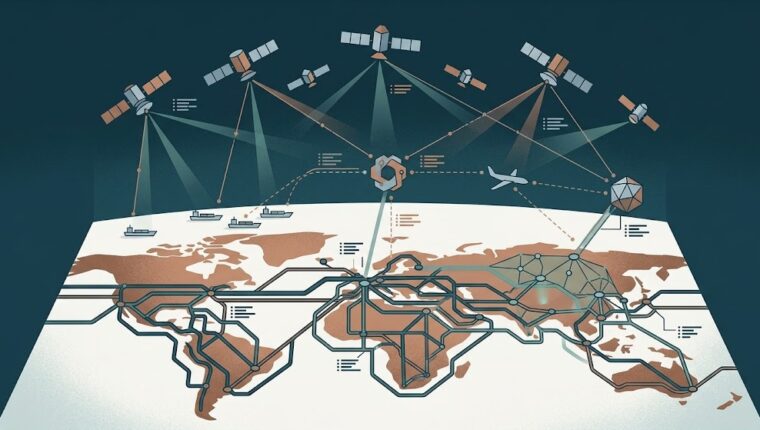
Starlink is satellite internet built by SpaceX. Instead of cables under the ground or towers on buildings, it uses thousands of small satellites orbiting close to Earth. A dish on your roof talks to those satellites directly.
That design means Starlink works anywhere with a clear view of the sky. A farm in Al Ain. A majlis in the desert. A boat off the coast of Fujairah. A construction site with no fibre for kilometers. Places where Etisalat and du coverage is weak or nonexistent.
Starlink operates in the UAE under a TDRA licence granted in 2024 and valid for ten years. This is a fully legal, fully regulated service. It does not require a du or Etisalat account.
The Real Costs in AED
| Plan | Price | What you get |
| Residential Lite | AED 230/month | Unlimited data, standard speeds. The entry point for homes. |
| Residential | AED 300/month | Unlimited data at maximum available speed. |
| Business | From AED 248/month | Priority network access for companies and sites. |
| Roam 100GB | AED 190/month | Portable use across the region. 100GB monthly cap. |
| Roam Unlimited | AED 370/month | Portable with unlimited data. Billed in USD, so AED varies. |
Then there is the hardware. The standard kit costs AED 1,099 to AED 1,465 depending on configuration, and around AED 1,545 including shipping. Delivery takes one to two weeks, though demand since launch has pushed some orders out longer. The kit includes the dish, router, cables, and mounting base.
Installation is self-service through the Starlink app. You mount the dish somewhere with unobstructed sky access, connect the cables, and configure WiFi in the app. Professional mounting help exists in the market but is optional for most setups.
Total first-year cost on Residential Lite: roughly AED 4,300 including hardware. Compare that to an entry-level Etisalat or du fibre plan over the same period before deciding.
The Restriction Nobody Mentions Loudly
Here is the detail that matters most for many residents considering Starlink.
Starlink in the UAE operates under UAE telecom regulations. The same content filtering and VoIP restrictions that apply to Etisalat and du apply to Starlink. WhatsApp calling and other unlicensed VoIP services are subject to the same rules they have always been subject to.
If part of the appeal of satellite internet was the idea of bypassing UAE internet rules, that is not what this is. Starlink is a licensed UAE telecom service operating under TDRA oversight. Anyone telling you otherwise is selling you something.
Honest Answer: Is It Faster Than Fibre?
In cities, no.
If you live in Dubai or Abu Dhabi with access to Etisalat or du fibre, the fibre is faster, the latency is lower, and the bundled packages offer better value. A du or Etisalat fibre plan delivers higher speeds than Starlink at a comparable or lower monthly price, without AED 1,500 in upfront hardware.
Starlink is not a fibre replacement for city residents. It is something else entirely: connectivity for the places fibre does not reach.
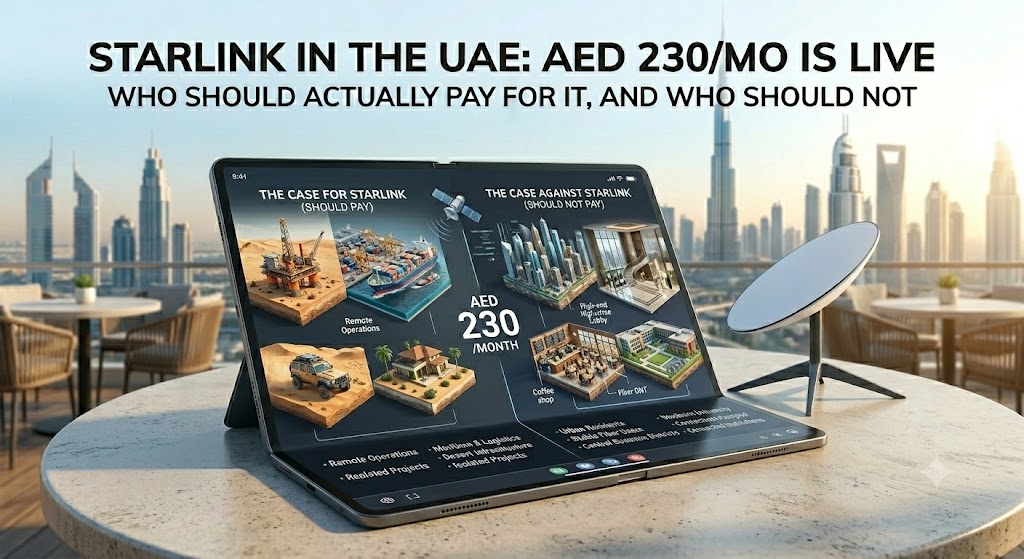
Who Should Actually Get It
- Residents of remote areas: farms, desert properties, majlises, and communities where fibre has never arrived and 4G hotspots choke. This is the core use case and Starlink is genuinely transformative here.
- Construction and site businesses: a site office in Al Ain with no fibre, drone survey teams uploading data, CCTV that keeps dropping. The Business tier was built for exactly this.
- Boat owners: maritime use is approved in the UAE. Connectivity off the coast was previously expensive satellite phone territory. Starlink changes that completely.
- Backup internet for businesses that cannot go down: the Red Sea undersea cable cuts earlier this year slowed internet across the region. Starlink does not depend on undersea cables. For a business where downtime costs real money, a Starlink kit as a failover line is genuine insurance.
Who Should Skip It
- City residents with fibre access: you would pay more for slower internet. Keep your fibre.
- Anyone hoping to bypass UAE internet rules: that is not what this service does.
- Renters in apartments: the dish needs clear sky access. Most apartment buildings make mounting impractical or against building rules. Check with building management first.
The Bigger Picture
The significance of the Starlink launch goes beyond who buys a dish this month.
For the first time, the UAE internet market has a third operator. Etisalat and du have shared the market between them for decades. Starlink will not threaten them in the cities. But in the areas they have historically underserved, there is now an alternative, and alternatives have a way of improving everyone’s behaviour.
It also strengthens the UAE’s infrastructure resilience. A country whose connectivity does not depend entirely on undersea cables is harder to disrupt. The regional internet slowdowns earlier this year made that case better than any press release could.
The Bottom Line
Starlink in the UAE is real, legal, and live. From AED 230 per month plus around AED 1,500 in hardware.
For city residents with fibre, it is not for you, and that is fine. For the farm in Al Ain, the boat in Fujairah, the desert majlis, and the construction site that has fought with a 4G hotspot for years, it is the best news in a decade.
Buy it for what it is. Skip it for what it is not.
Robius.news — Dubai, UAE — 2026 | Built to be first. Built to be trusted.