 UAE, UNFILTERED
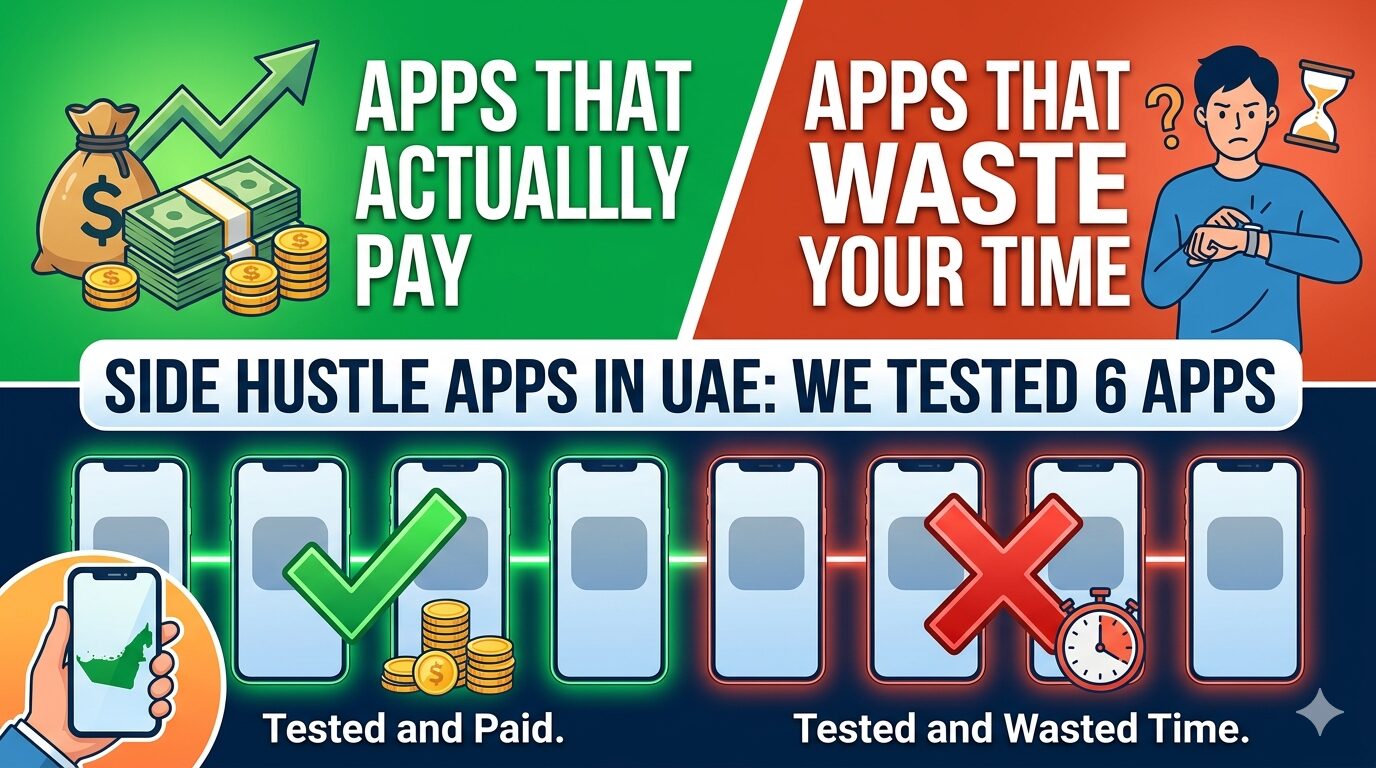
Side Hustle Apps in the UAE: 5 That Can Pay, and What to Skip in 2026
A real side hustle pays you for work. A fake one asks you to pay first. That sounds obvious until the fake app gives…
The short answer
A real side hustle pays you for work. A fake one asks you to pay first. That sounds obvious until the fake app gives…
A real side hustle pays you for work. A fake one asks you to pay first.
That sounds obvious until the fake app gives you a dashboard, a balance, daily tasks, and a recruiter on WhatsApp telling you that one more deposit will unlock your earnings. The UAE has seen enough of those schemes that the first question should not be, “How much can I make?” It should be, “Am I being paid for a service, or am I being asked to fund the job?”
We checked the current platform terms and the UAE rules around part-time work, freelancing, tutoring, tax, and paid social content. Five platforms can genuinely pay. None of them guarantees useful income, and some are much better as occasional pocket money than as a second salary.
| T H E R O B I U S V E R D I C T CAUTION: Upwork, Fiverr, Preply, UserTesting, and Respondent are real platforms that can pay for real work or research participation. The income claims around them are where the hype starts.Do not pay to unlock tasks, increase your earning level, release a withdrawal, or activate a job. And before you turn any platform into regular paid work, make sure your UAE work authorization matches what you are actually doing. |
The Quick Ranking
| Platform | Best for | Robius take | Current fee / payout reality |
| Upwork | Skilled freelance work | Best chance of meaningful side income | Freelancer fee varies by contract, currently 0% to 15% |
| Fiverr | Productized digital services | Real, but crowded and slower to build | Freelancer receives 80% of each completed order |
| Preply | Tutoring | Strong if you can teach and retain students | 100% commission on trial lesson, then 18% to 33% |
| UserTesting | Occasional usability tests | Legit pocket money, not predictable income | Reward shown before each test; PayPal, usually about 14 days |
| Respondent | Research interviews | Can pay well per study, but UAE volume may be thin | Incentives vary; participant fee is 5% or $1 |
1. Upwork: The Best Option If You Already Have a Skill
Upwork is the strongest option on this list if you can already do something a business will pay for: writing, design, development, finance, marketing, data work, translation, consulting, or specialist admin work.
The important update is the fee. The old version of this article said Upwork charged 20% on the first $500 with a client, then 10%, then 5%. That is outdated. Upwork now says its freelancer service fee can range from 0% to 15% per contract, and the exact percentage is shown before you submit a proposal or accept an offer. Once the contract starts, that percentage is fixed.
Upwork supports freelancers in more than 180 countries and tells users they are responsible for complying with local work-authorization rules. That last sentence matters in the UAE. The app giving you an account does not give you permission to work.
What makes Upwork useful is that the client is paying for a defined professional output. There is no reason for a freelancer to send money to a client to access a project. In fact, Upwork prohibits jobs that require freelancers to make cash deposits or handle money transfers.
Best use: build a narrow profile around one real skill and a specific buyer. “Marketing” is weak. “B2B content for UAE fintech companies” gives a client a reason to pick you.
2. Fiverr: Real, but the Storefront Has to Earn Its Traffic
Fiverr is also legitimate, but it works differently. On Upwork, you apply for jobs. On Fiverr, you package a service and wait for buyers to find or select it.
Fiverr’s current earnings guidance says freelancers receive 80% of the purchase amount for completed orders, including Gig Extras and tips. In other words, a $100 order leaves $80 in freelancer earnings before your own tax obligations or payout costs.
That makes Fiverr easy to understand and hard to grow. A generic logo-design or article-writing offer competes with an enormous catalog. A narrowly defined service has a better chance. Think Arabic-English e-commerce copy for UAE retailers, Power BI dashboards for small businesses, or real-estate listing videos for Dubai brokers, assuming you have the skill and the right legal setup.
Do not copy the old article’s claim that Fiverr fees drop to 10% and then 5% as you earn more. Fiverr’s current public earnings page says you earn 80% of completed orders.
3. Preply: Better Economics If You Can Actually Teach
Tutoring is one of the cleaner side-hustle models because the value exchange is obvious: a student pays for your time and expertise. Preply can connect tutors with students globally, but its fee structure is heavier than many new tutors expect.
Preply takes 100% of the first trial lesson with a new student. For later lessons, the commission ranges from 33% for new tutors down to 18% as your total teaching hours increase. That means the platform makes more sense when you retain students for repeat lessons, not when you live on one-off trials.
The UAE also has a specific Private Tutor Work Permit. MOHRE’s current service page says the permit is valid for two years and lists no service fee. Employees in other sectors and teachers generally need a no-objection letter from their employer, while holders of a part-time work permit are exempt from that employer-approval requirement.
So tutoring can be a very sensible side hustle, but do the permit check before building a weekly roster of students.
4. UserTesting: Real Money, but Do Not Build a Monthly Budget Around It
UserTesting pays contributors to test websites, apps, prototypes, and digital experiences. The platform says the reward for a test is shown before you accept it, and payments are sent to a verified PayPal account, usually around 14 days after you complete the test.
That makes it legitimate. It does not make it reliable. Qualification depends on the customer’s target audience, and many screeners will not match your profile. The right way to think about UserTesting is occasional extra cash when a suitable test appears, not a repeatable hourly job.
If an app claims to be “like UserTesting” but asks you to recharge a wallet or deposit money before taking tasks, it is not the same business model at all.
5. Respondent: Higher-Value Studies, Fewer UAE Opportunities
Respondent recruits people for research interviews and studies. Researchers set the incentive, and the platform says participant incentives can range from $5 to $1,000 depending on the project. A 5% or $1 fulfillment fee applies to the participant’s incentive.
The catch for UAE residents is volume. Respondent’s 21 primary target markets do not currently include the UAE. Researchers can still use worldwide recruiting methods, so UAE residents may qualify for international or specialist studies, but you should expect fewer opportunities than participants in the platform’s core markets.
That makes Respondent worth keeping in your toolkit if you have a valuable professional profile, but not worth refreshing all day looking for work.
The Side Hustle Apps We Would Skip
Skip any “task” app where your earning level increases after you deposit money. Skip anything that says your balance is frozen until you pay a tax, verification charge, negative-balance fee, or withdrawal release payment.
That is not freelancing. It is a fraud pattern.
We have already documented the extreme version in the UAE, where a Dubai resident watched a fake balance grow through daily tasks and eventually lost AED 703,000. The psychology works because the platform makes the victim feel like the money was earned.
Also be suspicious of “recruiters” who offer an easy remote side job on WhatsApp and then charge for onboarding, training, a visa, a background check, or access to the work.
The same rule applies to the WhatsApp job-offer scam we track in the UAE: a real employer pays the worker. The worker does not fund the job.
Before You Earn: The UAE Legal Part
The old article made this part sound simpler than it is. There is no single “side hustle license” that covers every type of extra income. The correct route depends on whether you are taking a second job, freelancing independently, tutoring, or selling/promoting through your own business.
For a second job with another UAE employer, MOHRE’s part-time work permit allows a worker to work for more than one employer. The current MOHRE service requirements include a no-objection letter from the current employer.
For independent project work, the UAE Government’s current work-permit guide lists a freelance work permit for individuals providing services independently without an active employment contract with the client. Depending on your residency, activity, and jurisdiction, a business or free-zone license may also be the relevant route. Do not assume an Upwork or Fiverr account replaces local authorization.
Tutoring has its own permit, as noted above. Paid social content has another layer again: the UAE Media Council requires an Advertiser Permit for individuals who publish advertising content on social platforms, whether paid or unpaid. For UAE citizens and residents, the permit is free for the first three years, but the Council says residents and citizens must also hold the relevant trade license for electronic media activity.
The practical rule is simple: choose the work first, then check the authorization that matches it.
If you are already freelancing or working remotely in the UAE, our UAE remote-worker tech stack guide covers the banking, invoicing, and tax tools that matter once money starts coming in.
Do Not Confuse the AED 1 Million and AED 375,000 Tax Thresholds
The old article said side-hustle earnings below AED 1 million were “exempt from corporate tax.” That is too loose.
The Federal Tax Authority says a natural person conducting a business or business activity in the UAE must register for Corporate Tax when total business revenue exceeds AED 1 million in a calendar year. Salary, personal investment income, and real-estate investment income are excluded from that threshold.
VAT is a separate test. A UAE-resident business must register for VAT when taxable supplies and imports exceed AED 375,000 over the previous 12 months, or are expected to exceed that amount in the next 30 days. Voluntary registration starts at AED 187,500.
Those are revenue and taxable-supply thresholds, not an instruction to ignore records below them. Keep invoices and payout statements from day one.
For a more practical setup, the Robius freelancer-tools guide covers invoicing, banking, accounting, and record-keeping.
So Which One Should You Use?
Use Upwork if you have a professional skill and are willing to pitch for work. Use Fiverr if your service can be packaged clearly and you are patient enough to build visibility. Use Preply if you can teach and are comfortable building recurring student relationships. Keep UserTesting and Respondent as bonus opportunities, not as your financial plan.
And if your “side hustle” begins with somebody asking you for money, stop. A legitimate marketplace takes its fee from real work or real transactions. It does not need you to fund a fake balance before you can earn.
The Bottom Line
The best side-hustle app in the UAE is not the one promising the biggest number. It is the one where you can clearly explain who is paying you, what you are delivering, what the platform takes, and what legal route allows you to do the work.
Upwork, Fiverr, Preply, UserTesting, and Respondent all pass the first test: they have real business models in which clients or researchers pay for work, teaching, or participation. What they do not provide is guaranteed income.
Treat the platform as infrastructure, not as the opportunity itself. Your skill, demand, time, legal setup, and ability to find repeat work are what decide whether a side hustle becomes useful.
Sources
• UAE Government: Current work-permit guide, including part-time and freelance work permits — https://u.ae/en/information-and-services/jobs/employment-in-the-private-sector/job-offers-and-work-permits-and-contracts/work-permits
• MOHRE: Part-Time Work Permit requirements, including current-employer NOC — https://mohre.gov.ae/en/services/part-time-work-permit-2022
• MOHRE: Private Tutor Work Permit service, duration, documents, and fees — https://mohre.gov.ae/en/services/private-tutor-licensing
• UAE Media Council: Advertiser Permit requirements for social-media advertising activity — https://uaemc.gov.ae/en/%D8%AA%D8%B5%D8%B1%D9%8A%D8%AD-%D9%85%D8%B9%D9%84%D9%86/
• Federal Tax Authority: Corporate Tax registration threshold for natural persons — https://tax.gov.ae/en/services/corporate.tax.registration.aspx
• Federal Tax Authority: VAT mandatory and voluntary registration thresholds — https://tax.gov.ae/en/taxes/Vat/vat.topics/registration.for.vat.aspx
• Upwork: Freelancer service fee, currently 0% to 15% per contract — https://support.upwork.com/hc/en-us/articles/211062538-Learn-about-the-Freelancer-Service-Fee
• Upwork: Global freelancer eligibility and local work-authorization responsibility — https://support.upwork.com/hc/en-us/articles/211067778-Who-s-eligible-to-join-and-use-Upwork
• Fiverr: Current freelancer earnings: 80% of completed order value — https://help.fiverr.com/hc/en-us/articles/9234443621137-Your-earnings-page
• Preply: Tutor commission model — https://help.preply.com/en/articles/4171383-preply-commission-model
• UserTesting: Contributor payment method and typical 14-day timing — https://support.usertesting.com/hc/en-us/articles/4405125498003
• Respondent: Participant incentive payment and fulfillment fee — https://help.respondent.io/en/articles/5489331-paying-participant-incentives
• Respondent: Primary target countries and worldwide recruiting options — https://help.respondent.io/en/articles/5471299-what-countries-can-i-recruit-in-on-respondent
Robius.news — Dubai, UAE — 2026 | Built to be first. Built to be trusted.