
DEWA App Review 2026
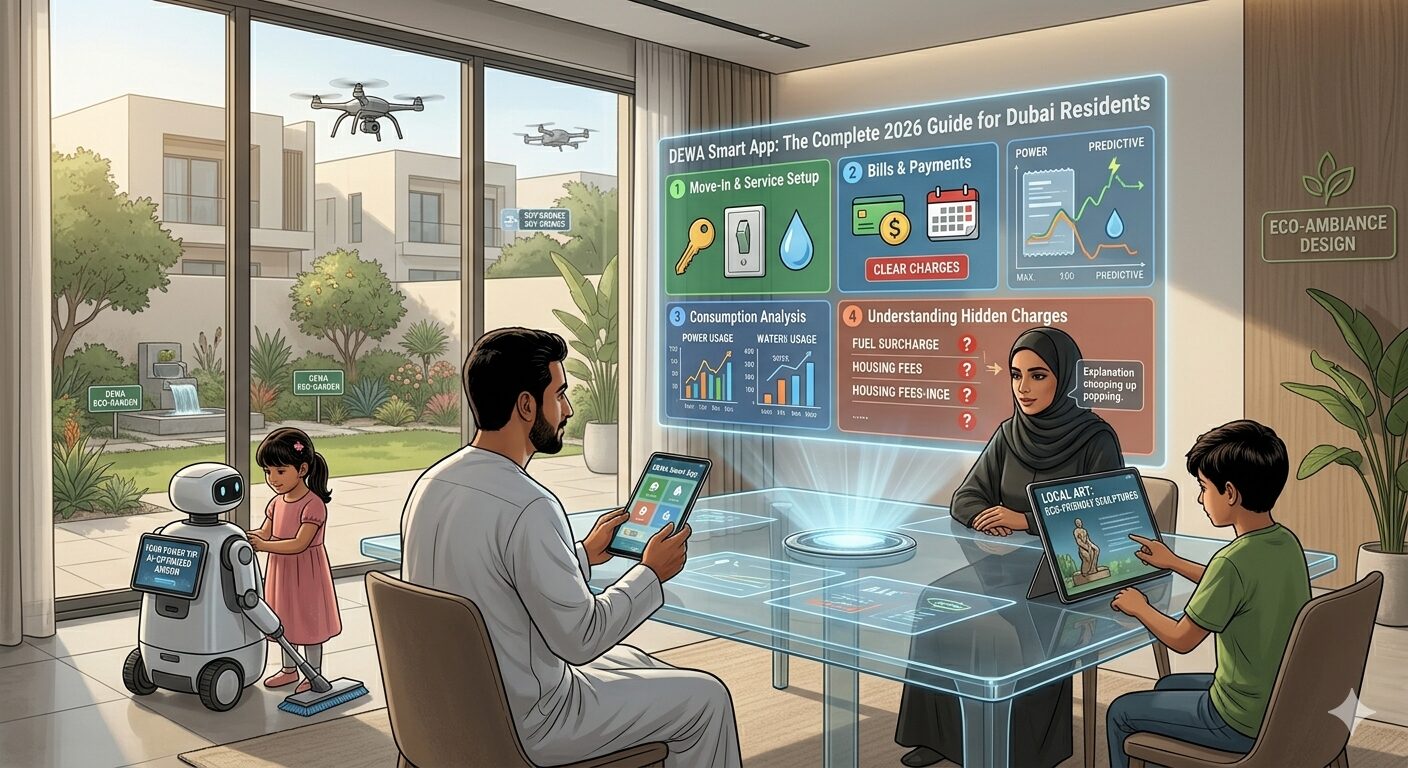
DEWA is not optional. Every Dubai resident depends on it for electricity, water, and the utility chain that makes everything else work like internet, visa renewal, school registration. The DEWA Smart App handles move-in activation, monthly bill payment, real-time consumption monitoring, and outage reporting for over 1.2 million active users. Here is everything you need to know, including the parts of your bill that nobody explains.
Why DEWA Is the First App Every New Dubai Resident Must Set Up
DEWA, the Dubai Electricity and Water Authority is the sole provider of electricity and water services in Dubai. There is no alternative. Every residential property, commercial unit, and villa in the emirate receives power and water from DEWA, metered and billed monthly. Without an active DEWA connection, you cannot get internet installed, cannot renew your residency visa (proof of residence is required), and in many cases cannot register your children for school.
This is why DEWA sits at the head of what residents informally call the utilities chain: Ejari registration comes first, then DEWA activation, then telecoms, then everything else. Understand DEWA and you understand the foundational infrastructure of life in Dubai.
| DEWA processed over 15 million app transactions in 2025. It reported record revenue of AED 6.45 billion in Q1 2026 alone. For a monopoly utility, it has invested seriously in digital services — and the app shows it. |
How to Activate DEWA When You Move In — Step by Step
DEWA activation (called Move-In) cannot happen until you have a valid Ejari certificate for the property. Ejari is the tenancy contract registration system without it, DEWA does not know who the authorised tenant is for that premises. Get Ejari first, then proceed.
The documents required for a residential tenant: your Emirates ID, your Ejari certificate, your tenancy contract, and your DEWA Premise Number (a unique code assigned to the property your landlord or building management can provide it). You do not need to visit a DEWA office. The entire process is available through the DEWA Smart App or dewa.gov.ae.
| Step | What Happens |
| 1. Open the DEWA app or dewa.gov.ae | Tap the hamburger menu and select ‘Activation of Electricity/Water (Move In)’ — found under the Trending tab |
| 2. Choose customer type | Select ‘New Customer in Dubai’ if it is your first DEWA account. Select ‘Existing Customer’ if you have had a DEWA account before and want to log in first |
| 3. Choose Expatriate or Investor | Expatriate if you are a tenant. Investor if you are the property owner or landlord |
| 4. Enter property and personal details | Premise Number, Emirates ID number, date of birth, passport/EID expiry date, contact details |
| 5. Pay security deposit and connection fee | Security deposit: AED 2,000 for apartments, AED 4,000 for villas. Connection fee: AED 155. Payment via card, Apple Pay, or Google Pay |
| 6. Receive confirmation | Reference number sent by email and SMS. Supply activated within 15 working hours of payment |
One detail that catches many residents off guard: DEWA does not automatically activate when you move into a property. Even if the previous tenant had a DEWA connection, you must complete the Move-In process yourself. Reconnection is never automatic. If you move in without completing this step, you may find electricity and water already running — but you will not receive bills, and when the previous tenant closes their account, supply may be cut without warning.
Important for residents moving between properties: DEWA does not offer a simple transfer between addresses. You must close your current account (Move-Out) and open a new one for the new property. The Move-Out process triggers your security deposit refund (more on that below).
Understanding Your DEWA Bill — Every Charge Explained
The DEWA bill arrives monthly and runs to several pages. Most residents look at the total amount due on page one, pay it, and move on. That is understandable — but it means missing information that can save significant money and help you dispute incorrect charges.
| Charge | What It Covers | How It Is Calculated |
| Electricity | Power consumption for the month | Slab tariff: AED 0.23/kWh (first tier) rising to AED 0.38/kWh at higher consumption, the more you use, the higher the rate per unit |
| Water | Water consumed during the month | Slab tariff per gallon: lower rate up to 6,000 gallons, higher rate above. Measured in cubic metres since March 2025 |
| Sewerage | Wastewater treatment and disposal | 2 fils per gallon of water consumed in 2026 (increasing to 2.8 fils in 2027 per DEWA’s phased schedule) |
| Housing Fee | Municipality fee for using the property | 5% of your annual rent as registered on Ejari, divided into 12 monthly instalments. Collected by DEWA on behalf of Dubai Municipality |
| Fuel Surcharge | Adjustment for fuel cost fluctuations | Variable amount applied per kWh reflects changes in the cost of fuel used to generate electricity |
| Meter Reading Fee | Administrative fee for meter services | Small fixed monthly charge that appears as a separate line item |
| AC / Cooling | District cooling charges where applicable | Charged by Empower or Nakheel if your building uses district cooling appears on the same bill in some buildings |
| The Housing Fee is the charge that surprises almost every new Dubai resident. It is not a DEWA fee. It is a Dubai Municipality fee, 5% of your annual rent collected by DEWA on the municipality’s behalf. If your rent changes, DEWA will not update this automatically. You must update your Ejari and then contact DEWA. |
The slab tariff structure for electricity is worth understanding. Dubai uses a tiered consumption model: the first band of consumption costs less per unit than the second, which costs less than the third. In summer months, when air conditioning runs continuously, many apartments breach the lower tiers and enter the more expensive bands. This is why a July electricity bill in Dubai can be two to three times a January bill for the same property and the consumption increase compounds because each additional unit costs more.
DEWA’s consumption assessment tool, available free through the app, shows exactly which consumption tier you are in and compares your usage to similar properties. Most residents who run this report find at least one clear opportunity to reduce their bill. The most effective single action for residents in older buildings: checking whether AC ducts are sealed properly and whether door and window seals are intact. Air conditioning accounts for the majority of electricity consumption in Dubai summer.
What the DEWA App Does Well
Bill payment is instant and reliable. Credit and debit cards, Apple Pay, Google Pay, Samsung Pay, and net banking are all supported. Payments reflect in your DEWA account within 2-5 minutes. The app generates an official PDF receipt that is accepted by immigration authorities and landlords as proof of residence and payment downloadable for any of the previous 24 months.
Real-time consumption monitoring is the standout feature for smart meter users. If your property has a smart meter (DEWA has been installing them across Dubai as part of its smart grid programme), the app shows hourly electricity and water consumption with comparative analytics against previous months and against similar properties in your area. This is genuinely useful data, the kind that makes the difference between a vague sense that your bill is high and an understanding of exactly when and where the consumption is happening.
Consumption alerts are underused and genuinely valuable. The app allows you to set thresholds: if daily electricity use exceeds a figure you specify, you receive a push notification. If water consumption spikes unusually the most common early sign of a leak you receive an alert. For residents who travel frequently and leave properties unoccupied, these alerts have caught active leaks early enough to prevent significant water damage and bill accrual.
Outage reporting works as designed. Navigate to Services and select Report Outage to log a power cut, water supply interruption, or streetlight problem. Each report receives a unique reference number for tracking. DEWA provides status updates through the app as restoration progresses. The system is honest about timelines in a way that builds more trust than vague reassurances.
Move-out is fully digital. When you are leaving a property, the closure application can be submitted through the app without visiting a Customer Happiness Centre. DEWA calculates the final bill, deducts any outstanding balance from the security deposit, and refunds the remainder to the UAE bank account you specify. Keep your UAE bank account open until the refund clears (the processing window is 10-15 business days).
The Security Deposit: What Most Residents Get Wrong
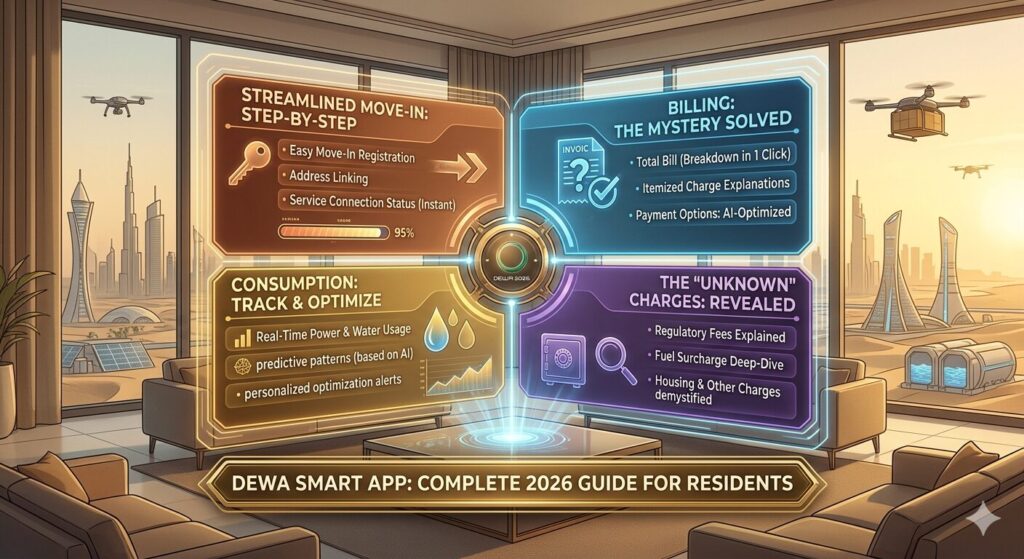
The security deposit paid at Move-In (AED 2,000 for apartments, AED 4,000 for villas) is one of the most misunderstood financial mechanics in Dubai’s utility system. It is not a fee. It is fully refundable when you close your DEWA account, provided there are no unpaid bills.
The most common mistake: residents move out of a property without formally closing the DEWA account. They stop paying bills, hand back the keys, and assume the utility will sort itself out. It does not. DEWA continues billing until the account is formally closed. The security deposit is eventually applied to the outstanding bills, often leaving residents with less than the full deposit refunded and sometimes with a balance owing that appears on their credit record.
The second most common mistake: residents in their first property in Dubai do not know the deposit is refundable at all. Several residents interviewed for this article had not claimed deposits from previous properties they vacated years ago. DEWA holds the deposit until you apply for it. It does not automatically trigger a refund.
If you are moving between properties within Dubai rather than leaving the country, the security deposit can be transferred to your new DEWA account rather than refunded and re-deposited. This saves the 10-15 day wait and avoids the temporary cash outlay of paying a new deposit before receiving the old one.
| Security deposit quick reference: AED 2,000 (apartment) / AED 4,000 (villa). Fully refundable. Close your account formally through the app when you move out. Specify a UAE bank account for the refund. Keep that account open for 15 business days. |
The Charges That Are Not DEWA’s Fault — But Show Up on the Bill
Several charges on your DEWA bill are collected by DEWA on behalf of other government entities and cannot be disputed through DEWA customer service. Understanding this prevents frustration when calls to DEWA about these charges produce no resolution.
Housing Fee disputes: If your Housing Fee is incorrect based on an old rent amount, a wrong property classification, or an Ejari that was not updated after a rent change — the dispute goes to Dubai Municipality, not DEWA. Update your Ejari to reflect the current rent first, then contact DEWA to request an adjustment using the updated Ejari.
Sewerage and irrigation charges: These are Dubai Municipality fees for wastewater treatment. The rate has been increasing in phases.1.5 fils per gallon in 2025, 2 fils in 2026, 2.8 fils in 2027. If these charges seem higher than expected, the increase is policy-driven and applies to all Dubai properties equally.
District cooling (AC) charges: If your building uses Empower or Nakheel district cooling, those charges appear on your DEWA bill but are managed by the cooling provider. Disputes about cooling charges go to Empower or Nakheel directly, not to DEWA.
The Green Features Most Residents Ignore
DEWA has invested significantly in sustainability features that the majority of residents never discover. The Shams Dubai programme allows property owners (not tenants) to install solar panels and sell excess electricity back to the grid relevant for villa owners interested in reducing long-term utility costs. The EV Green Charger programme provides subsidised home EV charging installation through a DEWA application process.
The DEWA Store, a genuinely unusual feature for a government utility offers discounts on energy-efficient appliances, LED lighting, and smart home devices through partnerships with retailers. Accessible through the app, it serves as DEWA’s mechanism for incentivising efficiency investments beyond just tariff structure. Most residents are unaware it exists.
The Green Bill option allows residents to opt out of paper bills and receive only digital notifications. For an app with 1.2 million active users, the adoption rate of digital billing remains lower than it should be. Switching takes thirty seconds in the app settings and removes a recurring paper document from your building’s mail system.
What the DEWA App Needs to Improve
- Move-out deposit refund tracking. Once a Move-Out is submitted, the app provides no real-time status on the deposit refund. A simple progress indicator ‘Final bill calculated, refund processing, refund transferred’ would eliminate a significant volume of customer service calls from residents who do not know where their AED 2,000 or 4,000 is.
- Housing Fee visibility and dispute routing. The app should clearly label the Housing Fee as a Dubai Municipality charge collected by DEWA, explain what drives it (5% of Ejari-registered rent), and provide a direct link to the Ejari update process for residents whose fee appears incorrect. Currently, most residents call DEWA about this and are redirected, a friction loop that wastes time on both sides.
- Smart meter rollout transparency. Real-time consumption monitoring is the app’s most powerful feature but requires a smart meter. The app should display whether your property has a smart meter and, if not, provide a direct in-app application for installation. Currently, this information is buried and the upgrade pathway is unclear.
- Consumption comparison benchmarking. The ‘similar homes’ comparison in the consumption assessment is useful but opaque residents do not know how ‘similar’ is defined (size, building type, occupancy, neighborhood). More transparent benchmarking would make the comparison actionable rather than merely interesting.
- Deposit transfer between properties. The deposit transfer option available when moving within Dubai is not visible in the app. It must be requested by calling DEWA customer service. A self-service deposit transfer flow within the Move-In and Move-Out processes would save a significant number of phone calls and eliminate the cash flow gap for residents moving between properties.
| DEWA Smart App verdict: One of the most functional government utility apps in the region. Bill payment, real-time consumption, outage reporting, and move-in/move-out services all work well. The Housing Fee confusion, deposit refund visibility gap, and smart meter upgrade pathway need straightforward fixes that would meaningfully reduce the volume of avoidable customer service contacts. |
Download: App Store and Google Play (search ‘DEWA’). Web: dewa.gov.ae. Customer care: 04 601 9999. WhatsApp bill pay: register through the app. Rammas AI assistant: available 24/7 on the app and website.
Robius.news — Dubai, UAE — May 2026 | Built to be first. Built to be trusted.