
UAE side hustle economy 2026 trend
Three years ago, most UAE residents did not think much about side income. A single job paid the rent, built the savings, and funded the lifestyle. That was enough.
Something has shifted.
Rising rents. Salary growth that has not kept pace with cost increases. A generation that watched the pandemic reveal how quickly a single income can disappear. And a UAE government that has made it significantly easier than ever to earn money legally outside your main employment.
The side hustle economy in the UAE is growing fast. Here is what is driving it, who is doing it, and what the data actually shows.
The Numbers Behind the Shift
MOHRE freelance permit applications have grown year on year since the permit was introduced. The AED 600 per year part-time work permit, which allows UAE residents to work legally for a second employer on the mainland, has seen growing uptake particularly among professionals in salaried employment who want supplementary income.
Free zone freelance licences from RAKEZ, Shams Dubai, and other free zones have also grown significantly. RAKEZ reported strong growth in individual freelancer applications in 2025, driven by UAE residents rather than new arrivals.
The gig economy platforms operating in the UAE tell a similar story. Upwork reports that UAE-based freelancers tripled their earnings on the platform between 2023 and 2025. The UAE now ranks among the top 15 countries globally by Upwork earnings per active freelancer.
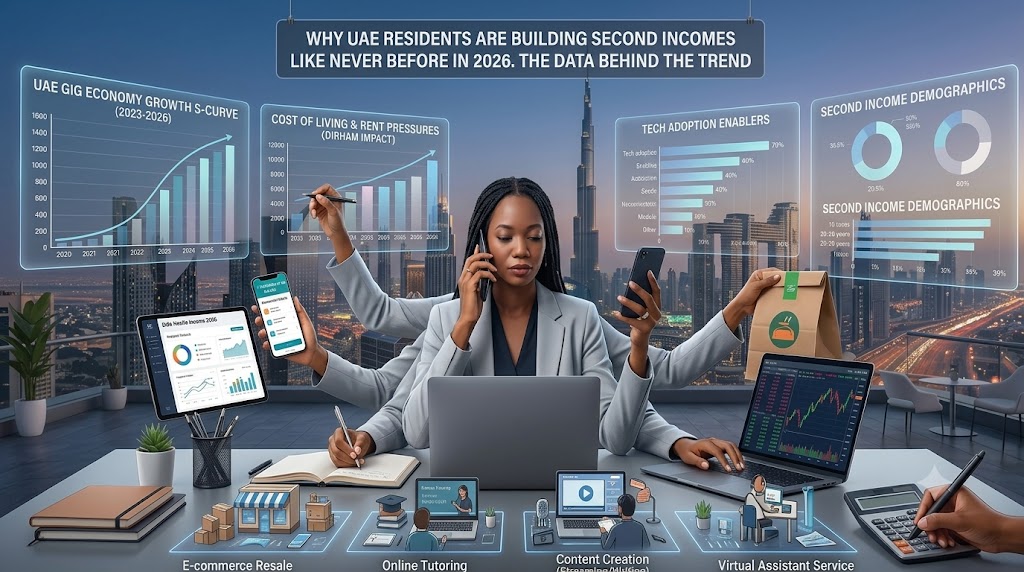
The UAE gig economy is growing at approximately 12 to 15% per year. Residents increasingly view a second income not as a luxury but as financial resilience. Two income sources are harder to disrupt simultaneously than one.
Who Is Building Second Incomes
The profile of UAE residents pursuing side income in 2026 has shifted from what most people imagine.
It is not primarily lower-income residents trying to cover basic expenses. It is mid-to-senior level professionals with established skills who are monetising those skills outside their employment hours.
Tech professionals
Software developers, UX designers, data analysts, and AI specialists are the highest-earning UAE side hustlers. The gap between UAE employer salaries and international freelance rates for technical skills is significant. A developer earning AED 18,000 per month in a UAE job can earn AED 3,000 to AED 8,000 per project on Upwork from international clients. Three to four projects per month alongside full-time work is realistic for someone with strong skills and established reviews.
Finance and consulting professionals
CFOs, financial controllers, and strategy consultants are increasingly offering fractional services to smaller UAE companies that cannot afford a full-time senior hire. A fractional CFO working two days per week for a UAE startup charges AED 15,000 to AED 25,000 per month for that engagement. The startup gets senior financial leadership without a full-time cost. The professional builds income and equity exposure outside their employer.
Content creators and educators
Online tutoring has emerged as one of the fastest-growing side income categories in the UAE. Preply and Superprof both report strong UAE-based tutor supply growth. Language coaching, particularly English and Arabic, and academic subject tutoring for international school students command AED 100 to AED 300 per hour for qualified tutors.
Content creation on YouTube, TikTok, and Instagram has also matured as an income source for UAE residents. The creator economy here benefits from high smartphone penetration, English-Arabic bilingual content demand, and a viewer base across the Gulf with disposable income.
What Is Making This Easier in 2026
The legal framework has improved
Three years ago, earning money outside your main UAE employment was legally murky for most residents. Today, the framework is clearer.
- MOHRE Part-Time Work Permit: AED 600 per year. Lets you legally work for a second UAE mainland employer.
- MOHRE Freelance Permit: AED 2,500 to AED 3,000 per year. Requires NOC from main employer but gives formal freelance status.
- Free Zone Freelance Licence (RAKEZ, Shams): AED 5,500 to AED 6,500 per year. The most popular route for independent freelancers. No employer NOC required.
- E-Trader Licence (DED Dubai): AED 1,070 per year. For UAE nationals selling products or services through social media.
The tools have improved
Wio Bank now accepts a MOHRE freelance permit as the primary document for opening a business bank account. Previously, freelancers needed a full trade licence to receive business payments. That barrier is gone.
Wise Business allows UAE freelancers to receive international client payments in USD, GBP, and EUR without the high wire transfer fees of traditional UAE banks. A freelancer earning from international clients can receive and convert that income significantly more efficiently than was possible two years ago.
Remote work norms have stuck
Post-pandemic remote work norms mean that more employers are comfortable with staff who manage their own time. A professional who finishes their work by 5pm and does freelance work in the evening is increasingly common and increasingly accepted in UAE professional culture.
The Honest Challenges
The side hustle economy is growing. It also has real friction points that most trend articles skip.
Time is genuinely scarce. A full-time job in the UAE, particularly in sectors like banking, consulting, and media, demands real hours. Adding meaningful freelance work on top requires discipline and often requires sacrificing evenings and weekends. This is sustainable for a period. It is not sustainable indefinitely without burning out or underdelivering on something.
The NOC requirement is a real barrier for mainland employment. Many UAE employers include exclusivity clauses in employment contracts. Taking on paid freelance work without informing your employer is technically a contract breach in many cases. The legal exposure is real even if enforcement is uncommon.
Client acquisition is slow. The first three months of building freelance income on any platform are usually the hardest. No reviews, no track record, and intense competition. Most people give up in this window before the income becomes meaningful.
The Bigger Picture
The UAE’s side hustle economy is not a temporary response to a cost-of-living squeeze. It is a structural shift in how professionals think about income.
The generation entering the UAE workforce now has watched enough disruption to know that a single employer is a single point of failure. Building skills that are platform-portable, developing a reputation that is independent of any one employer, and creating income streams that exist outside a salary are becoming part of how career-conscious professionals in the UAE plan their financial lives.
The government’s legal framework for this has improved faster than most residents realise. The tools available to receive, manage, and grow that income have improved too.
The question is not whether you should build a second income. The question is whether you have a skill worth monetising and whether you are willing to do the work of building it into something.
Robius.news — Dubai, UAE — 2026 | Built to be first. Built to be trusted.