 UAE, UNFILTERED
UAE Bonds Near 5%: Who Can Buy?
The UAE received AED 4.54bn in Treasury bids but issued AED 1.1bn. Robius separates institutional auction yields from retail sukuk access, fees and early-sale risks.
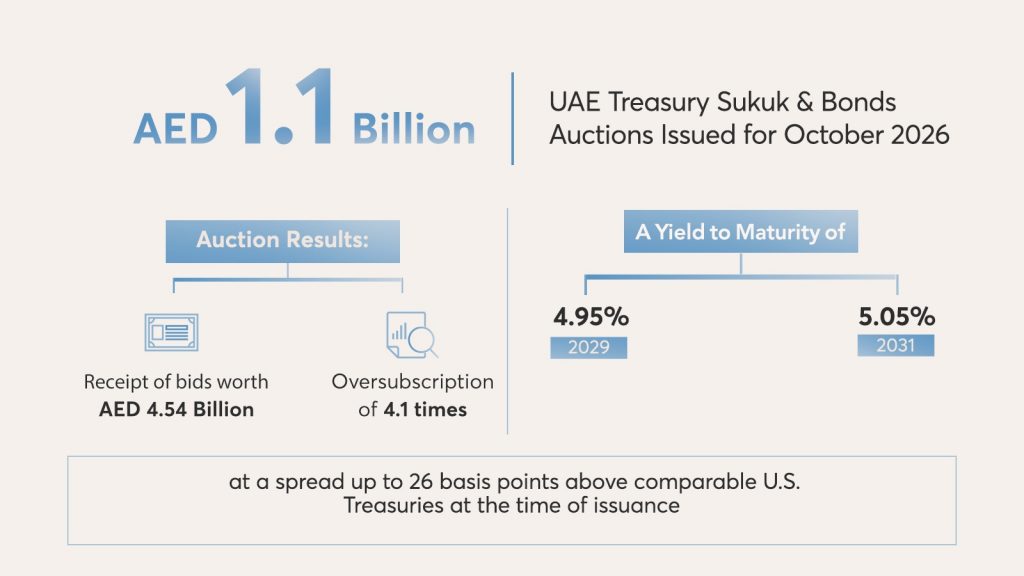
The UAE received AED 4.54bn in institutional bids but issued AED 1.1bn; auction yields near 5% are not live retail savings rates.
UAE residents comparing sovereign sukuk, savings and investments; banks, advisers, treasury teams and fixed-income investors.
Institutional auction access differs from retail. Yields, coupon rates, market prices, fees, early-sale proceeds and maturities must not be conflated.
Watch the Ministry's November issuance calendar and the next retail subscription announcement; obtain a live executable quote before investing.
Check the exact ISIN, maturity, purchase price, coupon or profit rate, net fees, authorised channel and early-exit risk.
The UAE’s latest Treasury auction produced a headline number of AED 4.54 billion in bids and yields close to 5%. Neither figure means AED 4.54 billion was raised, nor does it mean a resident can open an account today and lock in the same return.
On 31 October 2026, the Ministry of Finance reported AED 1.1 billion actually issued across a new Treasury Sukuk maturing in October 2029 and a Treasury Bond maturing in January 2031. Their auction yields to maturity were 4.95% and 5.05%, respectively. The bids came through institutional primary dealers. For UAE residents comparing savings, sovereign sukuk and investment apps, the useful questions are which security is being quoted, how it can be purchased, what price is available now and what happens if the investor sells early.
Four numbers, four different meanings
AED 4.54 billion was the aggregate amount bid by primary dealers. It is evidence of demand submitted at the auction, not proceeds paid to the government. AED 1.1 billion was the amount issued. Dividing bids by issuance produces approximately 4.13, consistent with the Ministry’s rounded 4.1-times oversubscription figure. The AED 3.44 billion difference is excess demand, not a financing shortfall or unclaimed cash.
4.95% was the reported yield to maturity for the October 2029 Islamic Treasury Sukuk. 5.05% was the reported yield to maturity for the January 2031 conventional Treasury Bond. These are market-pricing observations for specific securities and maturities at an institutional auction. They are not a universal UAE deposit rate, not the coupon on every outstanding bond, and not an unconditional return for someone buying later.
The Ministry describes the auction as evidence of confidence in the UAE’s creditworthiness. That is the issuer’s assessment. A narrower observable conclusion is that the offered securities attracted more bids than the quantity issued at the prevailing auction terms. The announcement does not disclose the full bid distribution, all investors behind the primary dealers or a subsequent retail trading price.
The first gate is institutional, not a banking app
The Federal Debt Management Office identifies eight primary dealers with the right to buy securities directly in the federal auctions and distribute them to clients. The dealers include conventional and Islamic banks, but that does not make each auction a public subscription open to anyone with an Emirates ID. The institutional auction channel and a retail investment product are different routes, with different documentation, eligibility, settlement and execution.
The Ministry’s issuance calendar places the October auction in its institutional debt schedule. It separately publishes a retail issuance schedule. The distinction matters because a reader may see the 5.05% bond yield in a government headline and search a banking app for that exact rate. An app may offer a different security, a different maturity, a market quote after the auction, or no access to that tranche at all.
For a useful starting point on the genuinely individual-accessible channel, the earlier Robius explainer on the UAE’s five-year retail T-Sukuk describes the AED 1,000 entry route. Its September pricing has since been confirmed; that historical offer must not be confused with the October institutional auction.
There is a retail sukuk market, but it has two doors
The Ministry of Finance now describes two individual routes. Retail T-Sukuk are subscriptions to newly issued sovereign sukuk, with a published minimum of AED 1,000. An eligible applicant needs a valid Dubai Financial Market National Investor Number and must be a UAE national or resident with a valid Emirates ID. The offering window, profit rate, tenor and participating channels are specific to each issue.
Fractionalised T-Sukuk provide access to interests in already-listed sovereign sukuk through participating banks’ digital platforms, with a published AED 4,000 minimum. These are market-priced holdings rather than fresh subscriptions at par. The Ministry lists a 0.25% buy fee and a 0.25% sell fee for this channel, no redemption fee at maturity, and potential VAT or other applicable charges on fees. Institution-specific conditions can still apply.
That fee distinction is material. On an illustrative AED 10,000 fractionalised purchase, a 0.25% purchase fee is AED 25 before any applicable tax; selling at the same principal amount would add another AED 25 fee before tax. That is a calculation from the Ministry’s stated percentage, not a quotation from a bank or a claim that the security can be sold at the original price. If the market price moves, the sell-side fee is calculated against the relevant transaction value.
By contrast, the Ministry says retail new-issue fees depend on brokers’ and custodians’ terms. It does not publish a single fee-free promise for every channel. The practical comparison is a written net-cost quote, not a headline minimum investment.
September’s 5.06% retail offer is already history
There is a concrete retail example. On 22 September the Ministry announced a 5.06% annual profit rate for the second five-year sovereign Retail T-Sukuk. Subscriptions ran from 23 to 28 September 2026, with listing scheduled for 1 October. That was a specified new-issue retail profit rate, not a standing rate available indefinitely to every saver.
The October institutional 4.95% sukuk yield applies to a different security maturing in October 2029. The 5.05% conventional bond yield applies to a different instrument maturing in January 2031. The September five-year retail issue and these October tranches are not identical exposures. Comparing the percentages without dates, purchase prices, cash-flow structures and maturities can produce a false winner.
Dubai Financial Market explains the distinction between a sukuk’s stated profit or coupon rate and the result from buying or selling the security. A regular distribution can be specified in the terms while the value realised by an investor who trades before maturity depends on the market price. The Ministry likewise warns that market prices and liquidity fluctuate. Neither source says an investor is guaranteed to realise the auction’s quoted yield on a later purchase.
July gives the more revealing comparison
The October announcement becomes more informative when placed beside the Ministry’s July auction. On 30 July, the Ministry reported AED 4.83 billion in bids for AED 1.1 billion issued, an oversubscription ratio of 4.4 times. The October ratio of 4.1 times is slightly lower, although both auctions drew substantially more bids than supply.
More importantly, the July Treasury Bond tranche also matured in January 2031. Its reported yield to maturity was 4.48%, compared with 5.05% for the January 2031 bond in October: a rise of 0.57 percentage points, or 57 basis points, between the two reported auction dates. That comparison holds the stated maturity broadly constant, unlike comparing a two-year sukuk with a five-year bond.
It still does not establish the cause. The auction announcements alone do not isolate changes in US rates, domestic liquidity, market prices, investor positioning or credit spreads. A higher yield is a higher market borrowing yield at that point, not automatically evidence of deteriorating UAE credit quality. The Ministry also quotes small spreads over comparable US Treasuries at issuance, but those benchmarks are time-specific and not a fixed premium promised to later buyers.
For UAE businesses, this is the deeper economic value of a local-currency government debt market: repeated issues create observable dirham benchmarks across maturities. Those benchmarks can help frame financing and investment discussions, although a sovereign auction rate is not the rate a small business will be offered by its bank.
Why 5% on a bond is not 5% in a savings account
A deposit product and a marketable bond answer different needs. A bank account may have a variable promotional rate, salary-transfer requirements, minimum balance, withdrawal conditions or a short fixed period. A bond or sukuk has an issuer, defined maturity, distribution structure and a market price that may move before redemption. Government backing reduces some risks relative to weaker private issuers but does not remove interest-rate, price, liquidity, operational or reinvestment considerations.
The Robius comparison of UAE digital-bank savings conditions shows why a headline deposit rate can depend on the exact account and customer behaviour. A 5% bond yield observed at an auction cannot be ranked against a 5% bank promotion without matching the holding period, access to cash, fees, eligibility and how returns are calculated.
There is also a difference between buying one government security and delegating investments to a portfolio service. The Robius comparison of UAE investment platforms explores products with very different investment mandates. A platform’s inclusion of sukuk in a diversified portfolio does not mean its customers own the same sovereign security, receive its stated coupon or have the same fee schedule.
For someone who might need the funds before maturity, the decisive question is the executable bid price and the cost of exiting. A listed security can have a market without a buyer always being available at the price the holder wants. Ask about minimum tradable size, broker and custody fees, accrued profit treatment, settlement timing and the consequences of selling below the purchase price.
The currency peg explains the US comparison, not a guarantee
The Central Bank of the UAE explains that maintaining the dirham’s fixed exchange-rate relationship with the US dollar requires domestic monetary conditions to remain closely aligned with US rates. That is why the Ministry compares its dirham sovereign yields with similar-maturity US Treasuries. The comparison helps contextualise pricing, but a spread measured at auction is not an offer to earn a fixed extra return above whatever US Treasuries yield tomorrow.
Nor should a dirham-denominated instrument be treated as eliminating every currency issue for an investor whose future expenses are in euros, pounds or another currency. The dirham-dollar peg is relevant to exchange-rate policy, while a household’s actual investment outcome still depends on its own currency needs and transaction costs.
What a UAE resident should check before committing money
Identify the exact instrument. Ask for the security name, ISIN, issuer, maturity, coupon or profit distribution schedule, and whether the quoted percentage is the coupon, yield to maturity, or a platform estimate. Two securities from the same government can have different yields because they mature at different times or trade at different prices.
Identify the route. Is this a live primary retail subscription, a fractionalised holding bought through a participating bank, or a secondary-market trade through a broker? Check the current offering window rather than relying on a closed September subscription announcement or the institutional October auction.
Request the all-in cost. Compare purchase price, accrued profit, commissions, custody and sale fees, applicable tax on fees, and the amount that would be received if sold today. Do not treat the Ministry’s 0.25% fractionalised fee as the complete fee schedule of every investment channel.
Check the counterparty. Use the Ministry, DFM, Nasdaq Dubai and the institution’s official channels to verify the security and intermediary. Government-branded graphics circulating through messaging apps do not establish that a private platform is authorised to take deposits or sell an instrument. The Robius investment-platform verification guide provides a separate legal-entity check before any transfer.
Match the cash horizon. If money may be needed in six months, a security maturing in 2029 or 2031 may create an avoidable early-sale risk. If holding to maturity, read the actual offering documentation, issuer obligations and distribution terms rather than extrapolating from an illustrative return table.
The Robius assessment: demand is real, access is conditional
October’s auction provides useful evidence of institutional appetite for UAE dirham sovereign debt and a new observation on the domestic yield curve. The issuer sold AED 1.1 billion, not AED 4.54 billion. The 4.1-times figure measures bidding against supply, not retail subscriptions. The near-5% yields describe particular auction securities, not a savings account rate available to everyone.
The genuinely important development for households is that the UAE now has documented retail routes into sovereign sukuk. Those routes deserve their own comparison on minimum investment, eligibility, live pricing, fees, liquidity and maturity. For an investor, the right next step is not to chase the largest percentage in a headline. It is to obtain the exact security terms and an executable, all-in quote from an authorised channel.
Sources
- UAE Ministry of Finance, 31 October 2026: October Treasury Sukuk and Bonds auction results
- UAE Ministry of Finance, 30 July 2026: July auction results and January 2031 bond yield
- UAE Ministry of Finance: Federal Debt Management Office primary-dealer framework
- UAE Ministry of Finance: 2026 institutional and retail issuance calendars
- UAE Ministry of Finance: retail and fractionalised T-Sukuk access, eligibility and fees
- UAE Ministry of Finance, 22 September 2026: 5.06% retail T-Sukuk terms and subscription dates
- Dubai Financial Market: retail sukuk, subscription channels and secondary trading
- Central Bank of the UAE: the dirham peg and domestic monetary-policy alignment
Checked 1 November 2026 against UAE Ministry of Finance, Dubai Financial Market and Central Bank primary sources. Auction yields and subscription windows are historical observations, not live executable investment quotes. Illustrative fee calculations exclude applicable tax. General reporting, not individual investment advice.
Robius.news | Dubai, UAE | 2026 | Built to be first. Built to be trusted.