 UAE, UNFILTERED
The UAE’s AI Stack Got More Concrete This Week
The most important UAE AI story this week was not a new chatbot. It was that several pieces of the system started touching real…
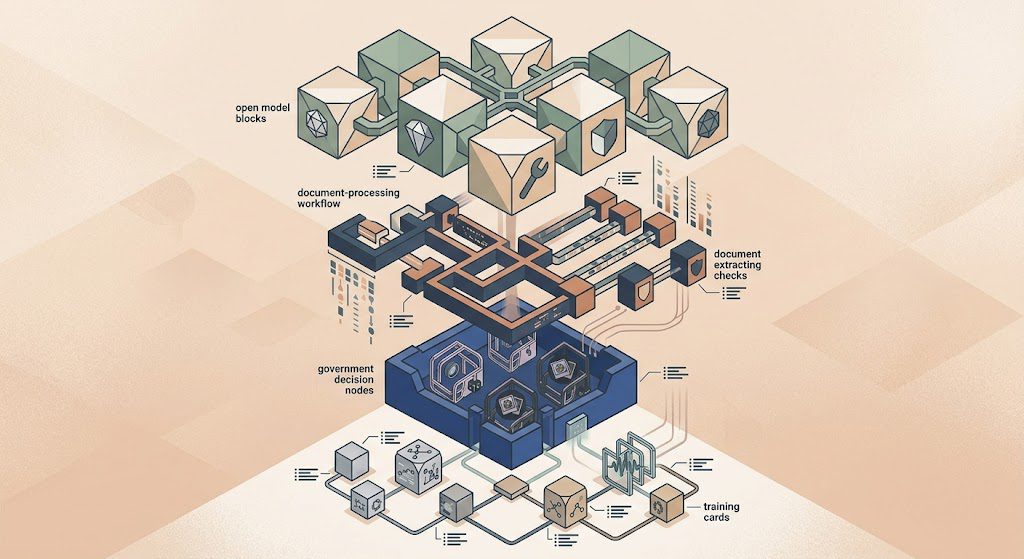
Four separate UAE developments moved AI from skills and model strategy toward governed decisions and transaction workflows.
UAE SMEs, technology teams, government-service users and real estate operators should watch how these layers move from pilots into routine work.
Announcements show capability and rollout direction, not proof of accuracy, savings, adoption rates or successful outcomes at scale.
Watch for deployment metrics, DLD rollout evidence, K2 adoption and clearer disclosures on where UAE agentic systems can act autonomously.
Pick one repeatable workflow, map the data and approval points, then test whether AI improves it before expanding scope.
The most important UAE AI story this week was not a new chatbot. It was that several pieces of the system started touching real work at the same time. Training, government decision support, property registration and model infrastructure all moved within a three-day window.
That does not prove the UAE has solved agentic AI deployment. It does show something more useful than another strategy announcement: the stack is becoming visible. The question now is whether the layers can connect without losing control over data, authority, evidence and human approval.
Four Layers Appeared in Three Days
On 1 September, Dubai Chambers launched agentic AI training aimed at more than 14,000 member companies represented through its Business Groups and Business Councils. The useful part is not the size of the audience by itself. It is that Dubai is trying to move agentic AI from specialist teams into ordinary business operations.
We already made the distinction in our Dubai Chambers agentic AI analysis: training is an on-ramp, not deployment. A company can finish a course and still have no safe workflow, no authority model, no clean data and no reason to let an agent touch a customer or financial process.
On 2 September, the UAE Cabinet described a system of 32 specialized AI advisers that can analyze government programs, policies and legislation, assess different forms of impact, review approved information and help ministers follow decisions and implementation. The system sits much closer to consequential work than a generic assistant answering questions.
Our 32 AI advisers explainer focused on that operating boundary. The advisers can support analysis and follow-up, but the public description does not turn them into ministers or give them unlimited authority. That distinction matters as agentic systems move into government workflows.
Then, on 3 September, Dubai Land Department described Initial Registration, a platform that can read Emirates IDs, passports and sale contracts, extract fields, and process standard registration transactions that meet business rules. DLD also describes separate submission and review roles, plus phased rollout and oversight tools.
The same day, MBZUAI’s Institute of Foundation Models released K2 Horizon, a family of six models from 0.9 billion to 375 billion parameters. MBZUAI says it published weights, code, training data and methodology. Reuters independently reported the release of training data, code, methods and development checkpoints.
| Layer | This week | What it still does not prove |
| Skills | Dubai Chambers agentic AI training for more than 14,000 represented member companies | That participating companies will deploy agents safely or productively |
| Decision support | UAE Cabinet system with 32 specialized AI advisers | That AI has final ministerial authority or can act without governed inputs |
| Workflow | DLD Initial Registration can extract documents and process qualifying standard registrations | That every property transaction is automated or that human controls disappear |
| Models | K2 Horizon publishes six model sizes with unusually broad release artifacts | That the models are automatically cheapest, safest or best for every UAE workload |
Training Is the On-Ramp, Not the Outcome
Dubai Chambers is solving one real problem: most companies cannot use agentic AI if their staff do not understand what an agent can do, where it can fail and how it differs from a normal chatbot. But skills are only one layer. The harder part starts when a company gives software permission to take actions.
That is why the shift we described in AI agents are leaving the IT department matters. Once agents touch finance, customer support, procurement or operations, the business question changes from ‘Can the model answer?’ to ‘What is it allowed to do, with which data, and who owns the error?’
Government Is Defining Where Agents Sit
The Cabinet announcement is useful because it describes a bounded role. The advisers analyze, compare, assess and support follow-up using approved inputs and sources. That gives us something more concrete than the word agentic. It shows where the system is intended to sit inside the decision process.
The UAE has been moving toward more agentic government services for months. Our earlier guide to the UAE agentic government-services push tracked that direction. This week’s Cabinet system makes the governance question sharper because the work now includes legislation, program impact and implementation follow-up.
The practical test is not whether an AI adviser can produce a recommendation. It is whether the system preserves source quality, shows uncertainty, separates advice from authority and leaves a clear record of what a human approved. Those controls are not decorative when the workflow itself becomes faster.
DLD Shows What Agentic AI Looks Like When It Touches a Transaction
DLD’s Initial Registration platform is the clearest workflow example in this week’s group. Instead of asking a model to summarize a document, the system reads identity documents and contracts, extracts the information needed for the registration process and can move qualifying standard transactions through business rules.
That is a much better test of agentic value than a demo. A registration workflow has inputs, rules, exceptions, permissions and an observable output. If DLD can reduce manual entry and first-time rejection without weakening review, the benefit is measurable. The official announcement, however, does not yet publish those outcome metrics.
And here is the catch. ‘Automatically processed’ does not mean ‘uncontrolled.’ DLD describes differentiated roles for submitting and reviewing transactions and a phased rollout. Readers should treat those controls as part of the product, not as friction that successful AI is supposed to remove.
K2 Horizon Makes the Model Layer More Concrete
The K2 Horizon release fills a different layer. It gives developers and researchers a range of model sizes rather than one flagship model, while publishing more of the development artifacts than an open-weight-only release normally provides. The smallest and largest models are aimed at very different deployment environments.
That matters because model selection is now an operating decision, not a beauty contest. Our guide to choosing the right AI model for the business made the same point from the SME side: quality, hosting, privacy, cost, latency and control can matter more than a leaderboard position.
The Robius Layer: The Interfaces Are the Real Stack
Put the four announcements together and the UAE AI story looks less like a race for one winning model. It looks like an operating stack. People need enough knowledge to choose a use case. Systems need explicit authority. Workflows need evidence and exception handling. Models need to fit the cost, privacy and performance requirements underneath them.
That is the Robius insight this week: the weak point is likely to be the interface between those layers. Training without workflow design becomes theater. A powerful model without permissions stays in a sandbox. Automation without review creates risk. Governance without usable tools leaves staff doing the old job manually.
So the next phase should be easier to judge. We do not need more promises that AI will transform the UAE. We can watch whether these systems reduce real work, preserve responsibility and move from announced capability into repeatable production use.
What to Watch Next
First, watch the DLD rollout for measurable operating evidence. Processing time, first-time acceptance, exception rates and the proportion of cases still requiring manual intervention would tell readers far more than another launch announcement.
Second, watch the Cabinet system for clearer public boundaries around approved sources, audit trails and human decision ownership. Third, watch whether Dubai Chambers training produces named business deployments. Fourth, watch K2 Horizon for independent benchmarks, real UAE deployments and evidence that teams can run the smaller models where local control matters.
Sources
- Dubai Media Office / Dubai Chambers: Official announcement of the agentic AI training program for more than 14,000 represented member companies. https://mediaoffice.ae/en/news/2026/september/01-09/dubai-chambers-launches-agentic-ai-training-for-14000-member-companies
- Dubai Media Office / UAE Cabinet: Official Cabinet meeting announcement describing the 32 specialized AI advisers and agentic decision-support framework. https://mediaoffice.ae/en/news/2026/september/02-09/mohammed-bin-rashid-chairs-uae-cabinet-meeting
- Dubai Land Department: Official Initial Registration launch describing document extraction, business-rule processing, roles and phased rollout. https://dubailand.gov.ae/en/news-media/dubai-land-department-launches-initial-registration-a-smarter-journey-for-developers-and-greater-efficiency-for-the-real-estate-sector/
- MBZUAI Institute of Foundation Models: Official K2 Horizon release details, model sizes and published artifacts. https://mbzuai.ac.ae/news/mbzuais-institute-of-foundation-models-launches-k2-horizon-the-worlds-largest-fully-open-ai-models-in-history/
- Reuters: Independent reporting on the K2 Horizon release and its training-data, code, methodology and checkpoint disclosures. https://www.reuters.com/world/middle-east/abu-dhabi-ai-institute-releases-fully-open-source-models-with-training-data-code-2026-09-03/
Robius.news — Dubai, UAE — 2026 | Built to be first. Built to be trusted.