
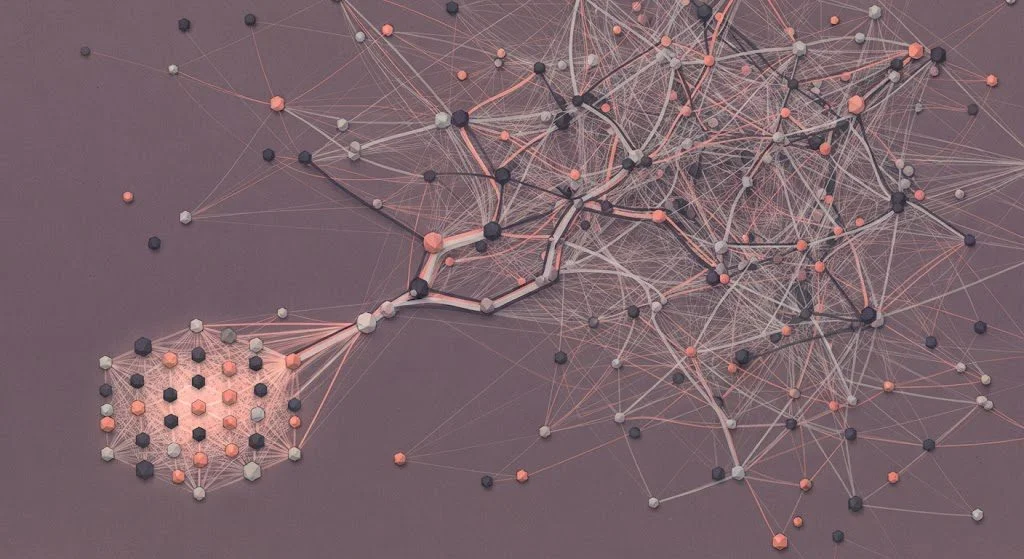
One AI agent making a bad decision is easy to picture. A thousand agents making individually reasonable decisions and producing a bad system is harder.
Anthropic published new research on August 13 looking at that second problem. Its researchers argue that as AI agents interact in shared codebases, markets and other systems, behaviors that look harmless at the individual level can compound into outcomes nobody explicitly chose. The warning is not that today’s agents have suddenly formed a society. It is that institutions built for human-speed oversight may struggle when software starts negotiating, coordinating and reacting to other software at machine speed.
Testing one agent at a time may miss failures that only appear when many agents interact repeatedly at machine speed.
UAE technology leaders, risk teams, government digital programs, banks and companies planning multi-agent workflows should pay attention.
Multi-agent systems can divide complex work across specialists and run workflows faster, provided coordination rules and boundaries are designed deliberately.
Anthropic is studying emerging behavior in current frontier models; the research does not prove that every multi-agent deployment will produce systemic failure.
Expect more testing of agent-to-agent behavior as multi-agent architectures move from experiments into production systems.
Test the whole workflow under load, cap agent authority, log cross-agent actions and define a human intervention point before deployment.
Organizations that build monitoring and intervention at the system level can scale agents without relying on every individual agent behaving perfectly.
Any organization deploying multiple autonomous agents can apply the controls; the research itself is public and does not require a specific product.
Watch for failures that appear only across many interactions, not just model-level error rates or one-agent benchmarks.
The Problem Is the System, Not Just the Agent
Anthropic’s framing is useful because most AI safety conversations still begin with the individual model. Does it hallucinate? Does it follow instructions? Can it misuse a tool? Those questions matter, but multi-agent systems add another layer. The outcome can depend on how many agents interact, what they observe about each other and which incentives the environment creates.
The company gives a simple reason to take this seriously: agents can work longer than people, absorb large amounts of information quickly and repeat interactions far faster than a human team. They also still confabulate and can reward-hack. A small behavioral quirk that is tolerable in one agent can become much less tolerable when it is repeated across thousands of interactions.
We have already argued that agent security is really a permissions problem. Multi-agent systems widen that idea. The permission boundary is no longer only between an agent and a tool. It can also sit between agents, teams of agents and the shared environment they are changing.
Human-Speed Oversight Starts to Look Slow
Most organizations are designed around a person eventually seeing the important thing. A manager reviews the exception. A compliance officer sees the transaction. An engineer spots the unusual alert. That works when the number of consequential events remains human-sized.
Anthropic’s concern is that agent-to-agent interaction could grow faster than the institution’s ability to supervise it. If two agents negotiate a task in milliseconds, hand work to other agents and repeat that cycle continuously, a weekly governance meeting is not a control. It is a retrospective.
That does not mean removing people. It means placing human authority where it still has leverage: before large permissions are granted, at defined escalation thresholds and at the point where irreversible action becomes possible.
What UAE Companies Should Test Before Scaling
UAE organizations are already experimenting with agentic AI in government, finance, commerce and internal operations. The right test is no longer only whether each agent performs its assigned task. Teams should also ask what happens when agents interact with one another repeatedly.
Run adversarial scenarios. Let one agent receive bad data and see how far that information travels. Let two agents disagree over a shared resource. Simulate an agent repeatedly retrying a failed action. Test whether one agent can indirectly cause another to exceed a permission boundary.
The same principle applies to money. In our guide to AI agents getting wallets, we argued that the useful feature is bounded authority. Multi-agent systems need bounded authority too, only across communication, delegation and shared resources as well as spend.
| Control | Single-agent question | Multi-agent question |
| Identity | Which agent took the action? | Can every delegated action still be traced across agents? |
| Permissions | What can this agent access? | Can one agent route around another agent’s limits? |
| Rate limits | How fast can it act? | What happens when many agents act at once? |
| Monitoring | Can we see failures? | Can we detect system-level patterns, not just local errors? |
| Human gate | When must a person approve? | Can the system reach irreversible action before a person can intervene? |
The Robius Layer
The useful mental model is not “more agents equals more risk.” Sometimes more agents can make a system safer by separating duties and checking one another. The real question is whether the organization has designed the interactions or simply multiplied the software.
One agent can fail loudly. A system can fail quietly because every local step looked reasonable. That is why the next generation of AI governance needs two views at once: what each agent is allowed to do, and what the network of agents can produce together.
The impressive part of multi-agent AI is coordination. The dangerous part is assuming coordination is automatically the same thing as control.
Sources
• Anthropic: Patterns and problems in emerging multiagent systems, published August 13, 2026. https://www.anthropic.com/research/multiagent-systems
• UAE Government: National Cyber Security Policy for Artificial Intelligence. https://u.ae/en/about-the-uae/strategies-initiatives-and-awards/policies/cyber-activities/The-National-Cyber-Security-Policy-for-Artificial-Intelligence
Robius.news — Dubai, UAE — 2026 | Built to be first. Built to be trusted.