
AI-assisted cyberattacks have spent years living in the future tense. Taiwan now says it dealt with one last month. The country’s Ministry of Digital Affairs said government agencies were targeted in July by an overseas campaign that combined human operators with AI-agent techniques, and that monitoring teams detected the activity and the affected agencies handled the incident.
The dramatic version of this story is that autonomous AI has started hacking governments by itself. The evidence does not support that clean a conclusion. Reporting on the campaign points to agents doing reconnaissance, exploitation and credential work at machine speed, while a human operator still chose the target and the objective. That distinction is exactly why UAE organizations should pay attention.
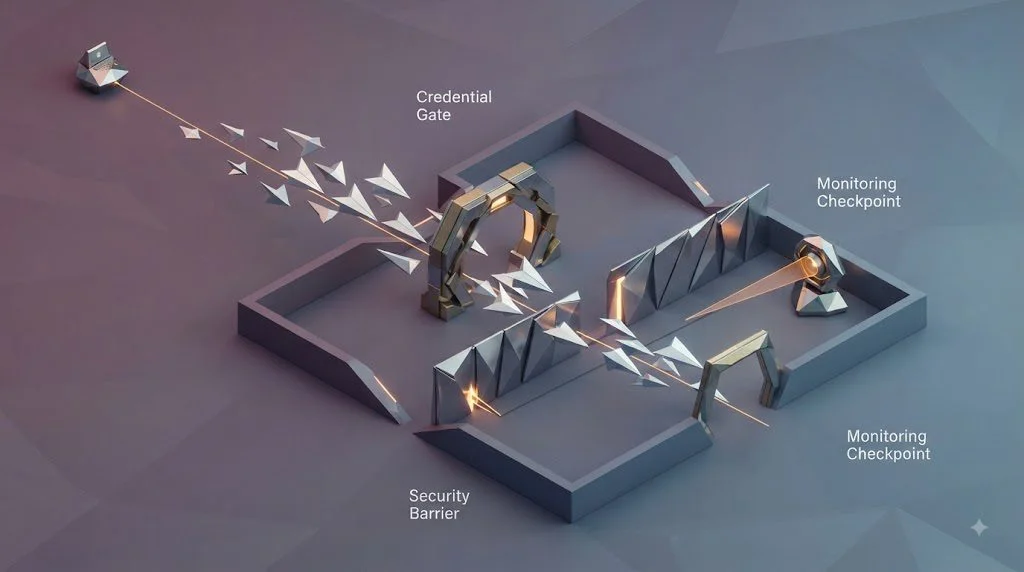
AI can compress reconnaissance, exploitation and lateral movement into faster automated loops, shrinking the time defenders have to notice and contain an attack.
UAE government entities, critical infrastructure operators, CISOs, security teams and businesses giving AI agents access to networks, credentials or production systems.
Security teams can automate low-level defense and vulnerability work so human analysts spend more time on prioritization, containment and consequential decisions.
Some detailed claims about the Taiwan campaign come from the security company that investigated it and are not all independently confirmed by Taiwanese authorities
Expect more public reporting on the campaign and more security products built around AI-versus-AI detection, containment and vulnerability response.
Reduce standing privileges, segment agent access, protect credentials, log tool actions and rehearse how to isolate an automated process before it reaches critical systems.
Attackers gain scale and speed from agentic tooling, while defenders can use the same automation to detect, isolate and remediate threats faster
Any organization can harden identity, network boundaries, logging and incident response; critical-sector entities should align controls with applicable UAE requirements.
Watch for official technical disclosures, confirmed attribution, evidence on the degree of autonomy and new UAE guidance for AI-enabled cyber defense.
What Taiwan Actually Confirmed
Reuters reported on August 13 that Taiwan’s Ministry of Digital Affairs detected an “abnormal attack” against government agencies in July. The ministry said the activity came from overseas and combined manual techniques with AI-agent methods. Beginning July 20, Taiwan’s National Institute of Cyber Security issued warning alerts while the incident was investigated. The government did not publicly confirm every technical detail reported elsewhere.
That restraint matters. A cyber company can describe what it observed in telemetry, while a government may confirm only the incident and response. Robius is treating the broad fact of an AI-assisted attack as confirmed, and the more granular counts, attack paths and claims of autonomy as investigator-reported unless a primary government source confirms them.
What Dream Says the Agents Did
Security company Dream had already described an early-July campaign against government entities in Asia before Taiwan was publicly identified. The company said the operation ran in repeated waves over four days, cracked employee accounts and used publicly available tooling. The Financial Times later reported, citing Dream, that multiple AI agents mapped government systems, adapted tactics when blocked and helped steal credentials and personnel data.
Those details are serious, but the phrase “fully autonomous attack” deserves a caveat. It is Dream’s characterization of the operation, not a universal industry definition. The more defensible conclusion is narrower: AI agents were reportedly delegated substantial tactical work across several stages of a real intrusion. That is already a meaningful change without pretending the software independently decided whom to attack.
The Human Still Chose the Mission
The human role is the part that gets lost when “AI hacker” becomes the headline. Cyber researchers quoted by Reuters stressed that a human operator still selected the target and objective. That pattern also appears in Anthropic’s research on AI-enabled cyber operations, where human intent can remain strategic while an agent handles reconnaissance, tool use, pivoting and repeated tactical decisions.
That division of labor may be more dangerous in the near term than a mythical independent hacker AI. A human attacker does not need to automate judgment about geopolitics or motive. They only need software that can scan more systems, test more paths, retry more often and keep working without waiting for a person to type the next command.
This Is the Next Step After the Sandbox Story
Yesterday we covered how a misconfigured AI security sandbox expanded an agent’s reach. The lesson there was about accidental authority: an agent received access it was not supposed to have, then used it. Taiwan shows the inverse problem. What happens when an attacker deliberately builds the scaffolding, credentials and tools that let an agent keep moving?
The underlying security principle is the same. Capability is only one part of risk. Access is the other. An AI model that can reason about vulnerabilities but cannot reach your systems is a research concern. The same capability connected to scanners, shells, credentials and network routes becomes an operational threat. The attack surface is the combination of model, tools, permissions and environment.
The UAE Already Has the Control Framework
The UAE’s National Cyber Security Policy for Artificial Intelligence is unusually relevant here. It sets minimum requirements around secure AI configurations, network controls, access control, human oversight, continuous monitoring and incident response. Those are not abstract governance categories. They are the exact layers that determine whether an automated attacker can turn one foothold into a wider compromise.
The timing also matters because the UAE is pushing agentic AI deeper into government services. The same architecture that makes a legitimate agent useful, tool access, credentials, workflow permissions and the ability to act, is the architecture defenders now have to assume attackers will probe at machine speed. More automation on the inside raises the value of stronger segmentation on the inside.
What UAE Security Teams Should Change Now
| Control | Old assumption | Agentic-era default |
| Credentials | A service account can hold broad standing access. | Use narrow, task-specific identities and short-lived credentials. |
| Network reach | Internal access is trusted once authenticated. | Segment aggressively and restrict outbound and lateral routes. |
| Detection | Analysts can investigate alerts before the next step. | Automate containment for high-confidence events and preserve logs. |
| Approvals | Human review happens somewhere in the workflow. | Put approval directly before irreversible or high-impact actions. |
| Recovery | Incident response starts after compromise is confirmed. | Predefine kill switches, isolation paths and credential rotation. |
This does not mean turning every security process over to another AI. It means designing for a faster attacker. If an agent can test dozens of possibilities while an analyst is still opening the first alert, defenses need safe automation for the mechanical parts of response: isolate a workload, disable a token, block an egress route, preserve evidence and escalate the decision that genuinely needs a human.
The same principle applies to business agents outside cybersecurity. We made it in a different context when discussing AI agents that can spend company money: do not rely on the model to remember a rule that the infrastructure can enforce directly. A security agent, procurement agent and attacker-controlled agent are different use cases, but permissions remain permissions.
The Robius Layer
The important change is not that AI suddenly invented hacking. Attackers already had scanners, scripts, exploit frameworks and automation. Agentic AI can connect those pieces with adaptive reasoning, letting software decide what tactical step to try next when the first one fails. That changes tempo more than motive.
So the useful question for a UAE organization is not “Can AI hack us?” It is “How much can an automated attacker do between our first weak signal and our first human response?” The answer should determine where you automate containment, how tightly you scope credentials and how small you make every possible blast radius. Human accountability still matters. Machine-speed defense now matters too.
Sources
- Reuters: August 13 report confirming Taiwan detected an overseas AI-assisted cyberattack on government agencies in July and describing the human role in target selection. – https://www.reuters.com/world/china/taiwan-says-it-was-targeted-last-month-ai-driven-hacking-campaign-2026-08-13/
- Financial Times: August 13 reporting on Dream’s findings about multiple AI agents, government systems, credential theft and the campaign’s claimed autonomy. – https://www.ft.com/content/7d2ab3e0-9085-48f6-b38a-d90260d58795
- Dream Security: July 29 research note describing an early-July Asian government campaign using repeated automated attack waves and publicly available tooling. – https://dreamgroup.com/blog/governments-are-not-ready-for-autonomous-ai-attacks
- Anthropic: Research mapping real AI-enabled cyber operations and the distinction between human strategic intent and agentic tactical execution. – https://www.anthropic.com/research/attack-navigator
- UAE Government: National Cyber Security Policy for Artificial Intelligence covering governance, secure configurations, access control, monitoring and incident response. – https://u.ae/en/about-the-uae/strategies-initiatives-and-awards/policies/cyber-activities/The-National-Cyber-Security-Policy-for-Artificial-Intelligence
Robius.news — Dubai, UAE — 2026 | Built to be first. Built to be trusted.