
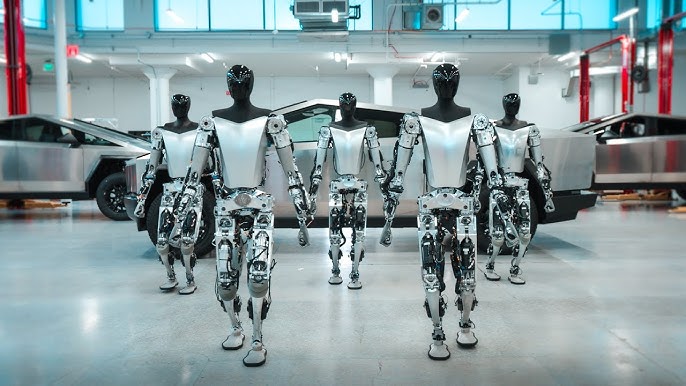
In December 2024, a video of Tesla’s Optimus walking over uneven ground was enough to generate headlines about the future of humanoid robots.
The old version of this Robius article went too far with it.
Walking over rough terrain showed progress in balance and control. It did not establish that Optimus could work independently in a factory, care for an elderly person or perform general household tasks.
By 2026, there is a better signal to watch: Tesla is building the manufacturing infrastructure for Optimus.
What Tesla says is happening now
In its second-quarter 2026 update, Tesla said it had decommissioned the Model S and Model X manufacturing lines at its Fremont Factory and was installing first-generation production lines for Optimus.
Tesla said it expected production to begin later in 2026. Its manufacturing-capacity table still listed Optimus in California and Texas as construction, not production.
That distinction matters. A factory line being installed is evidence that Tesla is committing manufacturing resources. It is not evidence that the robot has reached high-volume production or broad commercial deployment.
The first robots are for Tesla’s own learning loop
Tesla’s Q2 update says the initial Optimus builds will be used in an “Optimus Academy” for training-data collection and further functionality development.
That tells us something important about the maturity of the program.
The first manufacturing ramp is not described as a consumer launch. Tesla is building robots partly so it can collect more real-world data and improve what the system can do.
Tesla also says its Cortex 2 AI training infrastructure supports both vehicle and humanoid-robot autonomy software.
What Optimus is supposed to become
Tesla’s current AI and Robotics page describes the end goal as a general-purpose, autonomous, bipedal humanoid robot capable of performing unsafe, repetitive or boring tasks.
Tesla lists balance, navigation, perception and interaction with the physical world as capabilities required to reach that goal.
The key phrase is end goal.
A production line can manufacture the hardware. It cannot by itself prove that the autonomy software can handle open-ended real-world work safely and reliably.
The old AGI shortcut was wrong
The original article said Tesla was working on artificial general intelligence and therefore Optimus could become useful across many tasks.
That logic does not hold.
A company can pursue ambitious AI research without having a general-purpose robot that is safe enough to work around people. Physical autonomy adds its own requirements: perception, manipulation, balance, failure recovery, hardware reliability and safe behavior when the environment does not match the training data.
As we explain in Artificial Intelligence Explained, sounding or appearing intelligent does not establish what a system can safely execute.
Production is the next test, not the finish line
Humanoid robotics has two difficult problems at the same time.
First, the robot has to be manufacturable at a cost and reliability level that makes deployment practical.
Second, the robot has to perform useful tasks autonomously enough that a human is not constantly programming, supervising or rescuing it.
Tesla’s 2026 production-line buildout is meaningful evidence on the first problem. The second remains the more important capability question.
The Robius view
The 2024 walking video was a demonstration. The 2026 Fremont production-line conversion is a stronger business signal because Tesla is dedicating real factory capacity to the program.
But do not confuse manufacturing commitment with solved autonomy.
The question to watch is not whether Optimus can walk, dance or pick up one object in a controlled video. It is whether the same robot can perform useful tasks repeatedly, recover when something changes and operate safely without hidden human control.
Action Brief
Assessment: Optimus has moved materially closer to manufacturing, but Tesla’s own disclosures still frame early builds as part of training and functionality development.
Verified: Tesla decommissioned Model S and X lines in Fremont, is installing first-generation Optimus lines and anticipated production later in 2026 as of its Q2 update.
Not yet established by those facts: high-volume production, consumer availability or reliable general-purpose autonomy.
What to watch: production output, independently observable deployments, task success rates, degree of human supervision and failure recovery.
Last checked: September 9, 2026.
Source: Tesla Q2 2026 Update filed with the SEC
Source: Tesla AI & Robotics
Related Robius: Tesla’s brand-value decline was not the same as losing $15 billion
Robius.news — Dubai, UAE — 2026 | Built to be first. Built to be trusted.