

The most interesting part of AIREV’s new Qualcomm deal is not another AI partnership announcement. It is where the AI is supposed to run.
Abu Dhabi-based AIREV said on August 13 that its OnDemand autonomous-agent platform will be integrated with Qualcomm Dragonwing products, including an on-prem AI appliance. The company says the platform was designed to work without mandatory cloud dependence, including in sovereign data centers, corporate servers and edge devices. For UAE organizations handling sensitive data, that architecture matters more than the logo pairing.
Running agents where sensitive data already lives can reduce cloud dependence and give organizations more control over data location and network exposure.
UAE government teams, regulated companies, healthcare, finance, industrial operators and enterprises with sovereignty or latency requirements.
On-prem and edge agents could automate local workflows where sending all operational data to a public cloud is undesirable or impractical.
A local deployment does not automatically make AI secure; organizations still need identity, patching, access controls, monitoring and model governance.
The companies plan broader integration across Qualcomm technologies over time, but the announcement does not provide a detailed rollout schedule.
Map which AI workloads genuinely need on-prem or edge execution before paying for infrastructure simply because “sovereign AI” sounds safer.
AIREV and Qualcomm gain a stronger enterprise deployment story, while customers could gain more placement choices for agentic workloads.
Availability will depend on AIREV and Qualcomm deployment arrangements; the announcement does not publish a general UAE price or self-service launch date.
Watch for customer deployments, hardware requirements, model support, security controls, pricing and evidence of real production use.
The Deployment Location Is the Real Story
Cloud AI is convenient because the difficult infrastructure is someone else’s problem. But that convenience also means data, requests and sometimes business context leave the environment where they originated. For many workloads that is acceptable. For some, it is exactly the thing the buyer is trying to avoid.
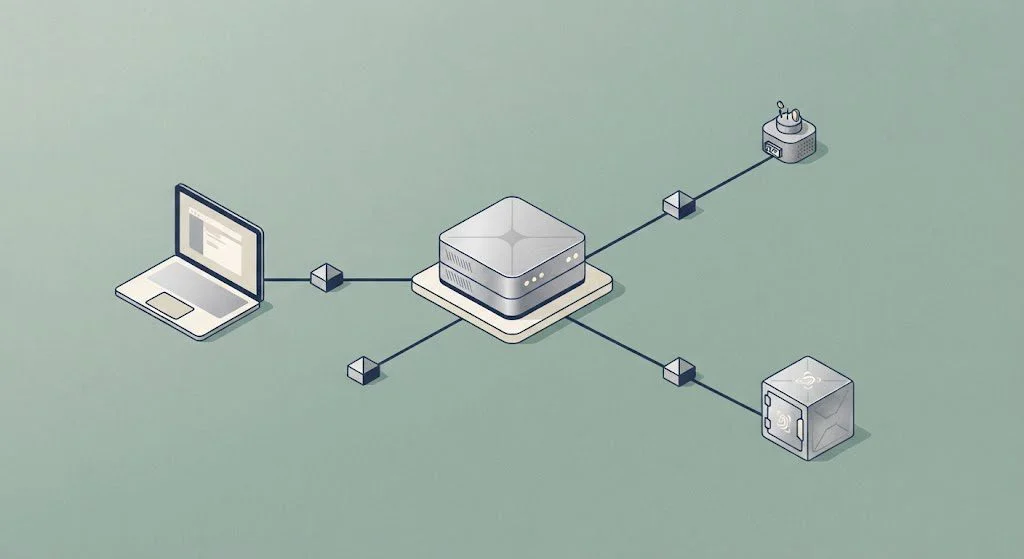
AIREV says OnDemand can run in a sovereign data center, on a corporate server or directly on a device. Qualcomm’s Dragonwing hardware gives that claim a clearer physical deployment path. The value is not “AI without cloud” as a slogan. It is the ability to decide which workloads deserve local execution and which can safely stay hosted elsewhere.
Sovereign Does Not Mean Automatically Secure
There is a trap in the language around sovereign AI. Keeping a workload in-country or on-premises can improve control over data location, but it does not solve basic security on its own. A badly patched local appliance with broad permissions can be more dangerous than a well-managed cloud service.
Our recent analysis of the Meta agent sandbox failure made the same point from another direction: the important question is what the agent can reach. Location is one control. Identity, network boundaries, logging, human approval and revocation still matter.
That is why a serious buyer should ask exactly which models run locally, what data leaves the device, how updates are delivered, whether telemetry is optional, where logs are stored and how agent permissions are enforced.
The Company Numbers Need Attribution
AIREV says the platform serves more than four million users, offers more than 300 specialized agents across over 50 languages and processed 6.8 trillion tokens in the second quarter of 2026. Those are substantial figures. They are also company-reported figures in the announcement, not independent usage data Robius has verified.
That distinction is important because enterprise buyers should not confuse scale claims with proof that a specific on-prem deployment is mature. The evidence we would want next is simpler: named production customers, deployment size, uptime, hardware footprint, security architecture and measurable operating results.
Where This Could Make Sense in the UAE
Government workflows with residency requirements are an obvious candidate. So are industrial environments with intermittent connectivity, healthcare workloads with sensitive records, and companies that want agents close to internal systems without exposing those systems broadly to the public internet.
The same “bounded authority” principle from our AI agent wallet guide applies here. The closer an agent sits to valuable data and real tools, the more deliberate its permissions need to be.
For an SME, however, on-prem hardware may add complexity that is not justified. Local AI can mean hardware procurement, patching, monitoring, energy, backups and someone who understands the system. Cloud is not automatically careless. On-prem is not automatically mature.
The Robius Layer
The important shift is that enterprise AI is becoming a placement decision, not just a model decision. The same agent may make sense in a public cloud for one workflow, a private environment for another and an edge device for a third.
AIREV and Qualcomm are betting that customers want that choice. The announcement is credible enough to watch, but the next proof point is not another partnership. It is whether real UAE organizations can run useful agents near their data without creating a new appliance-management problem around them.
Sources
• Emirates News Agency: AIREV and Qualcomm strategic agreement, August 13, 2026. https://www.wam.ae/en/article/c1pp81t-airev-qualcomm-advance-autonomous-across
Robius.news — Dubai, UAE — 2026 | Built to be first. Built to be trusted.