

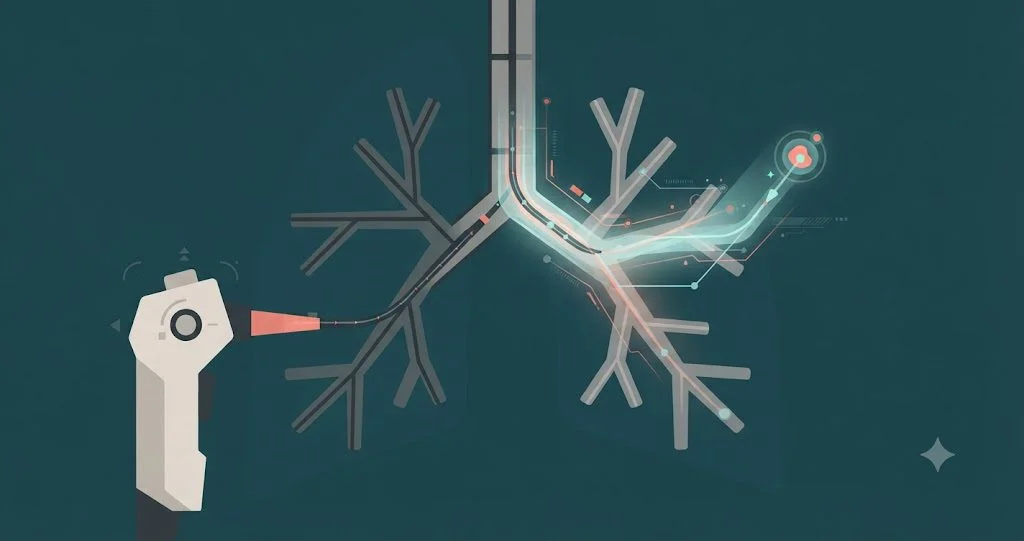
The word robot makes it sound as if a machine has taken over the procedure. That is not what Cleveland Clinic Abu Dhabi just introduced.
On July 28, the hospital announced the Middle East’s first use of the MONARCH robotically assisted bronchoscopy platform. Johnson & Johnson says the case also marked the region’s first clinical use of MONARCH QUEST, an AI-enabled navigation layer. The physician still guides the flexible endoscope through the lung and targets the nodule for biopsy.
Abu Dhabi has added AI-enabled navigation to a robotic bronchoscopy procedure used to reach and biopsy small, difficult lung nodules
Patients referred for lung-nodule assessment, families comparing diagnostic options, clinicians and anyone following medical AI in the UAE.
The platform is designed to help clinicians navigate deeper into the lung and target hard-to-reach nodules for biopsy
Bronchoscopy remains an invasive medical procedure with risks. The AI layer is navigation support, not an autonomous diagnosis or treatment decision.
If this procedure is recommended, ask what the robot changes, who controls it, how the biopsy result is interpreted and what alternatives apply to your case.
That distinction matters as AI moves deeper into healthcare. The safest way to read any “AI surgery” or “AI diagnosis” headline is to ask one question first: where does the algorithm stop and where does the clinician decide? In this case, AI supports navigation. It does not replace the doctor.
What Actually Happened
Cleveland Clinic Abu Dhabi says the MONARCH platform lets physicians guide a flexible endoscope deep into the lungs with enhanced stability and precision. The goal is to reach small or difficult nodules that can be challenging to access with conventional bronchoscopy and obtain tissue for diagnosis.
The hospital says the procedure is performed under general anesthesia and usually takes 30 to 75 minutes. Those timing and benefit claims come from the hospital, so they should be treated as provider information rather than a guarantee about any individual patient.
Johnson & Johnson, which makes the platform, describes MONARCH QUEST as AI-enabled navigation that integrates with advanced imaging. Its materials say the physician has continuous vision while the software combines navigation with intraprocedural 3D imaging data.
Where the AI Actually Sits
The AI is not deciding whether a patient has cancer. It is not independently driving a scope through the lung. And it is not replacing the pathology work that determines what the biopsy tissue shows.
Its role is narrower and more believable: help the clinical team navigate. Johnson & Johnson says the software uses AI-powered algorithms designed to support the user experience and integrate imaging data. The physician guides the instrument and targets the lesion.
That narrower description is important because “AI-powered” can hide very different levels of autonomy. A system that highlights a route is not the same as a system that makes the clinical decision at the end of that route.
A Robot Is Not an Autonomous Doctor
Robotic medicine often means mechanical control, stability and reach are being improved while a clinician remains in charge. That is the case here.
The distinction also changes the risk conversation. Johnson & Johnson lists potential bronchoscopy complications ranging from breathing difficulty, infection, low blood oxygen and bleeding at the biopsy site to rarer serious complications such as collapsed lung, respiratory failure, hemorrhage or cardiac problems. The presence of AI does not make those procedural risks disappear.
The useful patient question is therefore not “Is AI doing my procedure?” It is “What part of this procedure is AI assisting, and what part remains a physician decision?”
What a Patient Should Ask
- Why is robotic bronchoscopy being recommended for this nodule instead of another diagnostic route?
- Who physically controls the bronchoscope during the procedure?
- What does the AI-enabled navigation add to the imaging and navigation already being used?
- What are the material risks for my health and nodule location?
- Who interprets the tissue sample, and what happens if the biopsy is inconclusive?
Those are ordinary informed-consent questions. AI makes them more important because a technology label can make a procedure sound more autonomous than it is.
Why This Matters for UAE Health AI
This launch sits beside the Abu Dhabi-MIT cancer AI hub we covered recently. One story is about research infrastructure. This one is about AI showing up inside a live clinical workflow.
That is a useful progression. UAE healthcare AI is moving from models and research partnerships toward tools that sit beside clinicians during real procedures. The consumer-protection challenge is keeping the language precise as that happens.
The same evidence discipline matters in a broader health market that Dubai is actively trying to develop, as we discussed in our Dubai Longevity Authority analysis. Medical innovation becomes more trustworthy when the claims explain the actual function, evidence and human oversight.
The Robius Read
The most reassuring thing about this story is not that the platform uses AI. It is that we can describe exactly where the AI sits.
The robot helps the physician reach. The AI helps the physician navigate. The biopsy provides tissue. Clinicians and pathology still make the medical interpretation. That is a much more useful picture than calling the machine an AI doctor.
Sources
- Cleveland Clinic Abu Dhabi: MONARCH robotic bronchoscopy launch – Primary hospital announcement dated July 28, 2026.
- Johnson & Johnson: MONARCH Platform introduced to the Middle East – Primary manufacturer description of MONARCH QUEST AI-enabled navigation and safety information.
General information only. This is not medical advice.
Robius.news — Dubai, UAE — 2026 | Built to be first. Built to be trusted.