

Abu Dhabi has moved agentic AI into one of its highest-level government meeting workflows. The relevant question is not simply that an AI system appeared in the room, but what functions the official description assigns to it.
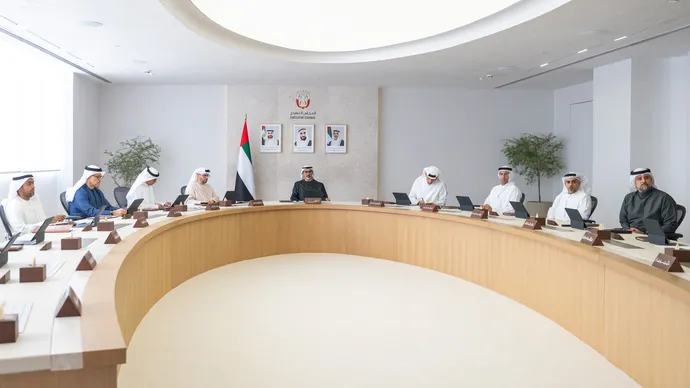
On September 17, the Abu Dhabi Executive Council used the AI Committee System for the first time during a council meeting. According to the Abu Dhabi Media Office, the platform analyses papers before a meeting, provides real-time insights and fact-checking support during discussion, and helps prepare reports, minutes and follow-up actions afterwards.
Abu Dhabi has moved agentic AI into a live Executive Council workflow for agenda analysis, meeting support, reporting and follow-up.
UAE government technology teams, AI governance professionals, public-sector suppliers and readers tracking how agentic AI is moving into real institutional workflows.
The model creates a concrete template for using agentic AI on bounded, document-based workflows where source traceability and human review can be designed in.
The public announcement does not disclose the model architecture, full permission map, error rates, human-review protocol or audit-log design.
Robius will watch for wider deployment, technical disclosures and evidence showing how the platform's recommendations and follow-up functions operate in practice.
Treat 'agentic AI' as a permissions question: check what the system can read, recommend, change and trigger before judging how autonomous it really is.
Council and government teams can receive structured summaries, real-time analytical support and clearer follow-up records around meeting outcomes.
The platform is described as an internal Executive Council workflow; the official announcement does not present it as a public service or open-access tool.
Watch which committees or entities adopt the system next and whether Abu Dhabi publishes details on permissions, human review, audit trails and operating results.
The official description presents the system as an analysis and decision-support layer, with outputs and decisions traceable back to the source papers used in the meeting.
Before the Meeting, It Reads the Agenda
The AI Committee System begins working before the council meets. The Media Office says it analyses proposals and topics tabled ahead of the session and prepares executive summaries explaining each agenda item.
This is a bounded use of agentic AI: the system has a defined body of source material, a specified output and a known audience. The announcement does not describe it as searching the open internet and creating policy independently.
For readers following the UAE’s government AI deployments, the distinction helps define the system’s stated role. Our earlier report on the UAE Cabinet’s 32 AI advisers examined a related question: what evidence the systems can access and what tasks they are described as performing.
During the Meeting, It Supports the Discussion
During the session, the platform can provide real-time AI insights and questions, help fact-check information, raise observations and propose analysis-based or data-driven recommendations.
The Executive Council remains the meeting and decision-making body; the official announcement does not describe the platform as independently approving policies, issuing orders or replacing council members.
The Media Office also says outputs and decisions remain traceable and linked to their original source papers. That gives reviewers a defined source record when a summary, observation or recommendation needs to be checked.
After the Meeting, It Becomes a Follow-Up System
The system’s job does not stop when the discussion ends. It can support real-time follow-up on proceedings, prepare detailed analytical reports and meeting minutes, summarise recommendations and required actions, and clarify which entities or committees are responsible for the next steps.
This places part of the deployment in administrative workflow management. Meetings create tasks, owners, deadlines and dependencies; the platform is described as helping turn those outputs into a structured follow-up record.
The Word ‘Agentic’ Still Needs Boundaries
Agentic AI is used for systems with varying levels of autonomy. The relevant implementation questions are about permissions: whether a system can only analyse and recommend, or can also change records, trigger workflows, send instructions or commit an organisation to an action.
The September 17 announcement gives a detailed public description of the analysis, meeting-support and follow-up functions. It does not publish a full technical architecture, model list, permission map, error rate, human-review protocol or audit-log design.
Those details would provide additional evidence about how the system behaves beyond the functions described publicly.
This Fits a Wider Move From AI Pilots to Workflows
Robius has been tracking a broader shift in the UAE AI stack from model announcements toward systems embedded in operating processes. Our UAE AI stack review covered several examples of that move across government and enterprise deployments.
The AI Committee System provides a visible workflow: papers are analysed before the session; summaries, insights and questions support the meeting; reports and follow-up actions are prepared afterwards. The public announcement does not provide enough detail to assess the platform’s full technical permissions or performance.
What Robius Will Watch Next
- Source access: what internal datasets and documents can the platform read?
- Permissions: can it only recommend and document, or can it trigger actions in other government systems?
- Human review: which outputs require a person to validate them before they enter the official record?
- Auditability: how are source links, model outputs, corrections and final decisions preserved over time?
- Expansion: whether the system moves into additional committees, departments or recurring government workflows.
The Bottom Line
Abu Dhabi’s September 17 announcement documents the first disclosed use of the AI Committee System inside an Executive Council meeting and defines functions before, during and after the session.
The announcement also states that outputs and decisions remain linked to their source papers. Future disclosures on permissions, review controls, model performance and deployment scope would make it possible to assess how the system operates beyond the public description.
Sources
- Abu Dhabi Media Office, 17 September 2026: official announcement describing the first Executive Council use of the AI Committee System and its before-, during- and after-meeting functions — Abu Dhabi Media Office
Checked 17 September 2026. Robius has not inferred technical permissions or decision authority beyond the functions described in the official announcement.
Robius.news — Dubai, UAE — 2026 | Built to be first. Built to be trusted.