 UAE, UNFILTERED
M42’s Ossi AI Is Active in Seven Healthcare Facilities. Four Agents Still Need Human Review
M42 has activated four clinical AI agents across seven UAE and Bahrain facilities. The real test is note accuracy, patient consent, safe escalation and measurable clinician time saved.
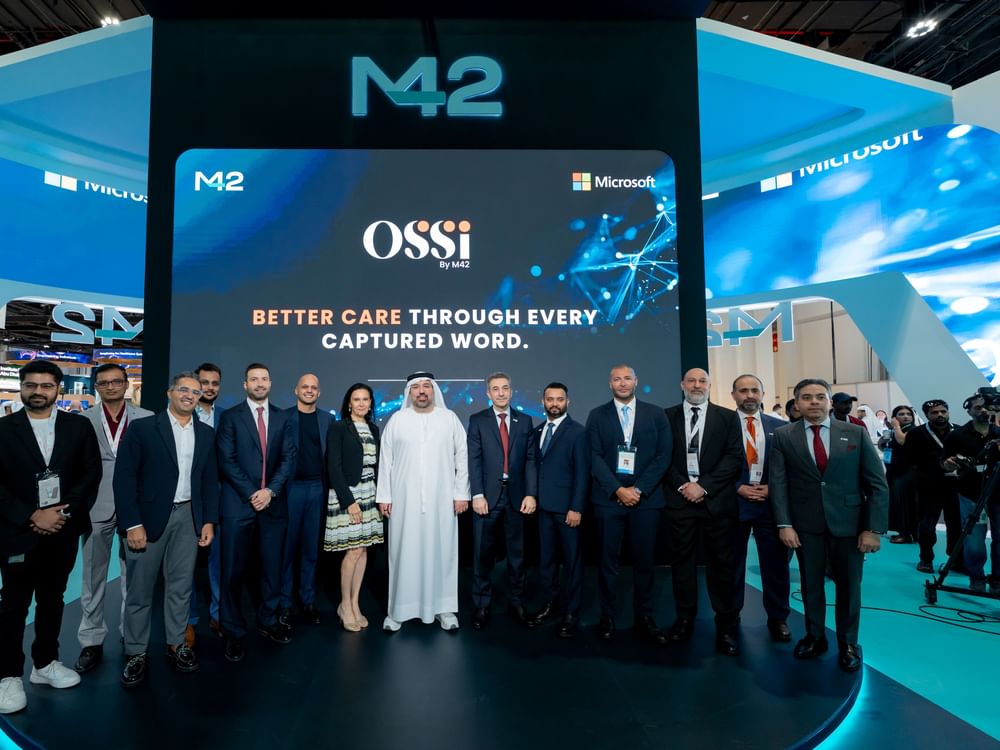
M42 reports live activation of a four-agent clinical AI support platform across seven healthcare facilities, moving beyond the prototype stage.
Patients, clinicians, healthcare administrators, clinical IT teams and UAE healthcare technology vendors.
Activation is company reported and does not prove better patient outcomes or independently measured time savings; clinician review and privacy safeguards remain critical.
Watch for clinical performance studies, correction rates, consent procedures, integration outcomes and measured documentation time savings.
Ask how clinical AI output is reviewed and corrected, whether consultations are processed or retained, and who remains accountable for final records.
Abu Dhabi’s M42 has moved a multi-agent clinical AI platform into seven healthcare facilities across the UAE and Bahrain. That makes Ossi a live workflow story, not another hospital chatbot announcement.
Unveiled at the Future Health Summit on 22 October, Ossi is designed to listen during consultations, prepare draft notes, retrieve patient history, surface medical information and suggest coding for review. M42 says it runs on its own architecture using Microsoft Azure infrastructure. The company lists Amana UAE, Amana Bahrain, Healthpoint, HealthPlus, Mubadala Health Dubai, Sheikh Sultan bin Zayed Hospital and the Imperial College London Diabetes Centre in Abu Dhabi among its first facilities.
The important question is not whether an AI agent can produce a neat summary. It is whether the summary faithfully represents the consultation, whether the right clinician checks it, and whether the system makes a difficult appointment safer or merely faster.
Four agents, four different risk levels
M42 describes four initial agents. They form a chain around the clinical encounter, rather than a single AI doctor making independent decisions.
- Ambient Scribe Agent: listens to the consultation and prepares a draft note for the clinician to review.
- Health Record Agent: retrieves and summarises relevant information from existing electronic medical records.
- Clinical Q&A Agent: helps clinicians find clinical information and produce patient-friendly educational content.
- Coding Agent: suggests medical codes based on the record, with final review by the appropriate team.
These tasks sound adjacent, but their error costs differ. A missed sentence in a summary might lead to an incomplete chart. An incorrect allergy or medicine summary could affect clinical decisions if someone accepts it without checking. An inaccurate code could create billing or reporting problems. The same general-purpose language technology therefore needs controls tailored to the task, not a single claim that it is ‘accurate’.
Seven facilities means operational deployment, not independently proven results
The strongest fact in the announcement is activation. M42 named where Ossi has been introduced. That is more useful than a demonstration at a trade show.
But activation alone cannot establish adoption levels, patient outcomes or administrative savings. The public release does not provide a trial protocol, audited pre-and-post time study, chart-error rate or patient-consent figures. In an interview with The National, M42 outlined potential reductions in preparation time and an estimate of up to 60% more clinician time with patients. Those are company expectations and examples, not independently published system-wide outcomes.
A useful evaluation would track what happens across different specialties and languages. Does a physician really spend less time after reviewing AI-generated notes? Are corrections minor or substantial? How often does the system return irrelevant clinical context? Are patients more satisfied with the conversation? Is the result different in a short follow-up visit and a complex oncology consultation?
The medical record stays central
Ossi is designed to work with existing electronic medical record systems rather than replacing them. M42 says the platform can integrate through HL7, FHIR or custom application interfaces. That makes it potentially useful across more than one hospital software stack, while introducing a familiar problem: an AI assistant is only as trustworthy as the records it can actually retrieve and interpret.
An incomplete medication history is not repaired by a fluent summary. Duplicate records, conflicting diagnoses, older laboratory results and translation errors can all be amplified if they arrive in a single confident paragraph. The clinical workflow therefore needs a way to show source records, dates and unresolved discrepancies to the person reviewing the output.
Robius has previously examined how Abu Dhabi’s disease registries help build structured clinical data, and why the cancer biobank’s evidence and consent pipeline matters. Ossi sits closer to the daily point where that digital infrastructure meets a patient and a clinician.
Ambient listening changes what patients should ask
A tool that listens to consultations creates a practical privacy question that patients can understand immediately: what exactly is being captured, and where does it go?
M42 says Ossi uses secure infrastructure and aligns with regional health-data governance requirements. That is a provider assurance, not a public technical audit. The announcement does not describe a universal patient opt-out process, how long consultation audio is retained, whether raw audio is stored at every site, or what individual patients will see in the consent process. Policies may differ by facility, so those details should not be inferred.
For patients, reasonable questions include whether the system is being used in their appointment, whether audio is retained, who can correct an AI-drafted note and whom to contact if their clinical record is inaccurate. For hospitals, the controls should extend to role-based access, vendor boundaries, incident logging and testing across Arabic, English and other relevant languages.
This is not the same as an autonomous AI clinician
The timing matters. Abu Dhabi has separately published a framework for researching and evaluating AI systems that might eventually perform defined clinical activities. That framework is about a future regulatory pathway to greater autonomy, with physician oversight and evidence requirements.
Ossi’s initial agents are positioned as workflow assistants, with outputs presented for clinician or staff review. A scribing system that drafts a note is not licensed to make an independent diagnosis simply because it is deployed in a hospital. Confusing these two stories would overstate both the product and the regulator’s announcement.
The measures that would make the next update valuable
M42 can make this a much stronger evidence story by disclosing a small number of comparable operational measures, with clear methodology:
- average documentation time before and after Ossi, including the time needed to correct its drafts;
- clinician acceptance and correction rates by agent and specialty;
- documented hallucination, omission and escalation incidents;
- patient communication and satisfaction outcomes;
- how language performance is tested and monitored;
- privacy, consent and data-retention arrangements that patients can understand.
No single metric is sufficient. A system that reduces documentation time but creates unnoticed mistakes is not an improvement. A system that takes a few seconds longer but reduces avoidable omissions may be one.
The Robius Read
M42 has crossed an important line by naming seven facilities where Ossi has been activated. The story now belongs to operations, not product marketing.
Its four agents can relieve real burdens if they reliably prepare records and leave clinicians with more time to think and listen. But healthcare is a setting where confident language should never be mistaken for verified fact. The next proof will come from transparent error monitoring, human review and evidence that patients benefit, not from the number of AI agents on a slide.
Sources
- Abu Dhabi Media Office: M42 launches Ossi, 21 October 2026
- Emirates News Agency: Ossi capabilities and facility list, 22 October 2026
- The National: Interview on Ossi clinical workflows, 22 October 2026
Checked 23 October 2026. Provider estimates of time saved and privacy assurances are attributed to M42; independently audited clinical outcomes were not available in the cited public disclosures.
Robius.news | Dubai, UAE | 2026 | Built to be first. Built to be trusted.