

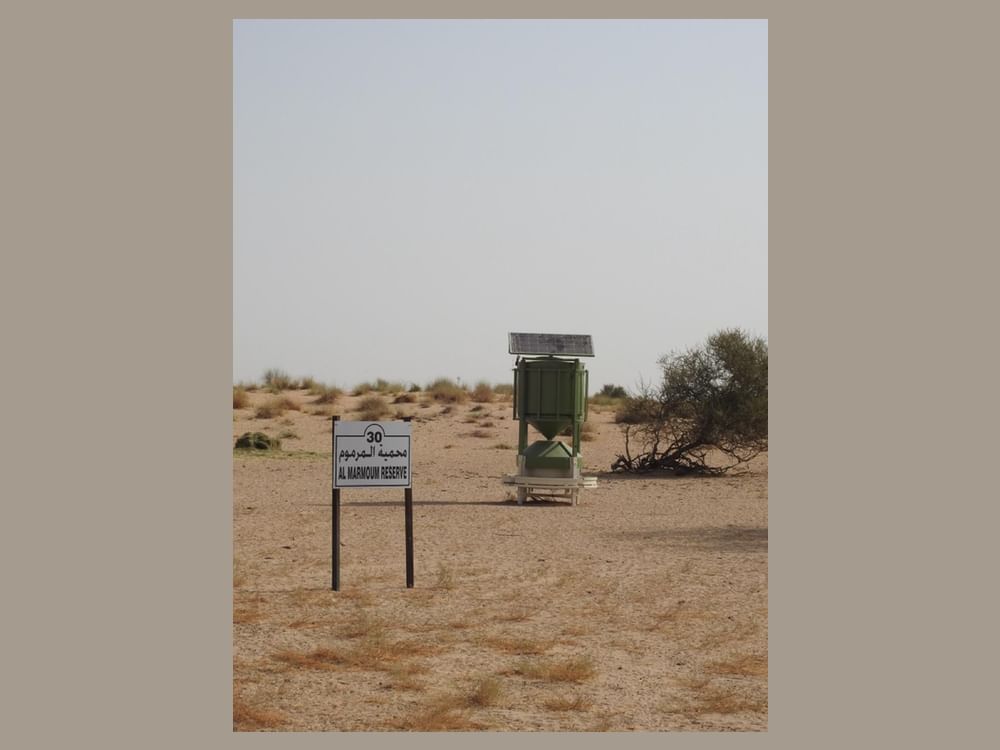
A solar-powered wildlife feeder in Dubai is doing more than dispensing food.
The UAE-developed Mghzlan Smart Feeder uses cameras, computer vision and connected sensors to identify animals, count visits, monitor feed consumption and adjust dispensing remotely. Emirates News Agency reported on 20 September that the system processes more than 15 million images a year and has been deployed at Al Marmoom Desert Conservation Reserve.
A UAE-developed system is connecting computer vision to a physical wildlife-management task at Al Marmoom, processing more than 15 million images annually while remotely controlling feed operations.
Conservation managers, environmental authorities, AI and IoT developers, and readers tracking practical UAE-developed AI deployments.
Combining wildlife identification, feed monitoring and remote dispensing could reduce unnecessary site visits and allow feed quantities to respond to observed activity rather than fixed assumptions.
The disclosed 80–97% figures are classification confidence levels, not a published independent accuracy benchmark. No labelled validation dataset, sample size or false-positive rate was disclosed.
The system is already deployed at Al Marmoom and in more than three countries; the next useful evidence would be independently measured conservation and resource-efficiency outcomes.
Treat the 15 million figure as image-processing volume and the 80–97% range as reported confidence, not as counts of animals or independently verified accuracy.
Wildlife reserve operators can gain remote monitoring and feed-management data, while animals may face fewer unnecessary human visits around feeding sites.
The current disclosure describes deployments rather than a public participation programme; operators interested in the system would need to engage the developer directly.
Watch independent species-identification accuracy, false positives, feed savings, maintenance requirements, deployment scale and evidence of measurable conservation outcomes.
That makes it an interesting example of AI moving into physical conservation infrastructure rather than another screen-based assistant.
What the feeder actually does
When wildlife approaches, day-and-night cameras record the species, number of animals and arrival time. The platform also tracks feed consumption, remaining stock, temperature and humidity.
Operators can manage multiple units remotely and receive alerts when feed needs replenishing or when people or vehicles are detected near an operating site.
Dub Dev Technology director Ali Khalfan Al Gaz Al Falasi told WAM that the device dispenses calculated quantities at scheduled times, reducing the need for daily human presence around wildlife.
The 15 million images are the workload, not 15 million animals
The biggest number in the announcement needs context.
Processing more than 15 million images annually does not mean the system has identified 15 million individual animals. Cameras can capture many images of the same animal or visit, and the disclosure does not provide a count of unique animals observed.
The figure is better understood as the scale of the computer-vision workload being processed by the system.
The reported 80–97% figure also needs the right label
WAM says field monitoring recorded animal-classification confidence levels between 80% and 97% in most cases. The developer separately said field tests reached confidence levels in that range when identifying species including gazelles, oryx, antelopes and birds, including in crowded or low-light conditions.
That is not the same thing as saying the system has independently verified 80–97% classification accuracy.
A confidence score is the model’s estimate of certainty for a prediction. A proper accuracy benchmark would require a labelled test set and published results showing how often those predictions were actually correct. The current disclosure does not provide that validation dataset, sample size, confusion matrix or an independent audit.
It has already moved beyond a prototype
The system has dispensed more than 50 tonnes of feed over a year and has been deployed in more than three countries, according to WAM.
At Al Marmoom, the practical value is the combination of monitoring and intervention. Instead of a feeder operating on a fixed schedule with little feedback, the platform can connect animal activity with feed use and stock levels.
That can help operators tailor quantities to a location while reducing unnecessary trips into wildlife areas.
Why this is a more interesting AI deployment than the headline suggests
The AI component is only one layer.
The system combines computer vision with solar power, cameras, environmental sensors, remote management and a physical dispensing mechanism. In other words, the model does not simply generate information. Its observations can affect a real-world resource.
That raises the standard of evidence that matters next. Useful follow-up data would include independently measured species-identification accuracy, false-positive rates, feed savings, maintenance requirements and evidence that automated dispensing improves conservation outcomes rather than simply making operations more convenient.
Robius has been tracking the same shift elsewhere in the UAE: AI increasingly sits inside operating systems and physical infrastructure rather than only appearing as a chatbot or consumer app. Abu Dhabi’s patient-safety AI, for example, now connects every hospital in the emirate, but its headline numbers also require careful interpretation.
The bottom line
The Mghzlan Smart Feeder is a real deployed UAE technology, not merely a concept demonstration. It is operating at Al Marmoom and combines AI, IoT and automated feeding in one conservation system.
But two numbers should not be overstated. Fifteen million images describe processing volume, not the number of animals monitored. And the reported 80–97% range is a confidence measure disclosed through the developer, not a published independent accuracy benchmark.
The more important test is what the system eventually proves in the field: whether better monitoring and automated feeding can reduce waste, reduce disturbance and improve wildlife-management decisions.
Sources
Checked 20 September 2026. The 80–97% figure is described by the source as classification confidence; Robius did not find a published independent accuracy benchmark in the disclosed material.
Robius.news — Dubai, UAE — 2026 | Built to be first. Built to be trusted.