

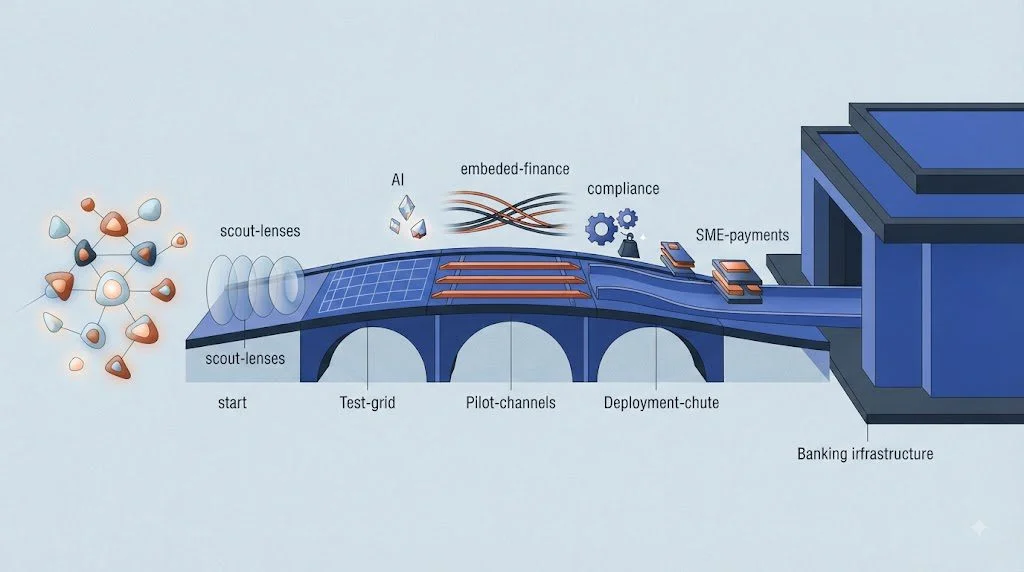
Dubai does not have a startup-logo problem. It has a deployment problem.
Technology Express reports that Emirates NBD and Dubai Future District Fund have partnered to identify, test and implement fintech and AI solutions inside financial services. If that wording turns into operating reality, the interesting part is not another innovation partnership. It is a route from startup deal flow into a bank that already has a documented process for scouting, testing and deploying external technology.
If the reported partnership works as described, UAE fintech and AI startups could gain a clearer route from ecosystem access into real bank pilots and deployment.
UAE fintech founders, AI startups, venture investors and enterprise technology teams should watch the first companies and use cases selected.
The reported focus spans AI banking, embedded finance, digital assets, SME solutions, WealthTech, compliance and next-generation banking infrastructure.
No primary partnership announcement, named pilots, implementation timeline, new funding allocation or commercial terms were located at the time of checking.
The first meaningful milestone is a primary announcement followed by named startups, pilots and evidence that experiments convert into production deployments.
Founders should prepare enterprise-ready use cases and track official Emirates NBD and DFDF channels rather than assume fund or ecosystem membership guarantees bank access.
Startups gain potential enterprise access, while Emirates NBD gains a wider pipeline of technology it can test against real banking problems.
No application route, selection criteria or participating startups for the reported Emirates NBD-DFDF partnership have been publicly identified yet.
Watch selection criteria, pilot volumes, conversion from proof of concept to deployment, commercial contracts and measurable customer or operating outcomes.
The Important Words Are Identify, Test and Implement
The Technology Express report says the collaboration will connect Emirates NBD with high-growth startups and focus on AI-driven banking, embedded finance, digital assets, SME solutions, WealthTech, compliance technology and next-generation banking infrastructure.
Those are broad categories. The useful part is the proposed mechanism. The report says the two organizations will identify, test and implement solutions. That is materially different from a partnership that stops at mentorship, events or introductions.
Robius could not locate a same-day primary announcement from Emirates NBD or DFDF confirming the new partnership as of August 11. So the partnership-specific details remain single-source reporting for now. The reason the story is still worth watching is that both sides already have independently verifiable infrastructure that makes the model plausible.
Emirates NBD Already Has a Startup-to-Deployment Machine
Emirates NBD’s own Future Banking Lab says it has engaged 482 fintechs, completed 74 proofs of concept and recorded nine implementations. Its process is unusually explicit: Scout, Evaluate, Experiment, Deploy.
That matters because the gap between a proof of concept and a production contract is where many corporate innovation programs die. A bank can host dozens of demos without changing a customer journey or an internal process. Emirates NBD at least publishes a framework designed to push selected technology through that last step.
The bank made the same point in July when it announced an Acceleration-to-Enterprise partnership with Techstars. Emirates NBD said selected AI and fintech startups could gain access to its cloud-native infrastructure to pilot real use cases, with a focus on compliance, wealth management, SME banking and capital markets. The new DFDF report looks less like a brand-new idea than another intake channel feeding the same machine.
For regulatory context, the Central Bank of the UAE’s June 2026 register lists Emirates NBD Bank P.J.S.C. as a national conventional retail bank headquartered in Dubai. For founders, that means any successful pilot is not merely access to a corporate innovation team. It is access to a regulated banking environment with real compliance, procurement and integration requirements.
DFDF Brings the Other Half: Capital and Deal Flow
Dubai Future Foundation describes DFDF as Dubai’s evergreen venture capital fund of funds, anchored by DIFC and Dubai Future Foundation, with an initial AED 1 billion in committed capital. Its mandate includes investing in venture funds with a local focus and investing directly in startups.
That gives DFDF something a bank innovation team does not naturally have at the same scale: a view across founders, funds and emerging companies before they become obvious enterprise vendors.
The model is similar to what we have been seeing elsewhere in the UAE. Mastercard Lighthouse UAE combines a corporate payments network with startup selection and ecosystem access. The difference here is that the reported DFDF relationship would connect venture deal flow directly to a bank with its own testing and deployment process.
Why Deployment Is the Scarce Resource
Capital helps a startup build. An accelerator helps it refine. Neither guarantees that a large regulated company will buy the product.
Banks are difficult customers for good reasons. Security review, data governance, model risk, procurement, integration, resilience and regulatory accountability all sit between a promising demo and a production deployment. For AI products, the CBUAE has also published guidance focused on transparency, accountability, explainability, privacy and responsible adoption by licensed financial institutions.
That is why a credible enterprise route can be more valuable than another pitch competition. The same pattern is appearing in SME finance. Our report on Wio and Geidea showed how distribution becomes more powerful when it is wired into a licensed financial institution rather than left as a loose referral. The value is in the operational handoff.
This Also Fits a Bigger UAE Finance Shift
UAE financial services are increasingly being distributed through places that are not traditional bank branches. Telecom apps, payment terminals, free zones and business software are all becoming entry points into banking or financing products.
We mapped that convergence in our embedded-finance trend analysis. The startup side of the market is moving in the same direction. Innovation programs are becoming less useful when they only create visibility and more useful when they create a route into enterprise systems.
If Emirates NBD and DFDF execute the reported plan, the partnership could become a supply line: DFDF helps surface companies, the bank evaluates them, selected products get tested, and the ones that survive can move toward deployment. That is the part worth measuring.
What We Still Do Not Know
The current report does not name a single participating startup. It does not identify an application page, a selection committee, a pilot timeline, a target number of deployments or a new capital allocation. It also does not say whether DFDF portfolio companies receive any priority.
Those gaps are not small. They decide whether the collaboration becomes a repeatable procurement channel or remains an ecosystem relationship with good intentions.
There is also no reason to assume every startup that reaches a pilot will reach production. Emirates NBD’s own Future Banking Lab numbers are useful precisely because they show the funnel. Hundreds of fintech engagements have produced dozens of proofs of concept and a much smaller number of implementations. That is normal enterprise selection, not a failure.
What UAE Founders Should Watch
Founders should ignore the word innovation and watch the conversion points.
First, who can enter the pipeline? Second, what counts as a successful pilot? Third, who pays for the experiment? Fourth, what procurement path exists after the proof of concept? Fifth, how much customer or operational data can the startup actually access during testing, and under what controls?
If the partnership publishes clear answers, it becomes materially more interesting than another accelerator. If the next update is only another summit and another set of ecosystem quotes, the thesis weakens.
For now, the opportunity is promising but unproven. Dubai already has capital, founders and institutions willing to talk about innovation. The harder asset is a reliable bridge from a startup’s product into a regulated enterprise. That is the bridge this reported partnership should be judged on.
Sources
- The Technology Express: August 11 report on the Emirates NBD and Dubai Future District Fund collaboration – https://thetechnologyexpress.com/emirates-nbd-and-dfdf-partner-to-drive-fintech-and-ai-innovation/
- Emirates NBD: July 6, 2026 Techstars Acceleration-to-Enterprise partnership and startup pilot pathway – https://www.emiratesnbd.com/en/media-center/techstars-and-emirates-nbd-accelerate-ai-and-fintech-solutions
- Emirates NBD: Future Banking Lab metrics and Scout-Evaluate-Experiment-Deploy framework – https://www.emiratesnbd.com/en/innovation/futurelab
- Dubai Future Foundation: Dubai Future District Fund mandate, evergreen fund-of-funds structure and initial AED 1 billion commitment – https://www.dubaifuture.ae/dubai-future-district-fund/
- Central Bank of the UAE: June 2026 Register of Licensed Financial Institutions, listing Emirates NBD Bank P.J.S.C. as a national conventional retail bank – https://www.centralbank.ae/media/thblruug/cb-register-june-2026.pdf
- Central Bank of the UAE: February 11, 2026 guidance on responsible AI and machine-learning adoption by licensed financial institutions – https://rulebook.centralbank.ae/en/rulebook/guidance-note-consumer-protection-and-responsible-adoption-and-use-artificial-intelligence
This is not financial advice.
Robius.news — Dubai, UAE — 2026 | Built to be first. Built to be trusted.