

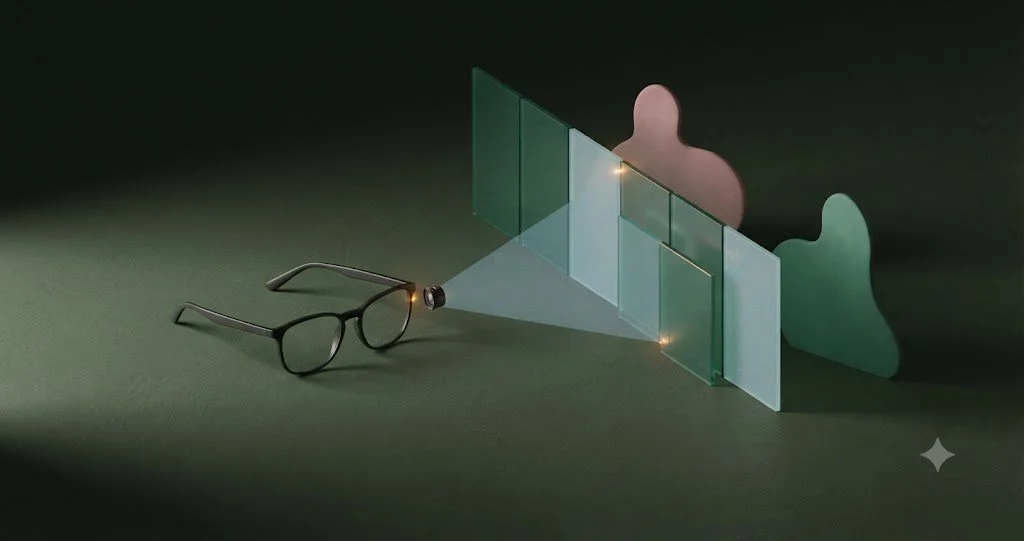
Smart glasses are reaching the awkward stage every new camera technology eventually reaches: they look normal enough that people stop noticing the camera.
That is why the privacy debate is getting louder. Australia’s privacy commissioner warned this weekend that existing laws may need to change as discreet smart glasses become more common. Meta, meanwhile, says its AI glasses include a capture LED that flashes while photos or video are being recorded, and newer models disable the camera when the system detects that the LED is blocked or tampered with.
A wearable camera can capture people before they understand they are in a recording workflow, especially when AI processing follows the capture.
UAE buyers, creators, retailers, employers and businesses considering smart glasses for customer-facing work.
Hands-free capture, translation, accessibility and AI assistance can be genuinely useful.
Bystander notice is easy to miss, AI features vary by market, and official Ray-Ban pages currently conflict on UAE purchase and shipping availability.
Verify local feature support before buying and set a clear workplace rule before employees use wearable cameras around customers or confidential material.
For UAE buyers, there is another layer. Ray-Ban’s own regional pages currently do not fully agree on UAE availability, even while its MEA product page shows Gen 2 pricing from AED 1,830. And for UAE businesses thinking about wearable capture, images and voices can become personal data once they are collected and processed in identifiable form.
The Privacy Problem Has Moved From the Phone to the Face
A phone camera announces itself. Someone raises a rectangle, points it and usually looks at the screen. Glasses remove much of that social signal.
The Guardian’s recent reporting captures the split well. Some users describe smart glasses as useful for hands-free photography and accessibility. Other people feel uneasy because the camera is integrated into something that looks close to ordinary eyewear. Australia’s privacy commissioner has now argued that the technology may expose gaps in existing privacy rules as discreet, persistent recording becomes easier.
The tension is not proof that smart glasses are inherently abusive. It is proof that the old social cue for ‘a camera is recording me’ is weaker when the camera sits on someone’s face.
Meta Has Added a Recording Signal, but a Signal Is Not Consent
Meta says every pair of its AI glasses has a white capture LED that blinks when content is being captured for the gallery. For video, the light continues blinking while recording. The company says there is no off switch for that LED.
From the second generation onward, Meta says blocking the LED disables the camera, and it is also updating devices to detect physical tampering with the light. That is a meaningful safeguard. It makes covert modification harder than simply placing tape over an indicator.
But an indicator and consent are different things. Someone can fail to notice a small light. They can see it without knowing what it means. They can understand that a camera is active without knowing whether the result will stay on the glasses, move to a phone, be posted online or be sent to an AI system.
That is the emerging design problem: privacy has to work for the bystander, not only for the person who bought the device.
The UAE Product Page Has Its Own Fine Print
Ray-Ban’s MEA page currently advertises Gen 2 models from AED 1,830 and describes a 12 MP camera, up to 3K video, a five-microphone array and Meta AI features. It also repeatedly warns that voice commands and some Meta AI functions are available only in selected countries and languages.
Then the availability information gets messy. The same MEA page’s FAQ does not list the UAE among the countries where Ray-Ban Meta can currently be purchased or shipped. Other official Ray-Ban pages for India and Mexico do list the UAE as a supported country.
Robius would not smooth that contradiction into a confident availability claim. If you are buying in the UAE, verify the exact local retailer, warranty, app support and AI features before paying. A price shown in AED is useful, but it is not the same thing as a clean promise that every feature and support path is live locally.
That is the same habit we used in our Google I/O guide, where global AI announcements only mattered after checking what UAE users could actually access.
What UAE Data Law Adds to the Business Conversation
The UAE Personal Data Protection Law defines personal data broadly. The official legislation includes a person’s voice and image among identifiers that can make data personal. It also defines biometric data as personal data produced through specific processing of physical, physiological or behavioral characteristics that allows unique identification, including facial images.
That does not mean every private photo taken through smart glasses is automatically a federal data-protection violation. The law has scope rules and exclusions, and other UAE laws can also be relevant. This is not legal advice.
But a business workflow is harder to dismiss as casual photography. If a company equips staff with glasses that record customers, meetings, visitors, locations or workspaces and then stores or analyzes that material, it should identify what data is captured, why it is needed, who receives it, how long it is kept and what notice or consent mechanism applies to the actual use case.
The law’s processing controls require fair, transparent and lawful handling, a specific purpose, data minimization, accuracy and security. Those are sensible design questions even before a legal team gets involved.
The Bigger Question Is What Happens After Capture
The camera is only the first step. Smart glasses are increasingly sold as AI interfaces. A captured image can be analyzed, translated, summarized, searched or used to answer a question about the world in front of the wearer.
That is useful. It also means the privacy question is no longer only ‘was I photographed?’ It can become ‘what did the system infer from the image, where was that inference processed, and who can use the result?’
Our iCloud encryption analysis made a similar distinction between data existing and who can access the keys to it. Our AI companion privacy review looked at another version of the same issue: the interface feels personal, but the data path behind it is what decides the actual privacy trade-off.
A Better Rule for Workplaces
If a UAE business wants to use AI glasses, start with places where the benefit is clear and the privacy boundary is manageable. A technician documenting equipment with no customers in frame is different from a salesperson recording a meeting. A warehouse workflow is different from a clinic waiting room.
Make the recording state obvious. Tell people when capture is happening. Avoid confidential screens and documents that have nothing to do with the task. Keep the default retention short. Do not send every capture into AI analysis just because the device can.
And before buying a fleet, confirm which features are actually supported in the UAE. Hardware that works as a camera but loses the AI function you were paying for can turn an exciting pilot into an expensive pair of ordinary glasses.
The Robius Read
Smart glasses will probably become less visually strange from here, not more. That is exactly why privacy design has to get better as the hardware disappears into normal clothing.
Meta’s capture LED is a real safeguard. It does not solve the whole social problem. UAE data law gives businesses a reason to think carefully about identifiable images and voices. Ray-Ban’s inconsistent regional availability pages give buyers a reason to verify support before paying.
The next wearable race will not only be about who has the best camera or AI. It will also be about whether the person standing in front of the glasses understands what is happening.
Sources
- The Australian: Privacy commissioner warns new laws may be needed for smart glasses
- The Guardian: How Meta smart glasses have divided opinion
- Meta: AI Glasses – Your Questions Answered
- Ray-Ban MEA: Ray-Ban Meta AI Glasses
- UAE Legislation: Federal Decree by Law No. 45 of 2021 Concerning the Protection of Personal Data
Robius.news — Dubai, UAE — 2026 | Built to be first. Built to be trusted.