 UAE, UNFILTERED
Dubai’s New Airport Is About to Have 120,000 Workers on Site. Here Is What That Scale Actually Means
Al Maktoum Airport 120000 workers Dubai 2026 Dubai’s New Airport Is About to Have 120,000 Workers on Site. Here Is What That Scale Actually…
The short answer
Al Maktoum Airport 120000 workers Dubai 2026 Dubai’s New Airport Is About to Have 120,000 Workers on Site. Here Is What That Scale Actually…
Al Maktoum Airport 120000 workers Dubai 2026
Dubai’s New Airport Is About to Have 120,000 Workers on Site. Here Is What That Scale Actually Means.
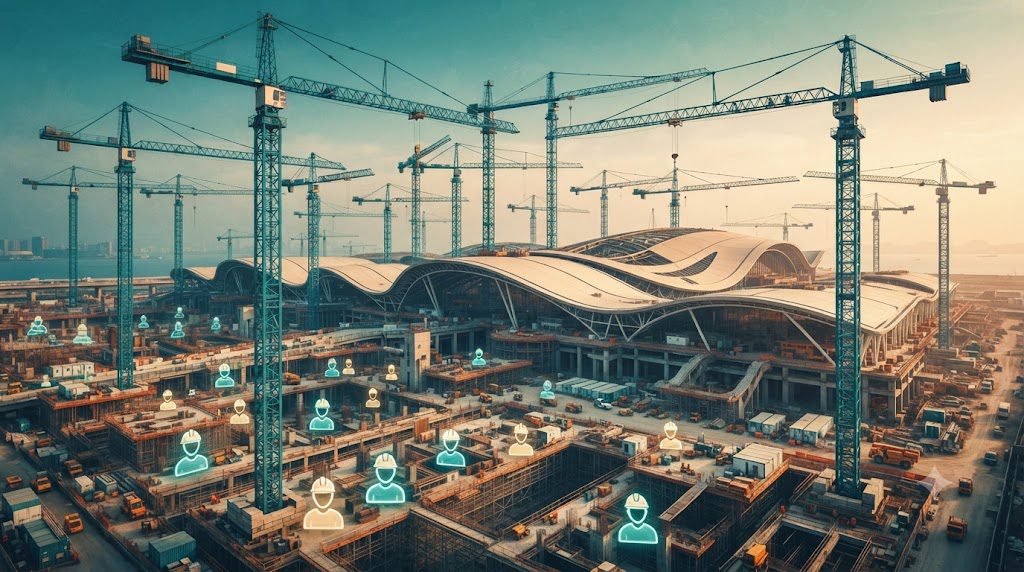
Al Maktoum International Airport, at Dubai World Central in Dubai South, currently has about 9,000 workers on site. That number is heading to roughly 120,000 at peak construction, according to Dubai Aviation Engineering Projects, the body delivering the build. For reference, that is the population of a mid-sized European city arriving to construct a single piece of infrastructure.
The scale tells you what this is. Dubai is not refurbishing an airport. It is building the largest one in the world from the ground up, while the city keeps growing around it.
| THE ROBIUS VERDICT: One of the largest construction projects on Earth, with direct implications for Dubai’s property market, southern corridor development, jobs market, and long-term transport network. Al Maktoum International Airport is designed to eventually handle 260 million passengers per year, which would make it the highest-capacity airport in the world. The AED 128 billion first phase, approved in April 2024, is planned for 150 million passengers annually and remains on schedule to open in 2032, as Dubai confirmed in June 2026. DXB, the current primary airport, handled a record 95.2 million passengers in 2025. The transition from DXB to Al Maktoum will unfold across years, not as a single moving day. |
Why This Scale Matters Beyond Aviation
A workforce of 120,000 needs housing, transport, food infrastructure, medical facilities, and support services. Dubai South, the district around the airport, is being developed in parallel to absorb exactly that demand. And it is not a construction camp. It is an urban master plan spanning residential communities, commercial districts, and logistics zones, with the airport workforce providing the initial density that makes the rest commercially viable. Officials have projected demand for housing for a million people living and working in Dubai South over time.
What This Means for Property in Dubai South
Off-plan property in Dubai South has been one of the fastest-growing segments of the 2026 surge, with major developers positioning projects around the airport catchment. The workforce expansion turns a previously speculative investment thesis into something more concrete. A workforce that size needs nearby accommodation, and the service economy that follows it, retail, restaurants, schools, clinics, generates its own employment and its own housing demand in turn.
One honest caveat belongs here. None of this guarantees price appreciation, because property markets answer to more than a single infrastructure project. What has changed is that the fundamental demand driver is now measurable rather than promised.
The Timeline, Precisely
Al Maktoum opened for cargo in 2010 and has run limited passenger operations for years. The transformation began in April 2024, when the AED 128 billion expansion was approved. Progress since has been rapid: more than 10 million work hours logged over 15 months, over 17,000 concrete piles installed, 45 million cubic metres excavated, and a second runway completed so the original can be rehabilitated. Contracts worth AED 13 billion are currently executing, with further packages exceeding AED 55 billion due for award by year-end.
The destination dates are now consistent across official statements. The first phase, built for 150 million passengers a year, opens in 2032. The full 260 million capacity is a multi-decade project, with Dubai Airports’ leadership placing completion well into the 2050s. DXB remains the primary gateway until the first phase is live, and one more distinction matters: the 120,000 figure is the construction workforce, not the eventual operations staff, which will be counted separately across airlines, ground handling, retail, and security.
The Jobs and Transport Implication
A build of this scale creates employment far beyond construction. Engineering, logistics, hospitality, healthcare, education, and retail all grow in proportion to the population being served. For residents and potential arrivals, Dubai South is worth tracking as a jobs and housing market rather than dismissing as a remote industrial zone.
Transport is following the same southward pull. The RTA has begun design work on extending the Route 2020 metro line from the Expo station to Al Maktoum’s West Terminal, roughly three kilometres and two new stations. An Airport Express Line linking DXB to Al Maktoum is also under study. Expo City Dubai already sits about ten minutes away. The south of Dubai is being wired into the city, and the airport is the reason.
Sources
- Khaleej Times: Onsite workforce set to expand from 9,000 to 120,000, with DAEP construction milestones — https://www.khaleejtimes.com/business/uae-jobs-onsite-workforce-on-dubais-al-maktoum-airport-set-to-expand-from-9000-to-120000
- Arabian Business: Project cost, first phase capacity of 150 million passengers, 2032 opening, DXB 2025 traffic, and metro plans — https://www.arabianbusiness.com/business/transport/dubai-al-maktoum-international-airport
- Aviation Business ME: First phase confirmed on schedule for 2032 with capacity and connectivity details — https://www.aviationbusinessme.com/news/al-maktoum-airport-expansion-advances-toward-2032-launch
Robius.news — Dubai, UAE — 2026 | Built to be first. Built to be trusted.