

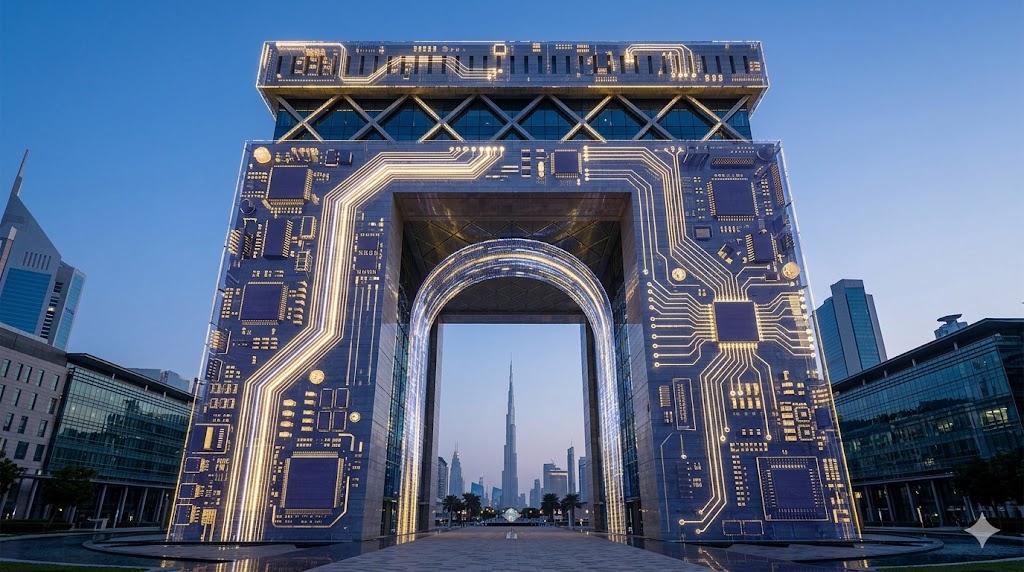
DIFC AI-native financial centre
Unlike traditional hubs like London or New York, DIFC isn’t weighed down by legacy systems. That is the actual argument the Dubai International Financial Centre is making for why it, and not a financial capital with centuries of institutional history, should be the one to rebuild finance around artificial intelligence from the ground up.
On April 21, DIFC announced it will become the world’s first AI-native financial centre. Not a financial centre that uses AI tools. A financial centre where AI is written into the legal code itself.
| VERDICT: A genuinely unprecedented regulatory bet, with real money and real jobs attached, and real questions about delivery. No financial centre on earth has declared itself AI-native before. DIFC is proposing to embed AI into its legal system, its regulations, its workforce training, and its physical infrastructure simultaneously, projecting $3.5 billion in economic value and 25,000 jobs. The ambition is real and the foundation, DIFC’s existing Regulation 10 on AI data governance, is more substantial than a press release. Whether the implementation matches the announcement is the thing worth watching over the next 18 months. |
What ‘AI-native’ actually means, beyond the buzzword
Most financial centres talk about AI the way most companies do, a chatbot here, a fraud detection model there, a compliance dashboard in the back office. DIFC is proposing something structurally different: making AI part of what it calls the core operating system of the centre itself, across five layers at once.
The legal and regulatory layer is the most unusual part. DIFC plans to introduce ethics and governance frameworks that apply not only to humans but explicitly to AI agents and robotics operating within its jurisdiction. This builds on DIFC’s existing Regulation 10, introduced as part of its 2023 AI strategy, which already governs personal data processed through autonomous and semi-autonomous systems. That existing groundwork is what separates this announcement from a pure marketing exercise. DIFC was already regulating AI-driven data processing for two years before this declaration.
The business operations layer means embedding AI into enterprise workflows, compliance systems, and financial services delivery directly, with DIFC stating its own staff are already using specialised AI agents daily for productivity, governance, and client services. The talent layer means expanding executive education, regulatory training, and technical certification so the workforce can operate alongside AI and robotics, rather than simply being displaced by it. And the physical infrastructure layer targets actual deployments of physical AI and robotics within the district by 2030.
The numbers, and why DIFC thinks it can win this
The headline figures are AED 12.9 billion, roughly 3.5 billion US dollars, in projected economic value, and 25,000 new jobs. DIFC has also stated an explicit ambition to become the number one global destination for AI-in-finance companies, aiming to surpass the world’s other top financial centres in start-up density, venture capital funding, and unicorn creation specifically within AI-driven finance.
DIFC’s argument for why it can move faster than London, New York, or Singapore rests on one structural advantage: it operates under an independent legal system based on English common law, separate from the UAE’s federal legal framework, which gives it genuine regulatory agility most established financial centres do not have. A two-century-old financial capital cannot simply rewrite its core legal code around a five-year-old technology. DIFC, as a purpose-built jurisdiction with full regulatory authority over its own zone, can.
Comparative context matters here. Singapore currently leads the Asia-Pacific region with 63% of its financial institutions using AI in production, according to industry tracking cited in coverage of the announcement. That is meaningful adoption. It is also adoption layered on top of an existing legal and regulatory structure, not a structure rebuilt around AI from its foundations. DIFC’s bet is that the rebuild, not the adoption rate, is where the real long-term advantage lives.
The Dubai AI Festival is the proof-of-concept moment
DIFC’s transformation will be showcased at the Dubai AI Festival on October 26 and 27, 2026, at the Dubai World Trade Centre, expected to bring together more than 20,000 participants from over 100 countries. DIFC has also said it intends to export its AI governance software and trained talent to markets across the Global South, positioning the centre not just as an adopter of AI governance but as an exporter of it.
That October date functions as a natural checkpoint. By then, the question will no longer be what DIFC announced in April, but what it has actually shipped: how many AI firms have registered, what the published frameworks for autonomous agents actually say, and whether the physical infrastructure commitments have moved from slide deck to ground.
The honest read
This is genuinely ambitious in a way that is rare even by Dubai’s own standards for bold announcements. Embedding governance for AI agents and robotics directly into a financial centre’s legal code, before most of the rest of the world has even finished arguing about how to regulate AI chatbots, is a real first. The existing Regulation 10 framework gives this more substance than a typical headline-grabbing pledge.
The honest caveat, consistent with how this guide treats every UAE AI announcement, is that the gap between announcing a transformation and delivering one is usually the part that takes years, not months. Twenty-five thousand jobs and 3.5 billion dollars in economic value are projections, not commitments with a penalty clause attached. The right way to read this in twelve months is the same filter we apply to every claim like it: what is actually live, registered, and operating, not just announced.
For now, DIFC has done something no other financial centre has done: put a stake in the ground and a legal framework underneath it. That is more than most AI announcements in finance can claim. What happens between now and the Dubai AI Festival in October is where this story actually gets decided.
Sources
• DIFC official announcement: DIFC to become the world’s first AI-Native financial centre — https://www.difc.com/whats-on/news/difc-to-become-the-worlds-first-ai-native-financial-centre
• Arabian Business: DIFC to become world’s first AI-native financial centre, $3.5bn and 25,000 jobs — https://www.arabianbusiness.com/business/difc-to-become-worlds-first-ai-native-financial-centre
• MENA Fintech Association: DIFC to embed AI across regulation and operations — https://mena-fintech.org/news/difc-to-embed-ai-across-regulation-and-operations-as-first-ai-native-hub/
• PR Newswire: official DIFC press release, full programme details — https://www.prnewswire.com/news-releases/difc-to-become-the-worlds-first-ai-native-financial-centre-302748546.html
• ADEPTS/Taxadepts: DIFC AI-Native analysis, Singapore 63% AI-in-production comparison
Robius.news — Dubai, UAE — 2026 | Built to be first. Built to be trusted.