 UAE, UNFILTERED
MOHRE App and Tasheel Explained: Work Permits, Labor Contracts, WPS, and the Employment Rules Every UAE Worker and Employer Must Know in 2026
MOHRE Tasheel UAE 2026 MOHRE is the Ministry of Human Resources and Emiratization, the federal authority that governs every private-sector employment relationship in the…
The short answer
MOHRE Tasheel UAE 2026 MOHRE is the Ministry of Human Resources and Emiratization, the federal authority that governs every private-sector employment relationship in the…
MOHRE Tasheel UAE 2026
MOHRE is the Ministry of Human Resources and Emiratization, the federal authority that governs every private-sector employment relationship in the UAE. Tasheel is its authorized processing network. Together, they control work permits, labor contracts, WPS salary compliance, Emiratization targets, and labor dispute resolution. If you work in the UAE private sector, or run a business that employs anyone, this is the system your working life runs on.
MOHRE, Tasheel, and the MOHRE App: What Each One Is
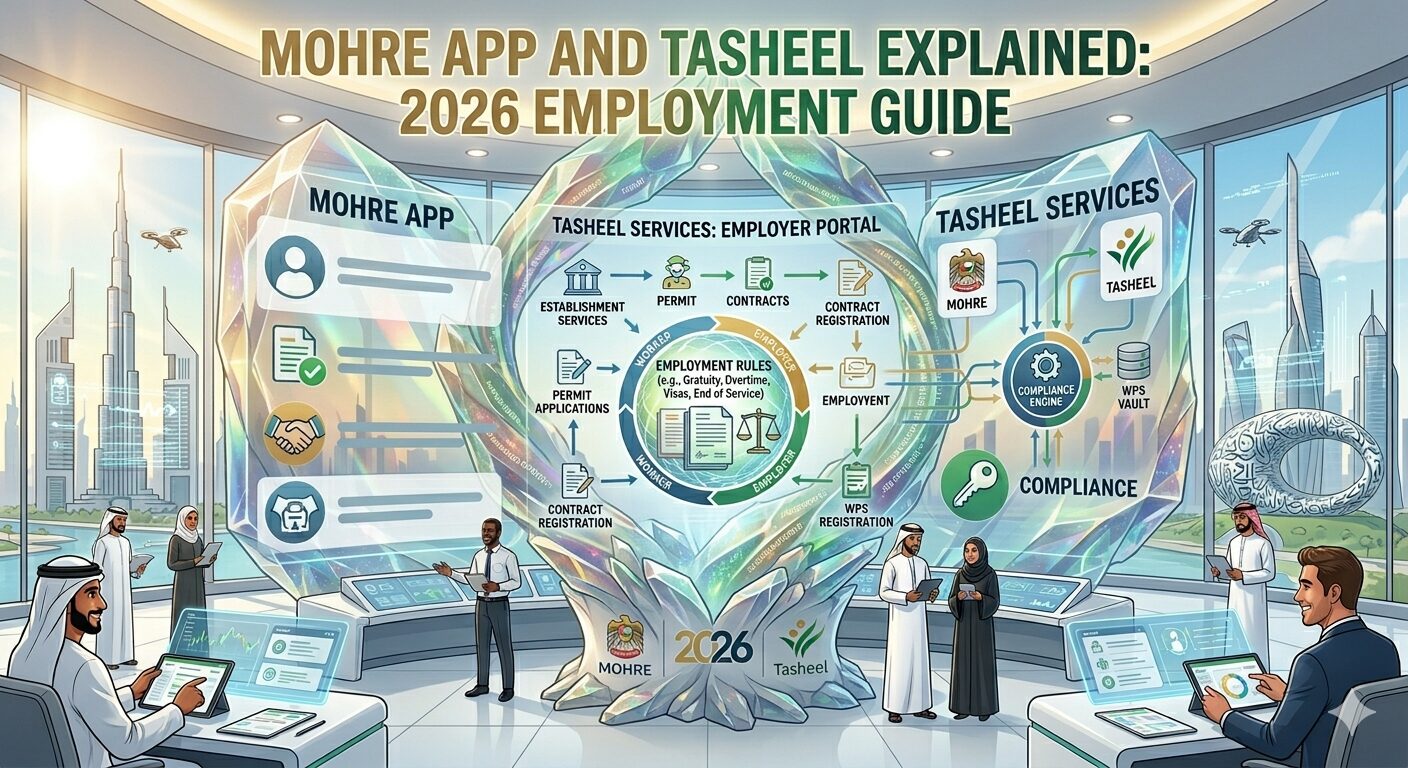
Before anything else: MOHRE, Tasheel, and the MOHRE app are three different things that work together. Most residents and employers encounter all three but rarely understand how they relate.
| What It Is | What It Does | Who Uses It |
| MOHRE | The Ministry of Human Resources and Emiratisation. The federal authority that makes the rules, sets the fees, processes applications, and enforces compliance across all private-sector employment in the UAE. | Referenced by everyone; directly interacted with by employers and employees through the channels below |
| Tasheel | The authorised e-platform and physical service centre network through which employers and typing centres submit labour transactions to MOHRE. The word means ‘facilitation’ in Arabic. | Employers, PRO officers, and typing centres submitting work permits, contracts, and establishment registrations |
| MOHRE App | The official mobile gateway to MOHRE services. Allows employees to check their contract status, verify company WPS compliance, file labour complaints, and check their work permit. Employers can view establishment details and compliance status. | Both employees and employers for enquiry and self-service tasks. Not the primary submission channel — Tasheel is. |
| MOHRE governs. Tasheel processes. The MOHRE app verifies. Understanding which channel to use for which task saves hours of misdirected effort. |
The Work Permit: What It Is and Why It Must Come Before Everything Else
A work permit issued by MOHRE is the legal authorisation for a foreign national to be employed in the UAE private sector. It is not the same as a visa. The work permit is an employment authorisation; the residency visa is an immigration authorisation. Both are required to legally work and live in the UAE, and they are issued by different authorities at different stages.
The sequence matters, and getting it wrong creates delays that can take weeks to resolve. The correct order for a new hire joining from outside the UAE is: work permit approved by MOHRE first, entry permit issued by ICA or GDRFA second, employee enters the UAE on the entry permit, medical fitness test completed, residency visa stamped, Emirates ID registered, and finally labour contract authenticated through Tasheel. Skipping or reordering any step breaks the chain.
| Step | Authority | Typical Timeline |
| Work permit application | MOHRE via Tasheel or mohre.gov.ae | 1–3 working days |
| Entry permit issuance | ICA (federal) or GDRFA (Dubai) | 1–5 working days |
| Employee enters UAE | UAE border control | On entry permit date |
| Medical fitness test | DHA (Dubai) or EHS (other emirates) | Same day to 48 hours |
| Residency visa stamping | GDRFA (Dubai) or ICA (other) | 3–5 working days |
| Emirates ID registration | ICA | 5–10 working days |
| Labour contract authentication | MOHRE via Tasheel | 2 working days |
Work permit fees are not fixed. They are calculated based on the employer’s MOHRE company category, which is determined by the company’s Emiratisation compliance level and WPS payment history. A company in good standing with strong Emiratisation rates pays lower work permit fees than a company with compliance violations. Fees range from AED 250 to AED 3,450 per work permit depending on category. This is a direct financial incentive for employers to maintain compliance.
Critical deadline: the labour contract must be submitted to MOHRE through Tasheel within 14 days of work permit approval. Missing this deadline is a compliance violation that affects the company’s MOHRE standing and can increase future work permit fees.
The Labour Contract: What Must Be in It and How to Check Yours
Every private-sector employee in the UAE must have a written labor contract registered with MOHRE. The contract is governed by Federal Decree-Law No. 33 of 2021, which replaced the previous UAE Labor Law and introduced significant changes including new work model options, enhanced leave entitlements, and strengthened anti-discrimination provisions.
The registered MOHRE contract is the authoritative document in any employment dispute. If the terms in your signed offer letter differ from the terms in the MOHRE-registered contract, the MOHRE contract governs. This is one of the most important facts about UAE employment that employees frequently discover only after a dispute arises.
| Contract Element | What UAE Labour Law Requires |
| Work model | Must specify: full-time, part-time, temporary, flexible, or remote — the 2021 Labour Law introduced these five models |
| Job title and occupation | Must match the occupation code registered in MOHRE’s system — mismatches cause contract rejection |
| Basic salary | Must be stated in AED. Cannot be below the applicable minimum if one applies to the job category |
| Allowances | Housing, transport, and other allowances must be itemised if they form part of the compensation package |
| Contract duration | Fixed-term or unlimited-term. Fixed-term contracts are capped at 3 years and are renewable |
| Leave entitlement | Minimum 30 calendar days annual leave after one year of service. Sick leave: 90 days (15 fully paid, 30 half-paid, 45 unpaid) |
| Notice period | Minimum 30 days, maximum 90 days, for either party to terminate |
To check your own MOHRE-registered contract: open the MOHRE app or go to mohre.gov.ae. Under employee services, select Labour Contract Enquiry and enter your Emirates ID or labour permit number. The registered contract details including your recorded salary, job title, and contract dates are displayed. Compare these against your offer letter. Any discrepancy should be raised with your employer and corrected through a formal contract modification (AED 50 federal fee plus up to AED 72 Tasheel service fee).
WPS: The Wage Protection System and What Non-Compliance Costs
The Wages Protection System is MOHRE’s mandatory salary payment monitoring mechanism. Every private-sector employer in the UAE must pay salaries through WPS within 15 days of the end of each pay period. Salaries are paid via a WPS-approved bank or exchange house, generating a Salary Information File (SIF) that is transmitted to MOHRE. If the SIF does not arrive, or if it arrives but shows underpayment, MOHRE flags the establishment.
| Violation Type | Penalty | Escalation if Unresolved |
| Salary paid 1–15 days late | Warning issued to establishment | Repeat violations escalate to fines |
| Salary paid more than 15 days late | AED 50,000 fine per affected employee | Work permit bans on new hires |
| Persistent non-payment | Business closure order | Criminal referral under Labour Law |
| WPS not registered | Work permit suspension for new applications | Establishment blacklisted from MOHRE services |
| SIF file format error | Processing rejection — salary not counted as paid | Treated as late payment from due date |
The AED 50,000 fine per employee per late payment event is the number most employers do not fully absorb until they receive a violation notice. For a company with 20 employees where payroll runs one week late, the potential exposure is AED 1,000,000. This is not a theoretical risk — MOHRE actively monitors SIF submissions and enforcement has intensified in 2025 and 2026 under the ministry’s compliance drive.
The most common source of WPS violations for compliant companies is not intentional non-payment but SIF file format errors. If the payroll software generates a SIF file with incorrect field formatting, the file is rejected by MOHRE’s system. The salary transaction still processes through the bank, but MOHRE’s system has not received confirmation. The payment is treated as not having occurred from a WPS compliance perspective. This is why UAE-native payroll software that handles SIF generation automatically is not a luxury choice.
| AED 50,000 per employee per late payment event. 20 employees, one week late: AED 1,000,000 exposure. WPS is not a background compliance task. It is the most consequential financial compliance obligation in UAE private-sector employment. |
Emiratization in 2026: The Targets, the Penalties, and What the MOHRE App Tracks
Emiratization — the UAE’s programme to increase the employment of UAE nationals in the private sector is one of the most actively enforced MOHRE compliance programmes in 2026. The targets are set, the monitoring is real-time, and the penalties are among the most significant in UAE corporate compliance.
The current framework for private-sector companies with 50 or more employees: a mandatory 10% Emiratization rate by the end of 2026, increasing by 2 percentage points annually toward the 2031 target. Companies in priority sectors like financial services, banking, insurance, ICT, real estate, and retail face sector-specific targets that may be higher.
The penalty for non-compliance: AED 108,000 per unfilled Emirati position per year. For a company with 100 employees that is two Emirati hires short of its target, the annual penalty exposure is AED 216,000. Unlike WPS violations, Emiratisation penalties are assessed annually rather than per incident, but the amounts are substantial enough that they appear in compliance risk assessments at board level in many UAE-listed companies.
The MOHRE app and the Nafis platform (nafis.gov.ae) together provide employers with real-time Emiratization compliance dashboards: current headcount, registered Emirati employees, Emiratization rate versus target, and the gap that generates penalties. For HR and PRO officers, these dashboards are the primary monitoring tool. Checking them monthly not quarterly is the standard recommended by compliance advisors, because Emirati employee departures can move a company out of compliance without a corresponding hire being in place.
Labor Disputes: How to File, What to Expect, and the MOHRE App’s Role
Labor disputes between employees and employers in the UAE are handled through MOHRE before they can proceed to the labor courts. MOHRE provides a mandatory conciliation stage, a free, formal process through which most employment disputes are resolved without litigation.
To file a labour complaint: open the MOHRE app or go to mohre.gov.ae and navigate to the complaints section. Employees can file complaints about unpaid salary, wrongful termination, contract violations, end-of-service gratuity disputes, and WPS non-compliance. The complaint is filed using the Emirates ID and labour permit number. MOHRE contacts the employer and schedules a conciliation session, typically within two weeks of the complaint being lodged.
| Dispute Type | MOHRE Process | Timeline |
| Unpaid salary | Complaint filed via app or portal. MOHRE contacts employer. Conciliation session scheduled. | Conciliation within 2 weeks of filing |
| Wrongful termination | Complaint filed. MOHRE reviews contract and circumstances. Conciliation attempted. | 2–4 weeks for initial conciliation |
| Gratuity dispute | MOHRE calculates applicable gratuity under Labour Law. Conciliation attempted. | 2–4 weeks, may refer to court |
| WPS non-payment | MOHRE already monitors — complaint accelerates enforcement action on employer. | Enforcement typically faster than standard dispute |
| Contract term violation | Employee shows registered contract vs actual practice. Conciliation or court referral. | 2–6 weeks depending on complexity |
If conciliation fails, MOHRE refers the case to the competent labour court. For disputes under AED 100,000, the labour court process is typically completed within 3-6 months. Above that threshold, timelines extend. Throughout the dispute process, the employee retains the right to remain in the UAE on their existing visa, and the employer cannot cancel the employee’s residency visa while a labour complaint is active without MOHRE’s involvement.
One right that most employees do not know they have: if an employer is found to have filed a false absconding report against an employee who has an active labour complaint, this is treated as a serious violation by MOHRE and can result in penalties against the employer and the cancellation of the absconding report. An absconding report does not automatically overcome an active labour dispute.
What the MOHRE App Does and Does Not Do Well
The MOHRE app is primarily an enquiry and monitoring tool for both employees and employers. Its most used functions are contract verification, WPS status checks, work permit enquiries, and complaint filing. For most of these tasks, the app works acceptably. For submission of new applications including work permits, contract registrations, Tasheel centers or the mohre.gov.ae portal remain more reliable.
The app’s genuine strengths: labor contract lookup using Emirates ID is fast and accurate. WPS compliance status for employees checking whether their employer has registered and paid correctly is accessible within seconds. The complaint filing flow is more intuitive than the web portal. And the MOHRE wage calculator, which computes end-of-service gratuity based on salary, contract type, and years of service is a genuinely useful tool for employees approaching a job change or end of contract.
The app’s weaknesses are most visible in Arabic-English consistency. Several service areas are more fully developed in Arabic than in English, creating a two-tier experience that disadvantages the large majority of UAE private-sector employees who are non-Arabic speaking. For a ministry whose mandate covers the employment of several million foreign nationals, English-first design should be the standard, not the aspiration.
What Needs to Improve
- English-Arabic feature parity. Every service available in Arabic should be fully available in English with identical functionality. This is not a translation request, it is a basic accessibility requirement for the ministry’s primary user group.
- Clearer work permit status tracking. When a work permit application is submitted through Tasheel, employers want to see real-time status in the MOHRE app. The current status display is sparse and does not communicate what step the application is at or what is causing any delay.
- WPS violation pre-alert. Before a WPS violation is formally registered, employers whose salary SIF has not been received by MOHRE’s system by day 13 should receive an automatic push notification through the app. Catching the issue before the violation is recorded rather than after serves everyone’s interests.
- Integrated Emiratization dashboard for SMEs. The Nafis platform handles Emiratization reporting, but for companies using the MOHRE app as their primary compliance interface, the Emiratization target gap should be visible on the app’s main employer dashboard without requiring a separate login to Nafis.
- Labor complaint status transparency. Once a complaint is filed, the app shows a status code but does not communicate in plain language what stage the conciliation process is at, when the next action is expected, or what the employee or employer should be doing. A timeline view with plain-language status updates would meaningfully reduce the uncertainty that makes labor disputes more stressful than they need to be.
| MOHRE app verdict: A necessary compliance tool for every UAE private-sector employer and employee. The contract verification, WPS status, and complaint filing functions work. The Arabic-English gap, sparse application tracking, and the absence of proactive WPS alerts are the fixes that would most immediately benefit the millions of workers who depend on it. |
MOHRE App: App Store and Google Play (search ‘MOHRE’). Web portal: mohre.gov.ae. Tasheel centres: authorised locations across all emirates, findable at mohre.gov.ae/en/tasheel. MOHRE helpline: 800 60. Labour complaints: mohre.gov.ae/en/services/employee-services/labour-complaints. Nafis Emiratisation platform: nafis.gov.ae.
Robius.news — Dubai, UAE — May 2026 | Built to be first. Built to be trusted