
AI Model Training Cost
The number everyone avoids saying out loud
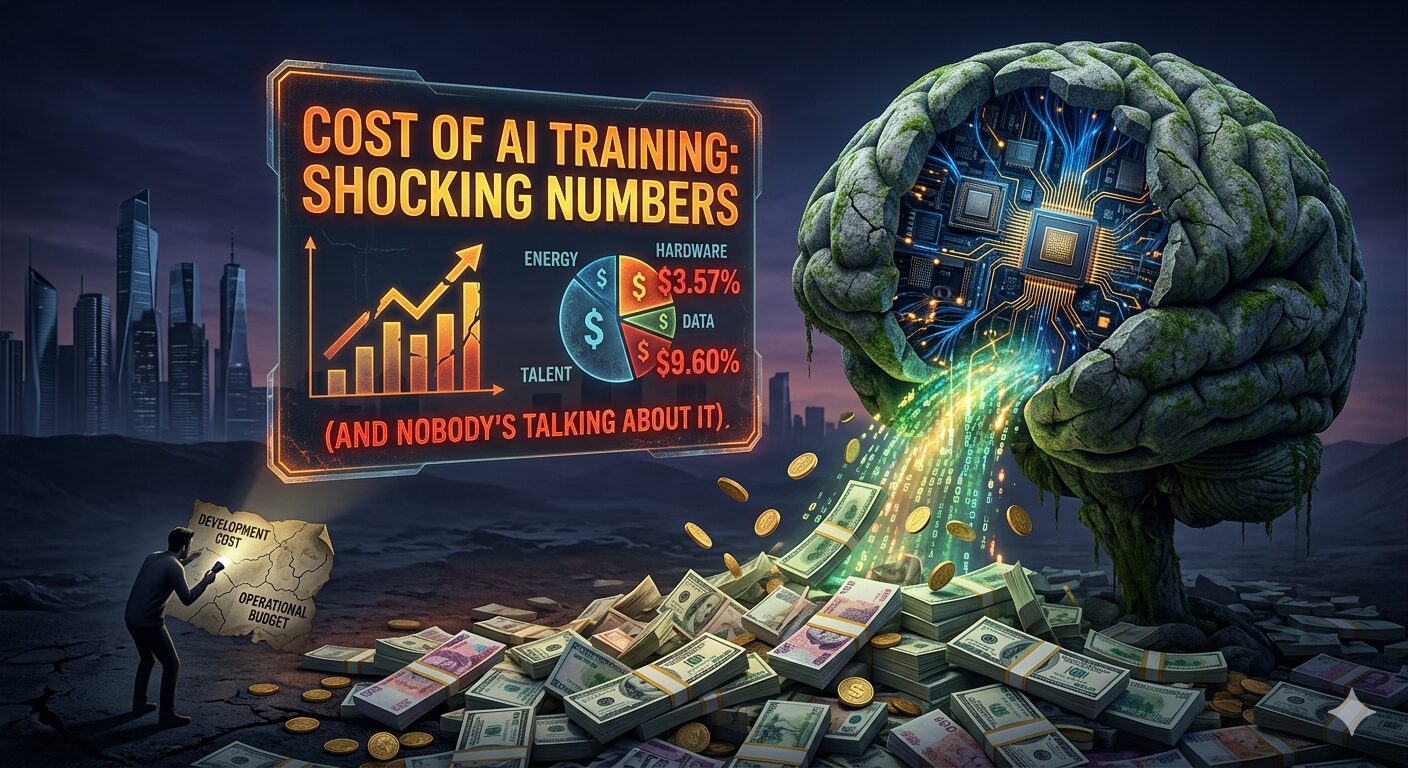
Training a state-of-the-art AI model from scratch costs between USD 50 million and USD 300 million.
That’s not a typo. Fifty to three hundred million dollars.
For that to sink in: A well-funded startup can burn through their entire Series B funding just training one model. And then they have to train another one when the first one becomes outdated.
Why so expensive?
1. Computing power (the biggest cost)
Training requires specialized AI chips (GPUs/TPUs) running 24/7 for weeks or months. A single high-end GPU costs USD 30K-50K. You need hundreds of them. Running them costs USD 50K-100K per day in electricity alone.
OpenAI reportedly spent USD 100M+ training GPT-4. Google spent similarly for Gemini. These aren’t exaggerations.
2. Data (the second biggest cost)
You need massive amounts of training data. Acquiring it, cleaning it, labeling it, storing it — all expensive. Quality data costs more. You might spend USD 20-50M just on data infrastructure.
3. Talent (the third biggest cost)
You need PhD-level AI researchers. A single senior AI researcher costs USD 300K-500K/year in salary + benefits. You need dozens of them. Top labs employ 50-100+ researchers.
4. Infrastructure and failure
Not every training run succeeds. You might burn USD 5M training a model and discover it doesn’t work. Then you try again. And again.
The economics are brutal
If your goal is to train a competitive AI model from scratch:
- USD 100-300M in capital required
- 12-24 months to train
- Massive risk (no guarantee it works)
- Ongoing costs to keep it current
This creates a winner-take-most market. Only the richest companies (OpenAI with Microsoft backing, Google, Meta, China’s ByteDance) can afford to compete. Everyone else is using existing models.
What this means
For startups
You can’t build a competitive AI model from scratch anymore. You’ll use existing ones (OpenAI, Anthropic, Google) and build applications on top. The AI itself is commoditized. Your value is in the application.
For governments
If you want a sovereign AI model (built domestically, controlled nationally), prepare to spend USD 300M-1B+ over 5+ years. Anything less is wishful thinking. UAE, Saudi Arabia, Europe — all exploring this. All underestimating the cost.
For the industry
Concentration is accelerating. The AI market will be dominated by 3-5 companies globally (maybe 5-10 if you include China). Everyone else builds on top of their APIs. This is the opposite of the “democratized AI” narrative.
For you (if you’re not a billionaire)
You’re using existing AI models (ChatGPT, Claude, Gemini, etc.). You’re not training your own. And the companies that do train models are so rich and well-capitalized that starting an AI company as a bootstrap founder is essentially impossible.
The sustainability question
Training modern AI models also consumes enormous electricity. A single training run of a large model uses as much electricity as 100 homes use in a year.
As models get bigger and more capable, electricity costs increase. At some point, the energy cost (USD 50-100M per model) becomes as expensive as the compute cost. Some estimates suggest we’re heading toward models that cost USD 1B+ to train just in energy costs.
This raises questions: Are these models sustainable? Can we train them responsibly? Who gets to decide?
The honest take
The AI revolution is real. But it’s being driven by a handful of companies with practically unlimited capital. That’s not a conspiracy. That’s economics.
If you work in tech, understand this: You’re probably not building AI. You’re building products that use AI that someone else trained. That’s fine. That’s where most of the value-add actually is.
The myth of the AI startup that trains its own model and disrupts OpenAI/Google? Not happening. The capital requirements are too high. The risk is too high. The incumbents are too far ahead.
The real AI opportunity is not in training models. It’s in building applications, products, and services that use existing models in novel ways. That requires USD 5-50M, not USD 300M. That’s accessible. That’s where innovation will happen.
Robius.news — Dubai, UAE — 2026 | Built to be first. Built to be trusted.