
Dubai Property Market 2026: Correction, Consolidation, What Comes Next
For three years, Dubai property ran on one setting.
Up.
Prices climbed nearly 60% between 2022 and early 2025. Brokerages multiplied from around 1,200 to roughly 8,000. Off-plan projects sold out in hours. Every buyer looked smart.
Then came 2026. A wave of new supply hit the market. A geopolitical shock rattled investor confidence. And a brokerage industry seven times its previous size started shrinking.
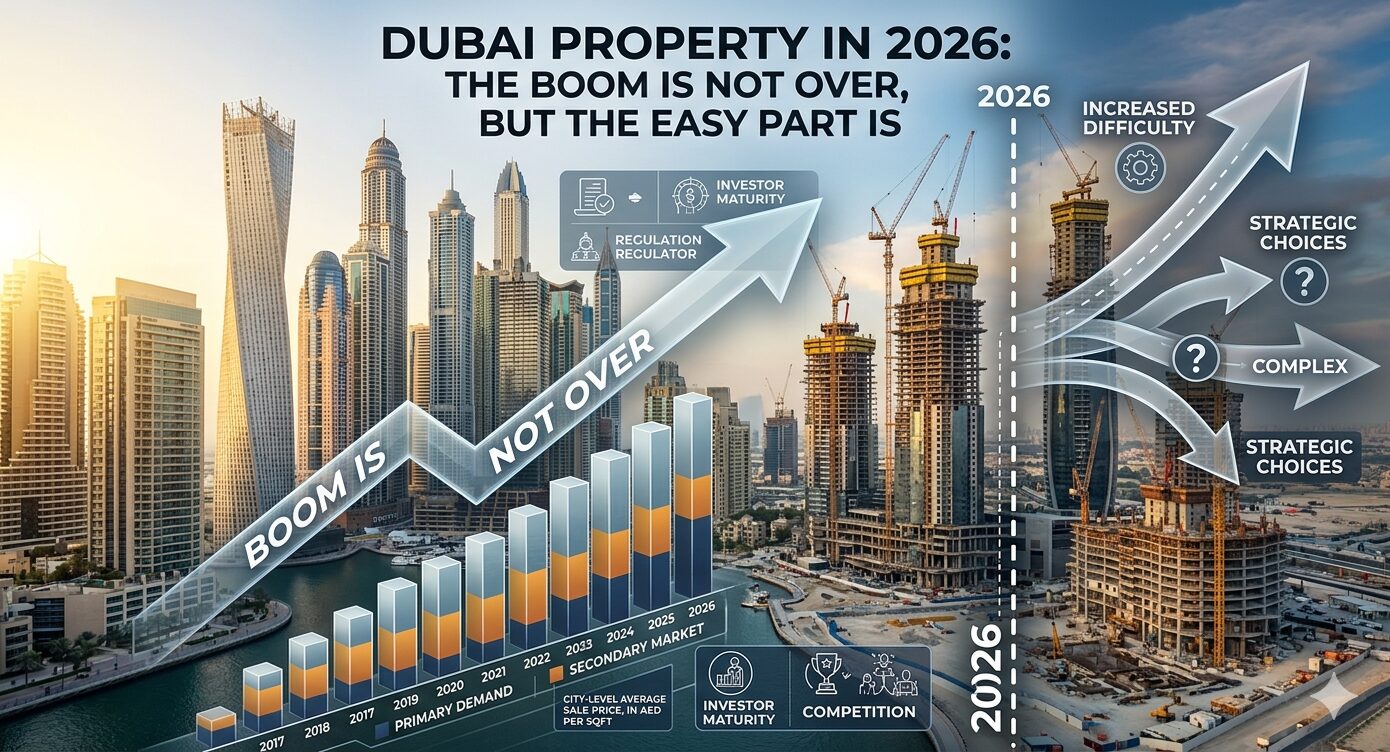
The boom is not over. But the market is different now. Here is what is actually happening.
The Numbers Are Mixed
Transaction volumes have stayed high. Dubai real estate transactions reached around AED 761 billion in 2024, a 20% increase from 2023. Weekly volumes at the time of writing are still substantial, with AED 21 billion recorded in the seven days ending May 23, 2026.
But equity markets told a different story earlier this year. The DFM Real Estate Index fell roughly 21% between the outbreak of the US-Israel-Iran conflict and early March 2026. Equity markets react faster than physical prices. That drop was institutional investors pricing in a risk that had not yet shown up in the transaction data.
ValuStrat placed citywide residential values at AED 1,689 per square foot in late 2025, up 19.8% year on year. Prices are now more than 30% above their 2014 peak. The question is whether 2026 is where that run ends, slows, or just continues at a different speed.
Dubai is expecting up to 120,000 new unit handovers in 2026. That is the largest supply year the market has ever faced. How buyers absorb it will define the next 18 months.
The Supply Wave Is Real
Fitch Ratings warned of a moderate price correction starting in the second half of 2025, estimating drops of up to 15% in affected areas. The reason was simple. Around 250,000 units are scheduled for delivery between 2023 and 2026, with the peak concentrated this year.
The impact is not the same everywhere. Areas with the heaviest new handover pipeline are feeling it most. Dubai Hills Estate, Jumeirah Village Circle, Arjan, and parts of Dubailand are already seeing slower price growth and longer decision timelines from buyers.
Prime areas are a different story. Palm Jumeirah and Downtown Dubai remain firm because supply there is genuinely limited. Investors who bought in those areas in 2021 and 2022 are in a different position from those who bought in emerging communities that are now being flooded with new stock.
Knight Frank found that 86% of Dubai property transactions in the first three quarters of 2025 were cash purchases. That is one reason the market has not experienced a credit-driven collapse. But it also means the market is more sensitive to investor sentiment than to interest rates. And sentiment has been tested this year.
The Brokerage Market Is Consolidating
The number of active brokerages in Dubai grew from around 1,200 in 2019 to roughly 8,000 by 2024. Every person who made a quick commission during the boom opened an agency.
That era is ending. Industry bodies are pushing for higher licensing requirements, minimum experience thresholds, and continuing education mandates. The regulatory pressure is not accidental. It is a deliberate response to a sector that grew too fast.
For buyers and renters, consolidation is good news over time. Fewer but better-qualified agents means better advice and fewer of the sharp practices that became common during the frenzy years.
The adjustment will be uncomfortable for a few thousand agents. It is overdue.
Who Is Buying and Why It Matters
The nationality mix of Dubai buyers has shifted noticeably since 2022.
Russian buyers surged after the 2022 sanctions, making up a significant share of transactions in Marina, Palm, and Downtown. That wave has moderated as capital controls have tightened and the initial urgency faded.
Indian buyers have grown steadily and now represent one of the largest buyer groups by volume. They tend to buy for a combination of lifestyle and investment reasons, often with longer time horizons than speculative buyers.
European buyers, particularly from the UK, Germany, and France, have increased as Dubai has positioned itself as a legitimate second-home and residency option for high-net-worth individuals.
The diversification of the buyer base is actually a stabilising factor. A market dominated by one nationality or motivation is fragile. A market with genuine demand from multiple directions is more resilient.
What This Means if You Are a Buyer
The frantic ‘buy today or miss it forever’ energy of 2022 and 2023 is gone. That is a good thing for buyers.
You have more time to make decisions. You have more negotiating room, especially in areas with heavy new supply coming through. You can actually do due diligence on what you are buying without losing the deal.
The deals worth having are still in areas with genuine lifestyle demand and constrained supply. The deals that look cheap in supply-heavy areas may be cheap for a reason. Understand which category your target property sits in before you commit.
If you are buying off-plan, developer quality matters more than ever right now. With 120,000 units scheduled for handover, some developers will deliver on time and to spec. Others will not. Research the developer’s track record, not just the CGI renders.
What This Means if You Are a Renter
Rent growth has slowed. Year-over-year increases that were running at 20 to 30 percent in 2022 and 2023 have moderated to the 4 to 6 percent range in 2026 for most areas.
In high-supply areas, rents are flat or slightly lower than a year ago. JVC, Arjan, and parts of Dubailand have seen softening as new handovers add competition for tenants.
In established, in-demand areas, rents are still high and landlords still have leverage. Marina, Downtown, JBR, and Business Bay have not softened meaningfully. If you are renewing in those areas, you have limited negotiating power unless your building has specific issues.
The RERA Smart Rental Index, which launched in January 2025, gives tenants a tool to check whether a proposed increase is within legal limits. Use it. A surprising number of residents do not know it exists.
What This Means if You Are a Seller
The window for selling at peak 2022 or 2023 prices in many areas has passed.
That does not mean the market has collapsed. Transaction volumes are still strong. Demand is real. But buyers in 2026 are better informed and less desperate than they were. You need a realistic price, not a peak-cycle wish price.
Properties in prime locations with genuine scarcity still command premium prices and sell in reasonable timeframes. Properties in supply-heavy areas competing with dozens of similar new units need to be priced accordingly.
Patience and correct pricing will get deals done. Stubbornness about peak prices in the wrong area will leave you sitting on the market.
The Bottom Line
Dubai property in 2026 is not in crisis. Transaction volumes, overall demand, and the city’s long-term growth story are all intact.
But the market has changed. The easy gains of the 2022 to 2024 period required little sophistication. The gains available now require knowing where supply is heavy, where demand is durable, and what you are actually buying.
The boom is not over. It is just harder than it was.
Sources: Arabian Business (May 2026), Mitchell’s Commercial Realty Weekly Insights (May 23, 2026), Better Homes (March 2026), Gulf News / Fitch Ratings, ValuStrat Q4 2025, Knight Frank, Global Property Guide, Exclusive Links Real Estate.
Robius.news — Dubai, UAE — June 2026 | Built to be first. Built to be trusted.