 UAE, UNFILTERED
Microsoft Puts UAE AI Diffusion at 70.1%. Here Is What That Number Actually Measures
Microsoft’s Q1 2026 AI Diffusion Report ranks the UAE first at 70.1%. The metric estimates the share of people aged 15–64 who used a generative AI product during…
The short answer
Microsoft’s Q1 2026 AI Diffusion Report ranks the UAE first at 70.1%. The metric estimates the share of people aged 15–64 who used a generative AI product during the reporting period. It is not a survey of every…
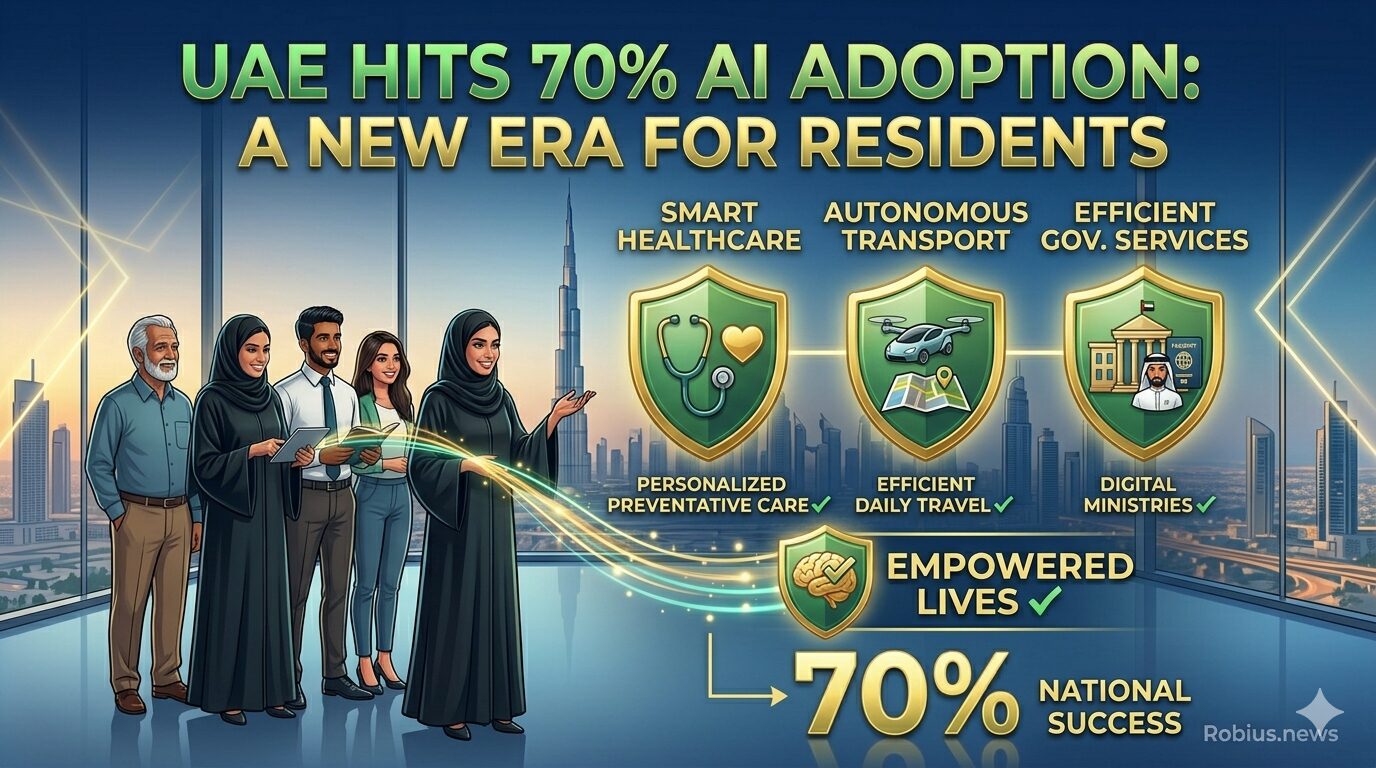
Microsoft’s Q1 2026 Global AI Diffusion Report puts the UAE at 70.1%, the highest figure in its national leaderboard.
The number is real. The old headline needed a more precise definition of what it measures.
70.1% of what?
Microsoft defines AI diffusion as the estimated share of people aged 15 to 64 who used a generative AI product during the reporting period.
The measure is derived from aggregated and anonymized Microsoft telemetry, then adjusted for factors including operating-system and device-market share, internet penetration and country population.
So this is not a survey in which 70.1% of all UAE residents told Microsoft they use AI. It is also not a measure of how skilled people are with AI, how often they use it, whether they use it at work, or whether it makes them more productive.
The UAE still leads Microsoft’s comparison by a large margin
For Q1 2026, Microsoft reported the UAE at 70.1%, Singapore at 63.4%, the United States at 31.3% and the global working-age average at 17.8%.
That makes the UAE number notable even after the fine print. What the index supports is a claim about widespread generative-AI use relative to other economies in Microsoft’s methodology. It does not by itself explain why adoption is higher.
Policy and infrastructure are context, not proof of causation
The UAE has deliberately built an AI-heavy policy environment. It appointed a federal Minister of State for Artificial Intelligence in 2017 and has continued to invest in AI infrastructure, education and government deployment.
The planned UAE-US AI campus in Abu Dhabi is designed for 5GW of eventual capacity, with a 1GW first phase announced in 2025. That is infrastructure capacity, not a measure of consumer adoption.
The federal government has also set a target to transform at least 50% of government sectors, services and operations to Agentic AI models within two years. That is a future implementation target. It does not mean half of UAE government services are already fully autonomous.
What the number means for residents
The safest conclusion is also the most useful one: generative AI is unusually widespread in the UAE compared with the other economies Microsoft measures.
For employers, government entities and service providers, that creates a population more likely to encounter AI-assisted workflows. It does not remove the need for training, privacy controls, human review or clear rules about when AI should and should not make decisions.
The Robius rule for adoption statistics: always ask what counts as a user, who is in the denominator and how the number was measured.
Sources
Microsoft AI Economy Institute: Global AI Diffusion Q1 2026.
U.S. Department of Commerce: UAE-US 5GW AI campus announcement.
UAE Government Media Office: Agentic AI government framework.
Robius.news — Dubai, UAE — 2026 | Built to be first. Built to be trusted.